SendPulse vs ManyChat: Real Instagram DM Costs (2026)

SendPulse vs ManyChat comes down to how your audience behaves in the DMs. SendPulse is a multichannel marketing suite (email, chatbots, CRM, course builder, landing pages) that bills you on every subscriber stored in your bots. ManyChat is an Instagram-first chatbot builder that bills you only on the people who actually message you that month. For a coach or creator running Instagram and WhatsApp DMs, that billing difference decides the cheaper tool more often than any feature does.
Both are legitimate, Meta-approved tools. Both can send a DM when someone comments a keyword, both have a visual flow builder, and both now sell "AI agents". Neither was built to hold a real qualifying conversation and book a sales call without you scripting every branch first.
This is a hands-on 2026 comparison written for coaches, course creators, and agencies who sell through inbound DMs. Every price below was checked on the vendors' own pricing pages in October 2026. We cover how each tool is priced, which Instagram triggers each one supports, how they handle WhatsApp after Meta's October 2026 fee change, what their AI actually does, and where both fall short when your goal is a calendar full of qualified calls. If you want the single-tool deep dive on ManyChat first, read our ManyChat review.
What SendPulse and ManyChat actually are
Direct answer: SendPulse is an all-in-one marketing platform where chatbots are one product among many, and ManyChat is a dedicated chat automation tool that grew up on Instagram and Facebook Messenger.
SendPulse started as an email marketing service and grew sideways. Today one account gives you bulk email, a chatbot builder for Instagram, WhatsApp, Facebook Messenger, Telegram, TikTok and Viber, a website live chat, a CRM, an online course builder (LMS), landing pages, pop-ups, web push and SMS. Each product has its own pricing page. The chatbot product is priced separately from email, the CRM and the course builder, which matters when you add things up.
ManyChat does one thing: conversational automation on social and messaging channels. Its channels are Instagram, Facebook Messenger, WhatsApp, TikTok, Telegram, SMS and email, with Instagram as the clear center of gravity. Most "comment GUIDE and I'll DM you the link" funnels you see on Reels run on ManyChat or a tool that copied it.
The mental model: SendPulse is a marketing suite that added chatbots, and ManyChat is a chatbot that added a few marketing channels. If you want email newsletters, a CRM and a course platform under one login, SendPulse covers more ground. If you want the deepest Instagram DM tooling and the biggest creator community, ManyChat is the specialist.
SendPulse vs ManyChat: quick comparison
| Feature | SendPulse | ManyChat |
|---|---|---|
| What it is | Marketing suite with chatbots | Dedicated chat automation |
| Billing meter | All bot subscribers stored | Active contacts that month |
| Free plan | 500 subscribers, 3 bots, 10,000 messages | 25 active contacts, 4 live automations |
| Every paid tier | Pro plan and up | |
| Instagram triggers | Comments, live comments, story mentions, DM keywords | All of those + story replies + follow-to-DM (beta) |
| AI | AI Agent element, your own API key | Manychat AI, Pro and up |
| Built-in CRM | Yes (free tier for 5 team members) | No, contact list + integrations |
| Email, LMS, landing pages | Same account (priced separately) | Email on Pro, no LMS |
| Creator community | Smaller | Huge (templates, tutorials) |
| Books calls in chat | External link | External link |
The short answer: SendPulse wins on price for small and mid-sized subscriber lists, on its free plan, on WhatsApp access at the entry tier, and on the extras (CRM, email, course builder) that live in the same account. ManyChat wins on Instagram depth, especially story-reply and follower triggers, on its active-contact billing for big audiences where few people write in, and on the size of its community. Both send an external booking link when it is time to book a call.
SendPulse vs ManyChat pricing in 2026
SendPulse and ManyChat meter different things, so "which is cheaper" depends on the ratio between your total audience and the people who actually message you.
- SendPulse charges by the total number of bot subscribers across all your messaging channels. Anyone who has ever started a conversation with one of your bots counts, whether they wrote to you this month or a year ago.
- ManyChat charges by active contacts: people your account exchanged a message with during the billing month. Each plan includes a number of active contacts, and you pay overage above it.
SendPulse chatbot pricing
SendPulse has two chatbot plans: Free and Pro. Pro is one feature set with a price that scales by subscriber count. Here are the published tiers, checked on sendpulse.com in October 2026:
| Bot subscribers | Monthly billing | Yearly billing (per month) |
|---|---|---|
| Free (500) | $0 | $0 |
| Pro 500 | $12 | $9.60 |
| Pro 2,000 | $22 | $17.60 |
| Pro 5,000 | $48 | $38.40 |
| Pro 10,000 | $74 | $59.20 |
| Pro 15,000 | $99 | $79.20 |
| Pro 20,000 | $119 | $95.20 |
The Free plan includes 3 chatbots, up to 500 subscribers, 10,000 messages a month across all bots, 10 variables, 10 triggers, unlimited flows, ready-made flow templates, deal creation in the CRM from a flow, limited API access, and 30 days of chat support. Per SendPulse's own comparison page, a free account can connect up to 3 channels from Facebook Messenger, Instagram, TikTok, Telegram, Viber or a website chat. WhatsApp is not on that list.
Pro removes the caps: unlimited chatbots, live chats, messages, triggers, flows and variables, plus contact tags, teamwork tools, in-chat payments, fetching data from an external URL, API and webhooks, ChatGPT and Google Sheets integrations, WhatsApp Business API access, no SendPulse branding, and chat support with no time limit. Every Pro tier has the same features. Only the subscriber ceiling changes. Yearly billing takes 20% off.
ManyChat pricing
ManyChat's plans (full breakdown in our ManyChat pricing guide) look like this on monthly billing: Free at $0 for 25 active contacts, Essential at $17 for 250, Pro at $39 for 2,500, Business at $99 for 7,500 with 5 seats, and Advanced at $199. The pricing page opens on the annual toggle, where the same tiers read $14, $29, $69 and $139 per month. Above your included contacts you pay overage, roughly $0.025 to $0.10 per contact depending on the tier.
Two plan gates matter for coaches. WhatsApp, SMS and email unlock on Pro, not Essential. And Manychat AI is also a Pro-and-up feature, so the "AI" ManyChat ads talk about starts at $39 a month billed monthly.
Which one is actually cheaper?
SendPulse publishes a side-by-side that assumes every subscriber is active in the same month, which is the worst case for ManyChat:
| Audience size | SendPulse (monthly) | ManyChat if all are active (monthly) |
|---|---|---|
| 500 | $12 | $39 |
| 2,000 | $22 | $39 |
| 5,000 | $48 | $99 |
| 10,000 | $74 | $161.50 |
| 20,000 | $119 | $199 |
On those numbers SendPulse is cheaper at every size, and that is the honest headline. But the table hides the variable that flips the result: how many of your subscribers write to you in a given month.
Take a fitness coach with 10,000 bot subscribers collected over two years of comment-to-DM giveaways, of whom about 2,000 message the account in a typical month. SendPulse bills the full 10,000, so $74 a month. ManyChat only bills the 2,000 active people, which fits inside Pro's 2,500 active contacts at $39 a month. Same audience, and ManyChat is now roughly half the price.
The rule of thumb:
- Small or new account, most subscribers still engaged: SendPulse is cheaper, often by half.
- Large account built from old giveaways, where only a fraction writes in each month: ManyChat's active-contact meter usually wins.
- Viral spikes: a Reel that pulls 3,000 new commenters in a week inflates both bills. On ManyChat they count as active that month. On SendPulse they stay on your subscriber count every month afterwards until you clean the list.
On either tool, check the subscriber or contact count in your dashboard before you pick a tier. Pruning dead subscribers is the cheapest optimization available on SendPulse.
Instagram: where ManyChat genuinely wins
Direct answer: for an Instagram-first coach whose funnel runs on stories, ManyChat is the stronger tool. It supports every Instagram trigger SendPulse does, plus two that SendPulse's help center does not document.
Here are the Instagram triggers each tool documents:
| Instagram trigger | SendPulse | ManyChat |
|---|---|---|
| Comment on a post (keyword or any text) | Yes | Yes |
| Keyword in a DM | Yes | Yes |
| Story mention | Yes | Yes |
| Comment on a live video | Yes | Yes |
| Reply to your story | Not documented | Yes |
| New follower (follow-to-DM) | Not documented | Beta |
What that means in practice:
- Story replies are a big deal for coaches. "Reply YES to this story and I'll send you the plan" is one of the most common Instagram lead mechanics, and it runs on a story-reply trigger. ManyChat has one. In SendPulse, a story reply lands as a regular DM, so you would catch it with a keyword trigger or the bot's standard reply rather than a dedicated story trigger.
- Follow-to-DM. ManyChat can message new followers, though it is still a beta that Meta enables account by account. SendPulse does not list it.
- Comment-to-DM parity is real. On the core mechanic, both tools work the same way: you pick a post (or all posts), choose a keyword or "any text", and send a private reply. Our comment-to-DM automation guide explains how that private reply works under Meta's rules.
- Community and templates. ManyChat has far more YouTube tutorials, Facebook groups and ready-made Instagram templates. When a flow breaks the night before a launch, someone has usually posted the fix already. Our ManyChat Instagram walkthrough covers the setup in detail.
One rule applies to both tools, because it comes from Meta rather than the vendor: the first message you send after a comment or story mention can only contain one message with one button or a set of quick replies. You get the full conversation only once the person replies or taps. SendPulse's help center spells this out on its comment and story-mention trigger pages, and ManyChat works under the same constraint. Design your opener to earn that first reply.
Price, WhatsApp and extras: where SendPulse genuinely wins
Direct answer: if you want WhatsApp on a small budget, a free plan you can actually run a campaign on, or email and a CRM in the same account, SendPulse is the stronger pick.
- WhatsApp at the entry paid tier. SendPulse includes WhatsApp Business API access on every Pro tier, from $12 a month. ManyChat keeps WhatsApp behind its Pro plan at $39 a month billed monthly. For a coach testing click-to-WhatsApp ads, that gap is real money.
- A free plan with room to breathe. 500 subscribers, 3 bots and 10,000 messages a month is enough to run a real lead magnet or giveaway on Instagram. ManyChat's 25 active contacts is a sandbox for testing a flow, not for running one. If free is the whole budget, our roundup of free Instagram auto-DM tools compares eight options.
- A built-in CRM. SendPulse's CRM has a free plan for the account owner plus 4 invited users, with up to 2 sales pipelines. Chatbot flows can create and update deals directly. ManyChat stores contacts and tags, but for a pipeline you connect an outside tool. Our CRM for coaches guide explains what a coach actually needs from one.
- Email, course builder and landing pages under one login. If you sell a course or a membership and want newsletters, an LMS, a landing page and DM bots in one account, SendPulse is unusually broad. Each product has its own price, so the total grows as you add them, but there is only one dashboard.
- More payment providers. Both tools can collect payments inside a chat on paid plans. SendPulse supports a longer list of payment providers, which matters if your clients are outside the US and Western Europe.
- More channels. SendPulse adds Viber, a website chat widget and web push to the Instagram, WhatsApp, Messenger, Telegram and TikTok bots both tools share.
Review sites reflect the gap in customer sentiment, too. At the time of writing, SendPulse's own comparison page cites a 4.5-star Trustpilot score for SendPulse versus 2.2 for ManyChat. Trustpilot skews toward billing complaints, so treat those numbers as a signal about support and billing friction, not product quality.
WhatsApp costs after Meta's October 2026 change
Direct answer: both tools pass Meta's WhatsApp fees through on top of the plan, and since October 1, 2026, those fees include your replies, not just templates.
Here is what changed. Since October 1, 2026, Meta bills service messages (free-form replies sent inside the 24-hour customer service window) per message, at the same rate as a utility template for the customer's country. Every business number gets 1,000 free service messages a month before charges start. Utility templates sent inside the 24-hour window are also billed again. SendPulse's pricing page and its blog both document this, and it applies to every WhatsApp Business API provider, ManyChat included.
On SendPulse's rate card, a US service message or utility template costs $0.0064 and a US marketing template $0.0300. A coach answering 3,000 WhatsApp replies a month to US leads pays nothing on the first 1,000 and about $12.80 on the remaining 2,000. Small, but it is no longer zero, and older guides (including some of ours) still describe service replies as free. Our WhatsApp Business API pricing guide covers the full category and template logic.
Two practical consequences:
- Long WhatsApp conversations now cost a little per message once you pass the free 1,000. That changes nothing about which tool to pick, since both pass the same Meta fees through, but it is worth knowing before you budget.
- Click-to-WhatsApp ads still open a free window. If someone messages you from a Click-to-WhatsApp ad and you reply within 24 hours, Meta's free entry-point window can run up to 7 days, during which your messages are not billed.
AI agents: what each tool actually does
Both tools now sell AI, and both use the word "agent". The details matter more than the label.
SendPulse's AI Agent is an element you drop into a flow. You write a prompt, pick a model from OpenAI, Anthropic, Google or DeepSeek, set how many recent messages to send as context, and cap the reply length in tokens. You can also enable web search and connect MCP servers. The catch: connecting an AI model requires a paid plan, and you bring your own API key, so the model provider bills you per token on top of your SendPulse plan. SendPulse gives every account up to 200 free AI requests across its tools, after which your own key pays. SendPulse also notes that the AI does not learn from your conversations: each request sends your prompt plus the recent messages you allowed, and nothing more.
Manychat AI is included from the Pro plan. It answers questions you have trained it on, replies to comments, and handles FAQs, all inside the flows you build. It is a real step up from the old single-reply "AI Step", but it still hands control back to your button-and-branch logic.
The pattern is the same on both sides: AI improves a flow, it does not replace it. You still design the decision tree, decide where the AI step sits, write the fallbacks, and maintain everything when your offer changes. SendPulse gives you more control (model choice, context size, tokens), and ManyChat gives you less to configure. Neither one is tuned out of the box to qualify a coaching lead over several messages and steer toward a booked call.
Is SendPulse or ManyChat safer for your account?
Both are safe to use. SendPulse and ManyChat both connect to Instagram, Messenger and WhatsApp through Meta's official APIs, and both list themselves as Meta Business Partners. SendPulse is also an official WhatsApp Business Solution Provider. Neither asks for your Instagram password, and neither scrapes the app.
The real risks come from how you use any tool: sending WhatsApp marketing templates to people who never opted in, blasting identical DMs, or ignoring Meta's messaging windows. Those rules come from Meta, so they apply equally on both platforms.
Where both fall short for booking sales calls
Now the limitation they share. If you are a coach selling a high-ticket offer, your goal is not to send a PDF. It is to turn inbound DMs into qualified sales calls on your calendar. Three things get in the way with either tool.
1. You build the conversation, branch by branch
Both hand you triggers, conditions and message blocks. You still decide what happens when a lead asks "how much is it", gives a vague answer about their budget, goes quiet for a day, or asks a question you did not script. A flow breaks the moment a real person replies in a way you did not anticipate, and coaching leads rarely follow the script.
2. Their meters reward short exchanges
Booked calls come from depth, not one-line exchanges. In our analysis of 828K real Instagram and WhatsApp DM conversations, 1 in 3 leads booked a call once the chat reached 21+ messages. ManyChat bills every lead who replies as an active contact, and SendPulse keeps every lead on your subscriber count forever. Neither model was designed around the long, patient qualifying chat that produces a booking.
3. Neither books the call, and neither closes it
Both send an external booking link when the flow reaches that step, instead of proposing a time inside the thread. And to be clear about positioning: no DM tool closes a high-ticket coaching offer in chat. You (or your closer) still sell on a live call. The job of DM automation is to qualify the lead and fill the calendar with the right calls. The close is a separate human step, covered in our high-ticket closing guide.
When to skip both: an AI setter
If your goal is booked calls rather than lead magnets or newsletters, the alternative to both SendPulse and ManyChat is a DM-native AI setter. Here is how the three approaches compare for a coach running inbound Instagram and WhatsApp DMs.
| Factor | SetSmart | SendPulse | ManyChat |
|---|---|---|---|
| Core model | AI conversation, no flows | Flow builder + AI element | Flow builder + Manychat AI |
| Qualifies leads | Through real dialogue | Buttons, variables, prompts you write | Buttons, fields, trained FAQs |
| Books the call | In the chat | External link | External link |
| Follow-ups | Automatic, context-aware | Sequences you build | Sequences you build |
| Channels | Instagram, WhatsApp, Messenger | IG, WA, Messenger, Telegram, TikTok, Viber, web | IG, Messenger, WA, TikTok, Telegram, SMS, email |
| Setup effort | Low (describe your offer) | Medium to high | Medium to high |
| Best for | Coaches booking sales calls | All-in-one marketing on a budget | Instagram comment-to-DM funnels |
The pattern is consistent: SendPulse and ManyChat are toolkits, and a setter is a finished worker. If you love building flows, or you need newsletters and a course platform in the same account, the toolkit route makes sense. If you just want more qualified calls on your calendar without becoming a chatbot developer, a dedicated AI setter gets you there faster. Our best AI setters roundup maps the whole category.
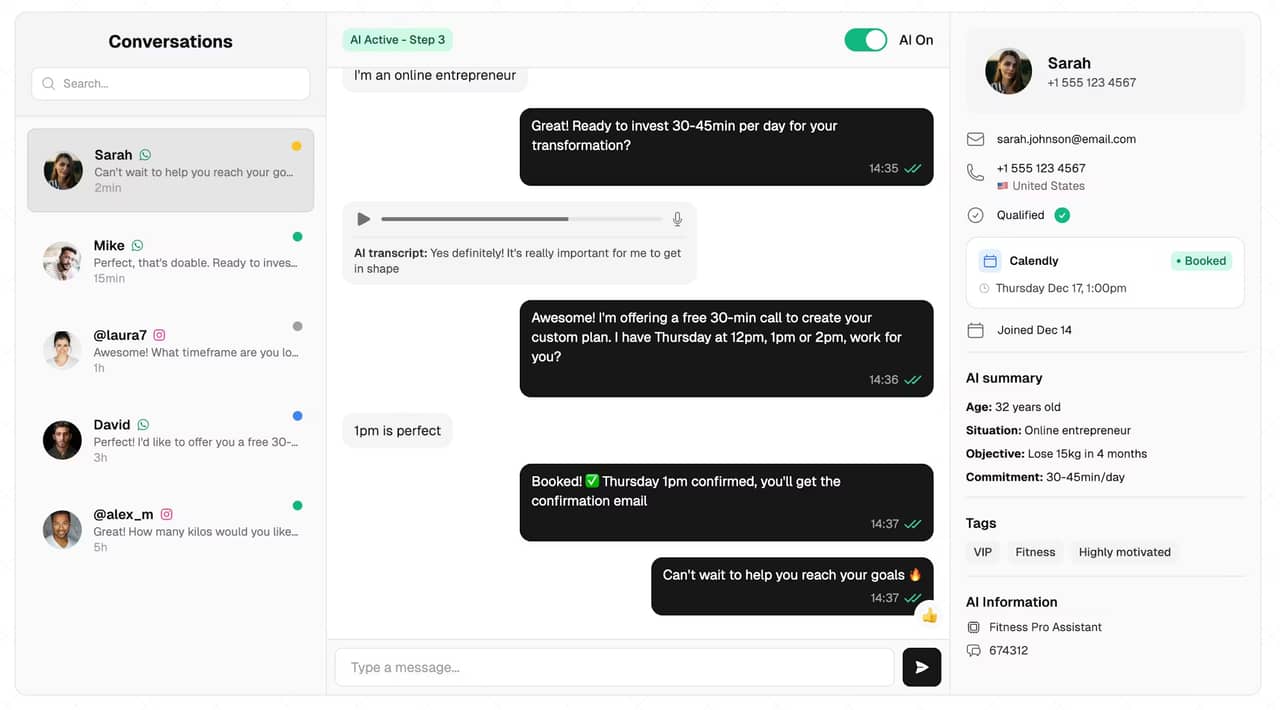
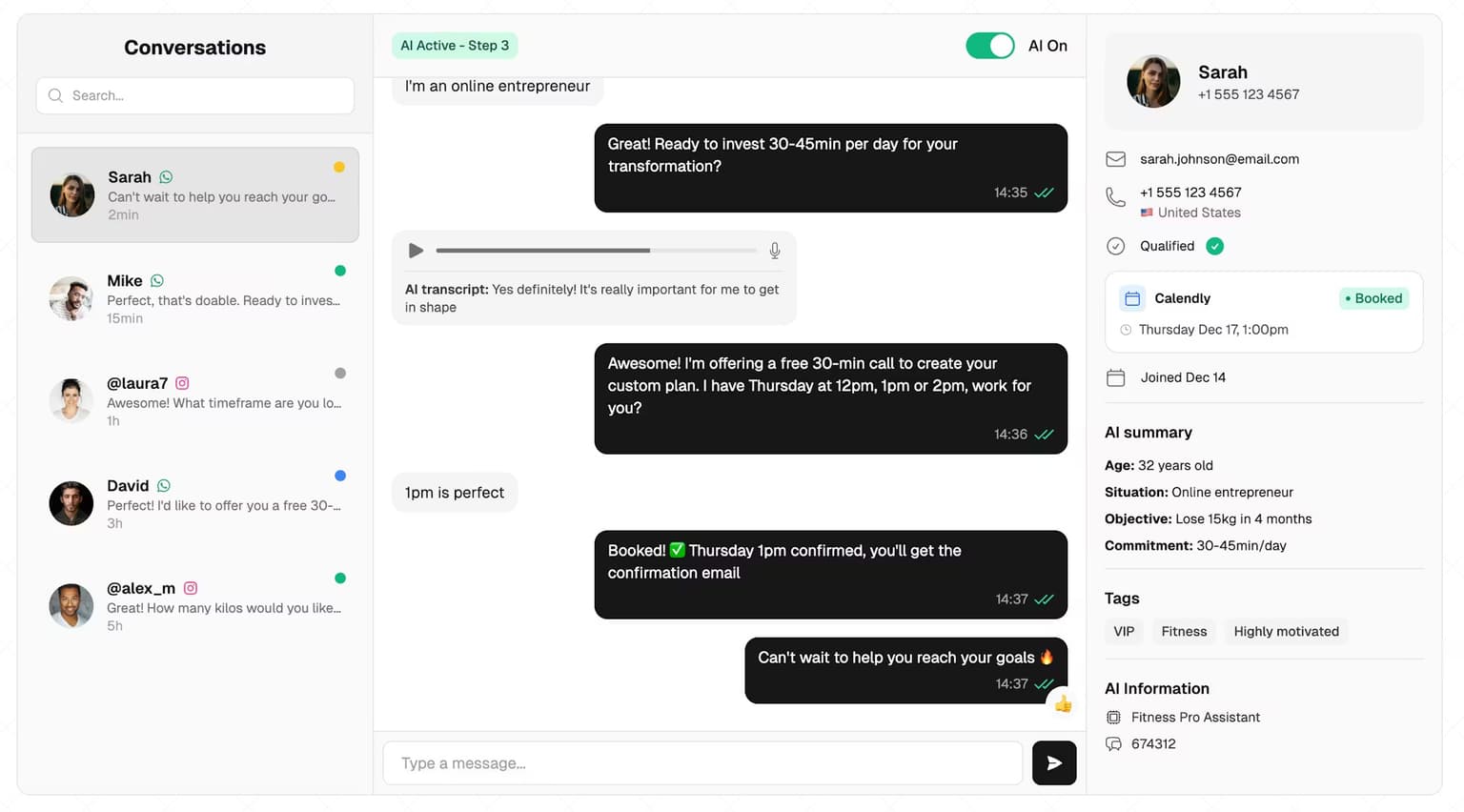
SetSmart is built for exactly that job. It is a DM-native AI setter for Instagram, WhatsApp and Messenger that qualifies inbound leads through natural conversation, follows up on its own, and books the call straight into your calendar (Calendly, Cal.com, iClosed or GoHighLevel), with no flow-building required. You describe your offer and your qualifying criteria, and the AI handles the back-and-forth, including voice notes. It runs on the official Meta APIs, keyword comment triggers and story replies included, and the plan is a free 7-day trial, then $97/month with 1,000 messages included.
"I book 15 to 25 calls per week... without managing a single setter."
Mathis Ladoué, Online Fitness Coach, 22.4K followers
Plenty of coaches keep their existing tool for the job it does best and add a setter for the job it cannot do. A common stack: ManyChat or SendPulse delivers the lead magnet from a comment, and the setter takes over when a lead shows buying intent, qualifies them, and books the call. If you are moving off a builder entirely, our ManyChat alternative guide compares the other options.
Which should you choose?
Choose SendPulse if you are early, budget-conscious, and want more than chatbots: email newsletters, a free CRM, a course builder or WhatsApp at the entry tier. On a small or engaged audience it is cheaper than ManyChat at every published tier, and its free plan is genuinely usable. Expect a smaller creator community and fewer Instagram-specific triggers.
Choose ManyChat if you are an Instagram-first creator or coach whose funnel runs on comment-to-DM, story replies and follower triggers, or if you have a large audience where only a small share messages you each month. Its active-contact meter can undercut SendPulse in that case, and its community is the biggest in the category.
Choose neither if your real goal is a calendar full of qualified sales calls and you would rather not spend weekends wiring decision trees. Both tools are excellent at sending messages and collecting data. A purpose-built setter that qualifies and books through conversation gets you to booked calls with far less overhead. Whatever you pick, speed, depth and follow-up matter more than the logo on the dashboard.
FAQ
Is SendPulse better than ManyChat?
It depends on your funnel. SendPulse is better if you want a cheaper all-in-one setup with WhatsApp at the entry tier, a free CRM, email and a course builder in one account. ManyChat is better for Instagram-first creators who rely on story replies and follower triggers, and for big audiences where few people message each month. For booking sales calls from DMs, neither is ideal on its own, since both are flow-based.
Is SendPulse cheaper than ManyChat?
Usually, for small and engaged audiences. SendPulse Pro starts at $12/month for 500 bot subscribers and reaches $74/month at 10,000, while ManyChat Pro is $39/month for 2,500 active contacts on monthly billing. The catch is the meter: SendPulse bills every stored subscriber, ManyChat only the people active that month. A large account with mostly inactive followers often pays less on ManyChat.
How much does SendPulse cost for Instagram?
The SendPulse Free plan covers Instagram for up to 500 subscribers, 3 bots and 10,000 messages a month. Paid Pro plans start at $12/month (500 subscribers) and scale to $22 for 2,000, $48 for 5,000 and $74 for 10,000, with 20% off on yearly billing. AI replies cost extra through your own model provider's API key.
Does SendPulse support Instagram comment-to-DM?
Yes. SendPulse's "Comment on your post" trigger sends a DM when someone comments on a selected post or on all posts, either for a specific keyword or any text. It also supports story mention and live comment triggers. Like every tool on Meta's API, the first message can only include one message with one button or quick replies until the person replies.
Is SendPulse free?
Yes, SendPulse has a free-forever chatbot plan with 3 bots, up to 500 subscribers and 10,000 messages a month across your bots. It does not include WhatsApp, payments, teamwork tools or AI model connections, which all need Pro. ManyChat's free plan is smaller, at 25 active contacts and 4 live automations.
What is a good SendPulse alternative for coaches?
It depends on the job. If you need deeper Instagram triggers, ManyChat is the closest alternative. If you want an AI that holds the qualifying conversation and books sales calls inside Instagram and WhatsApp DMs, a dedicated AI setter fits better, while the close still happens on the call.
Ready to automate your DMs?
Start your free 7-day trial and let AI handle your lead qualification 24/7.
Try SetSmart free