ManyChat vs BotPenguin: Best for Instagram DMs? (2026)

If you are a coach or creator choosing your first DM automation tool, ManyChat vs BotPenguin usually comes down to one trade-off: ManyChat is the polished flow-automation standard for Instagram, BotPenguin is the cheaper, broader bot builder that covers more channels for less money. Both are flow-first tools. Neither was built to hold a real qualifying conversation and book a sales call the way a dedicated AI setter is. This guide breaks down the pricing, the channels, the AI ceiling, and exactly who each tool fits, so you can pick without wasting a month of trial time.
The 30-second verdict
Pick ManyChat if you want the most reliable Instagram comment-to-DM automation, the biggest template library, and the tool most agencies and course creators already know. You pay a premium for polish and you pay by active contacts, which can climb fast.
Pick BotPenguin if budget is the deciding factor. It gives you a genuinely generous free plan, WhatsApp, Instagram, Facebook, Telegram and a website widget from one dashboard, and paid tiers that undercut ManyChat on raw message volume.
Pick neither if your real goal is to fill a calendar with qualified sales calls. Both tools deliver links and run scripted flows well, but a high-ticket coaching lead needs a back-and-forth conversation that qualifies them and proposes a call slot. That is a different category of tool, and we cover it at the end.
| ManyChat | BotPenguin | |
|---|---|---|
| What it is | Flow-based automation, Instagram-first | Multi-channel bot builder, budget-first |
| Priced by | Active contacts per month | Messages per month |
| Free plan | 25 active contacts | 1,000 messages (shared with AI) |
| Channels | Instagram, WhatsApp, Messenger, SMS, Telegram | WhatsApp, Instagram, Facebook, Telegram, website |
| AI | Single-step AI inside flows (Pro and up) | Metered AI answers as a paid add-on |
| Best at | Instagram comment-to-DM, lead magnets | Cheap broad coverage, website chat |
| Weak at | Cost at scale, real conversations | Depth, qualifying high-ticket leads |
| Books calls? | Not natively | Not natively |
What ManyChat is (and does best)
ManyChat is the most popular Instagram and Messenger automation tool on the market, used by over a million businesses. It connects to your account through Meta's official API and lets you build automations with a visual drag-and-drop flow builder: triggers fire flows, flows run actions. Someone comments a keyword on your Reel, ManyChat sends them a DM with your link. Someone messages you, a flow greets them and offers menu buttons.
Where ManyChat genuinely shines:
- Instagram comment-to-DM. This is the mechanic it is famous for, and it is the smoothest implementation available. If your growth engine is "comment WORD and I'll send it," ManyChat nails it. Our Instagram comment-to-DM automation guide walks through the exact setup.
- Templates and ecosystem. Thousands of pre-built flows, a huge agency community, and integrations for most tools a creator uses.
- Reliability. It is a mature product. Flows do what you tell them, and the Meta API connection is stable.
The honest limits, which we detail in our ManyChat review: it is fundamentally a flow builder. Its AI (added on the Pro plan and above) is single-step, it answers a question inside a flow but does not run a genuine multi-turn qualifying dialogue. And the pricing is tied to active contacts, so a single viral Reel can push you into a higher tier overnight. For the full mechanics of triggers and flows, see our ManyChat bot deep-dive.
What BotPenguin is (and does best)
BotPenguin is a multi-channel chatbot builder that competes on price and breadth rather than polish. From one dashboard you get WhatsApp, Instagram, Facebook Messenger, Telegram, and a website widget, plus Microsoft Teams on higher tiers. It runs the same flow-plus-keyword mechanics as ManyChat, and it does the "comment a word, get a DM" Instagram funnel too, usually at a lower price.
Where BotPenguin genuinely wins, as covered in our full BotPenguin review:
- Price. A real free-forever plan and paid tiers that are cheaper than most competitors for the message volume you get.
- Channel coverage. Very few tools give you five-plus channels including a website widget at this price point. If you want one bot answering your site chat and your DMs, BotPenguin is efficient.
- Third-party ratings. It scores well on the review sites for value.
The honest limits: BotPenguin is a general-purpose bot builder first. It is built to answer and capture, not to qualify a lead and steer them to a booked call. Its AI answers are metered as an add-on, so the moment you lean on the LLM instead of rigid flows, the real monthly cost climbs. And the free plan's message budget is shared with AI answers, so a chatty bot burns through 1,000 messages fast.
Pricing compared: contacts vs messages
This is the single most important difference, because ManyChat and BotPenguin count usage in completely different units. ManyChat charges by active contacts per month. BotPenguin charges by messages per month. That one distinction decides which is cheaper for your specific funnel.
A quick note on ManyChat's pricing page: it opens on the annual view, so the low numbers you see are what you pay per month only if you commit to a year upfront. We break the whole thing down in our ManyChat pricing guide. Here is the honest side-by-side using published monthly figures:
| Tier | ManyChat (by active contacts) | BotPenguin (by messages) |
|---|---|---|
| Free | $0, 25 active contacts | Free forever, 1,000 messages |
| Entry | Essential from $17/mo | Little from $29/mo |
| Mid | Business around $99/mo | King $99/mo, 12,000 messages |
| Top | Advanced around $199/mo | Emperor around $1,000/mo |
The nuance behind the table:
- ManyChat's Pro plan (around $39/month billed monthly, $29 on annual) is the first tier with any AI, and it is single-step AI inside flows. Every paid ManyChat tier also carries per-contact overage fees once you pass your contact cap, plus WhatsApp conversation fees on top.
- BotPenguin's King plan at $99/month gives you 12,000 messages, unlimited bots, and five channels. For the same roughly $99, ManyChat's Business tier limits you by contacts, not messages. If you have a large but quiet audience, ManyChat's contact model punishes you; if you have a small but chatty audience, BotPenguin's message model can be the one that stings.
- BotPenguin's AI-message packs start around $15 per 1,000 messages, an add-on cost that is easy to overlook when you compare headline prices.
The takeaway: do not compare the sticker prices. Map your funnel. A creator with 50,000 followers who runs one big comment-to-DM campaign a month may blow through ManyChat contacts and stay cheap on BotPenguin messages, or the reverse, depending on how conversational the bot is.
Channels and integrations compared
Both tools are multi-channel, but the mix differs in ways that matter for a coach or agency:
- ManyChat covers Instagram, WhatsApp, Messenger, SMS, and Telegram. Its Instagram implementation is the most refined on the market, which is why Instagram DM automation is its signature use case. SMS is a genuine plus if you run US text campaigns.
- BotPenguin covers WhatsApp, Instagram, Facebook, Telegram, and a website widget, with Teams higher up. The website widget is the standout: if you want the same bot answering your landing page and your DMs, BotPenguin does it in one place. ManyChat does not do website chat natively.
For WhatsApp specifically, both connect through the official WhatsApp Business API, which means both carry Meta's per-conversation fees on top of the subscription. If WhatsApp is your main channel, read our WhatsApp automation guide and compare how each tool handles opt-in and templates. For a wider set of options beyond these two, our ManyChat alternatives roundup ranks the field.
AI and conversation quality: where both hit a ceiling
Here is the thing most comparison posts gloss over. Both ManyChat and BotPenguin are flow-first. Their AI is bolted onto a keyword-and-button architecture, not the other way around.
- ManyChat's AI answers a question inside a flow, then hands back to the scripted branches.
- BotPenguin's AI answers from your trained content, but you pay per AI message and it still sits inside a builder designed for capture.
That works fine for FAQs, link delivery, and simple triage. It breaks the moment a real high-ticket lead behaves like a human. A high-ticket coaching lead rarely converts on message one. They ask a question, go quiet, come back two days later, ask about price, hesitate, and need a nudge. Winning that lead takes a conversation that reads context, asks the right qualifying question, handles the objection, and then proposes a specific call slot, not a keyword tree that dead-ends the moment the lead says something off-script.
Speed compounds the problem in your favour when you get it right. Across our lead response time statistics, the industry average first response sits around 42 hours, while an always-on assistant replies in seconds. A flow can reply instantly too, but only with a pre-written branch. When the lead goes off-script, a flow stalls and a real conversation keeps going.
This is why the qualification numbers matter. In our analysis of 828K real Instagram and WhatsApp DM conversations, a single automated follow-up more than doubled booked calls. Neither ManyChat nor BotPenguin runs that kind of contextual, multi-turn follow-up out of the box. They can send a scheduled reminder; they cannot read where the conversation stalled and revive it intelligently.
Instagram DM automation: head-to-head
For pure Instagram comment-to-DM and welcome-message automation, ManyChat is the safer pick. It is the category standard, the setup is smoother, and the template library means you can launch a campaign in an afternoon. See how it stacks up inside the broader Instagram context in our ManyChat for Instagram breakdown.
BotPenguin does the same Instagram mechanics at a lower price, and if you are cost-sensitive and technically comfortable, it is a legitimate money-saver. The trade-off is a slightly rougher editor and a smaller community, so you lean more on documentation than on copy-paste templates.
Either way, remember what Instagram automation on these tools actually is: a link-delivery and menu system. It gets the lead into the DM. What happens next, the qualifying and the booking, is where both tools run out of road.
WhatsApp: head-to-head
On WhatsApp the gap narrows. Both use the official API, both charge Meta's conversation fees, and both can run keyword flows and broadcasts. BotPenguin's lower base price often makes it the cheaper WhatsApp starting point, while ManyChat's WhatsApp experience is more tightly integrated with its Instagram side, which helps if you run both channels together. Our ManyChat WhatsApp guide covers the specifics of that setup.
For coaches whose leads live on WhatsApp, the deciding question is the same as everywhere else: do you need broadcasts and FAQ answers, or do you need something that qualifies the lead and books the call? Broadcasts are a flow job. Booking is not.
Which should you choose?
Use this decision guide instead of the headline price:
| Your situation | Better pick |
|---|---|
| Instagram-first, want the smoothest comment-to-DM | ManyChat |
| Tight budget, need many channels including website chat | BotPenguin |
| Large but quiet audience (few active chats) | BotPenguin (message-priced) |
| Small but very chatty audience | ManyChat (contact-priced) |
| Just delivering lead magnets and links | Either, pick on price |
| Qualifying high-ticket leads and booking sales calls | A dedicated AI setter |
If your honest answer is the last row, keep reading. Buying a flow builder to do a setter's job is the most common expensive mistake we see coaches make.
Where a DM-native AI setter fits
ManyChat and BotPenguin are both good at what they were built for: automating flows, delivering links, and answering common questions across channels. What neither was built to do is run the messy, human, multi-day conversation that turns an Instagram or WhatsApp lead into a booked sales call.
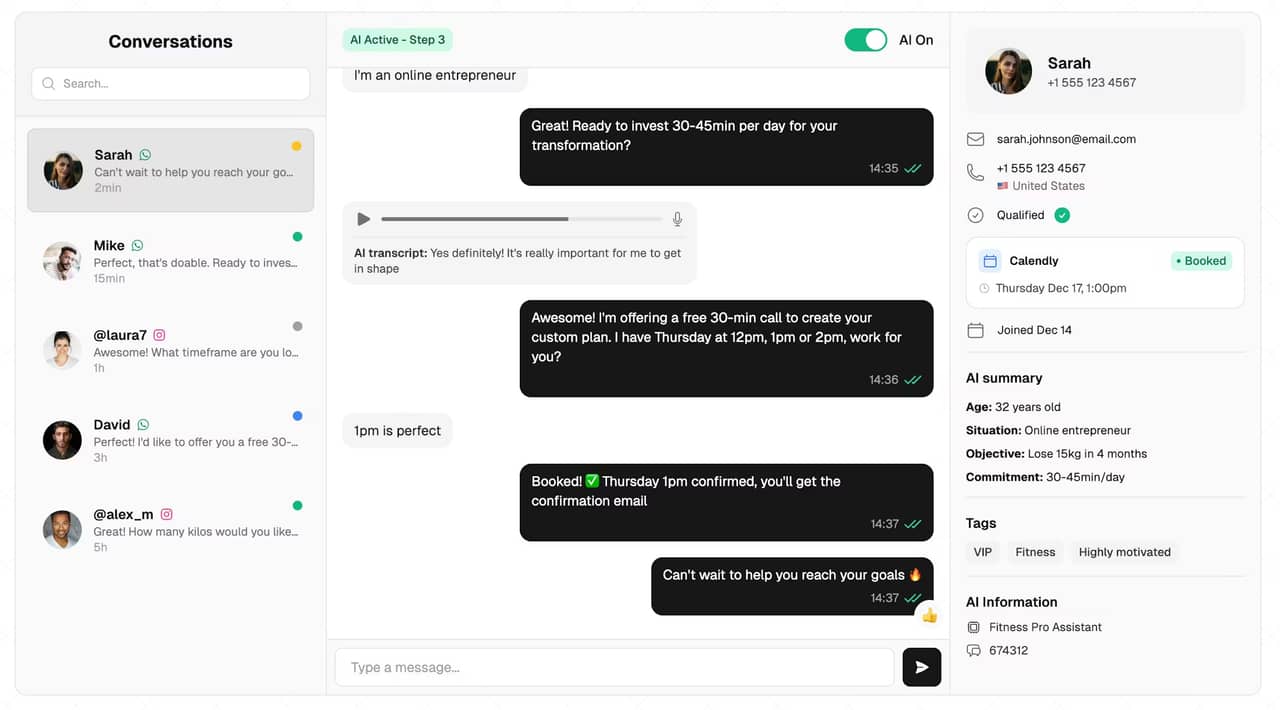
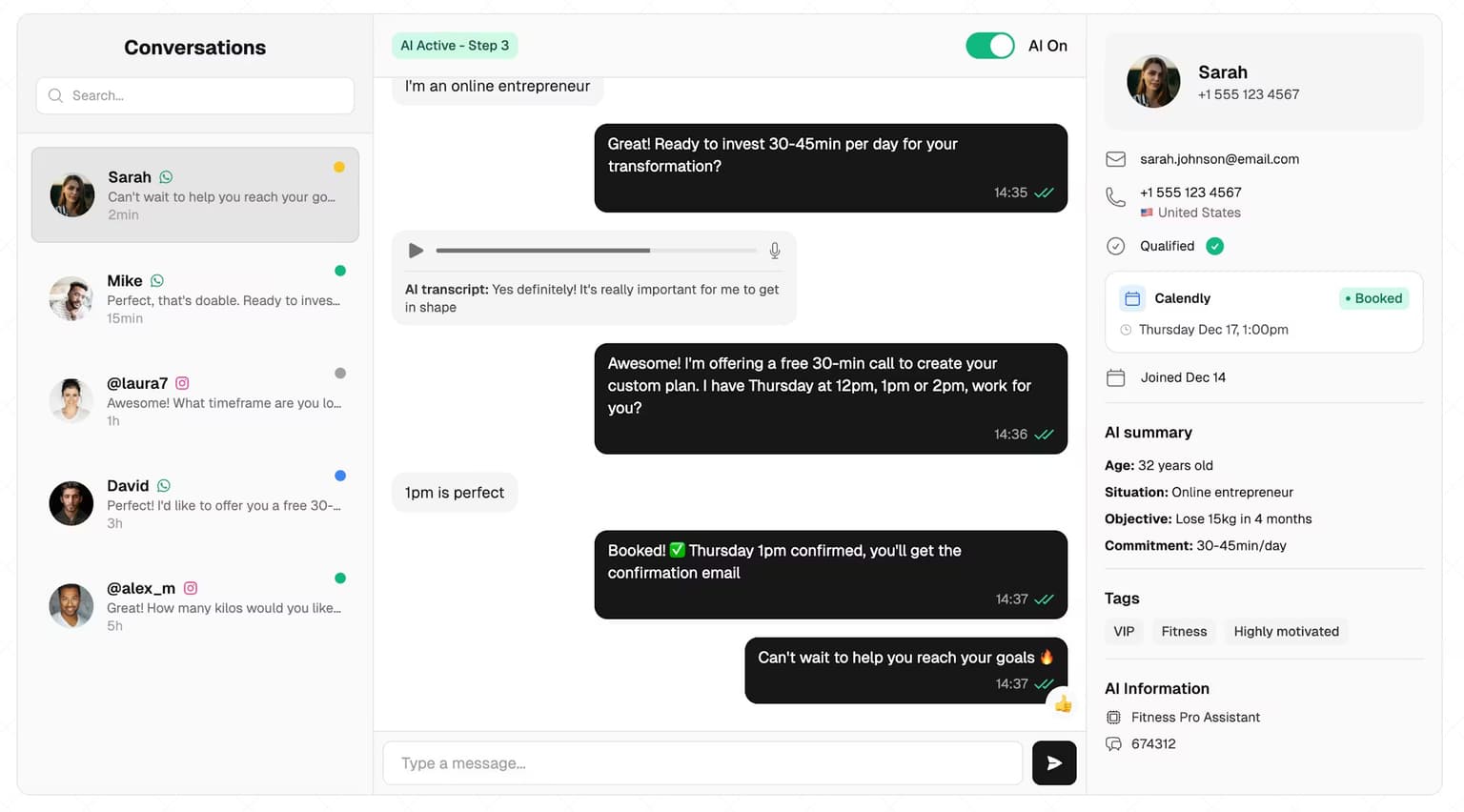
That job belongs to an AI setter, and it is a different product category. A DM-native AI setter holds a genuine qualifying conversation, detects intent, handles objections, proposes a specific time, and follows up automatically when the lead goes quiet, all inside the DM. Crucially, it does not try to close the deal in chat. For high-ticket coaching, the sale still happens on a human sales call; the setter's only job is to fill your calendar with qualified ones. If that is your model, our guide to high-ticket coaching shows where the booked call sits in the funnel, and our roundup of the best AI setters ranks the DM-native options.
SetSmart is built for exactly this: a purpose-built AI that qualifies leads and books calls on Instagram, WhatsApp, and Messenger, with automatic follow-ups. BotPenguin's King plan at $99/month and SetSmart at $97/month land within a couple of dollars of each other, and the contrast is the point. For that price, BotPenguin gives you raw breadth: more messages and more channels. SetSmart gives you a machine that fills your calendar with qualified sales calls instead of a bot that answers FAQs. Different tools for different jobs. If you want cheap broadcasts and FAQ bots, ManyChat or BotPenguin are fine, and you can compare more of the field in ManyChat vs UChat, ManyChat vs Chatfuel, and ManyChat vs Chatbase. If you want a filled calendar, buy the setter.
FAQ
Which is better, ManyChat or BotPenguin?
For Instagram comment-to-DM polish and ecosystem, ManyChat is better. For budget and channel breadth (including website chat), BotPenguin is better. Both are flow-first tools, so neither is the right choice if your goal is qualifying high-ticket leads and booking sales calls, which needs a dedicated AI setter.
Is BotPenguin cheaper than ManyChat?
Usually, yes, on headline price. BotPenguin has a more generous free plan and lower paid tiers, and it charges by messages rather than active contacts. But BotPenguin's AI answers are a metered add-on (from around $15 per 1,000), and ManyChat adds per-contact overages, so the real cost depends entirely on how your funnel behaves.
Is there anything better than ManyChat for booking calls?
For pure automation, ManyChat is hard to beat. For booking calls specifically, a DM-native AI setter is a better fit because it runs a real qualifying conversation and proposes call slots instead of just delivering links. See our best AI setters comparison.
What are some free alternatives to ManyChat?
BotPenguin's free-forever plan is the most generous of the big builders (1,000 messages, all channels). Smaller comment-to-DM tools also have free tiers. For a full tool-by-tool breakdown, see our ManyChat alternatives guide.
Do ManyChat and BotPenguin both work on Instagram?
Yes. Both connect through Meta's official API and run Instagram comment-to-DM and welcome-message automations. ManyChat's Instagram implementation is more refined and better documented; BotPenguin does the same mechanics at a lower price with a smaller community.
Can either tool book sales calls automatically?
Not natively. Both can send a scheduling link inside a flow, but neither runs the contextual, multi-turn conversation that qualifies a high-ticket lead and proposes a specific time. That is what a purpose-built AI setter does, and it is why coaches running high-ticket offers usually outgrow both tools.
Free 7-day trial, then from $97/month with 1,000 messages included.
Ready to automate your DMs?
Start your free 7-day trial and let AI handle your lead qualification 24/7.
Try SetSmart free