WhatsApp CRM: 7 Best Tools for Coaches (2026)

Your WhatsApp is where the real conversations happen. A lead replies to your click-to-WhatsApp ad, someone messages after your story, an old prospect resurfaces at 11pm. Then it all blurs together: hot leads buried under group chats, follow-ups you meant to send three days ago, and no way to tell who is ready to book a call and who was just curious.
That is the problem a WhatsApp CRM solves. It turns your inbox into an organized sales pipeline: every lead tracked, every conversation logged, every follow-up handled, so no qualified prospect slips through the cracks.
But "WhatsApp CRM" means very different things depending on the tool. Some are broadcast platforms with a contact list bolted on. Some are support inboxes for big teams. And a newer category uses AI to not just organize your leads but actually qualify them and book the sales call for you. This guide compares the 7 best options for coaches, creators, and agencies who sell through DMs, and shows you how to set one up.
What Is a WhatsApp CRM?
A WhatsApp CRM is a tool that lets you manage your WhatsApp conversations as a sales pipeline instead of a messy phone inbox. It connects to your WhatsApp Business number through Meta's official API and gives you a desktop dashboard where you can track leads, store contact details, and see the full history of every chat.
A good WhatsApp CRM should do six things:
- Unified desktop inbox — every conversation in one place, not scattered across your phone.
- Lead tracking — know which contacts are new, engaged, qualified, or booked for a call.
- Contact profiles — store each lead's name, goals, budget, timeline, and notes.
- Team access — let a VA or setter manage chats without handing over your personal phone.
- Tags and filters — segment by lead quality, offer interest, or pipeline stage.
- Follow-up automation — trigger scheduled reminders (or automatic messages) so no lead goes cold.
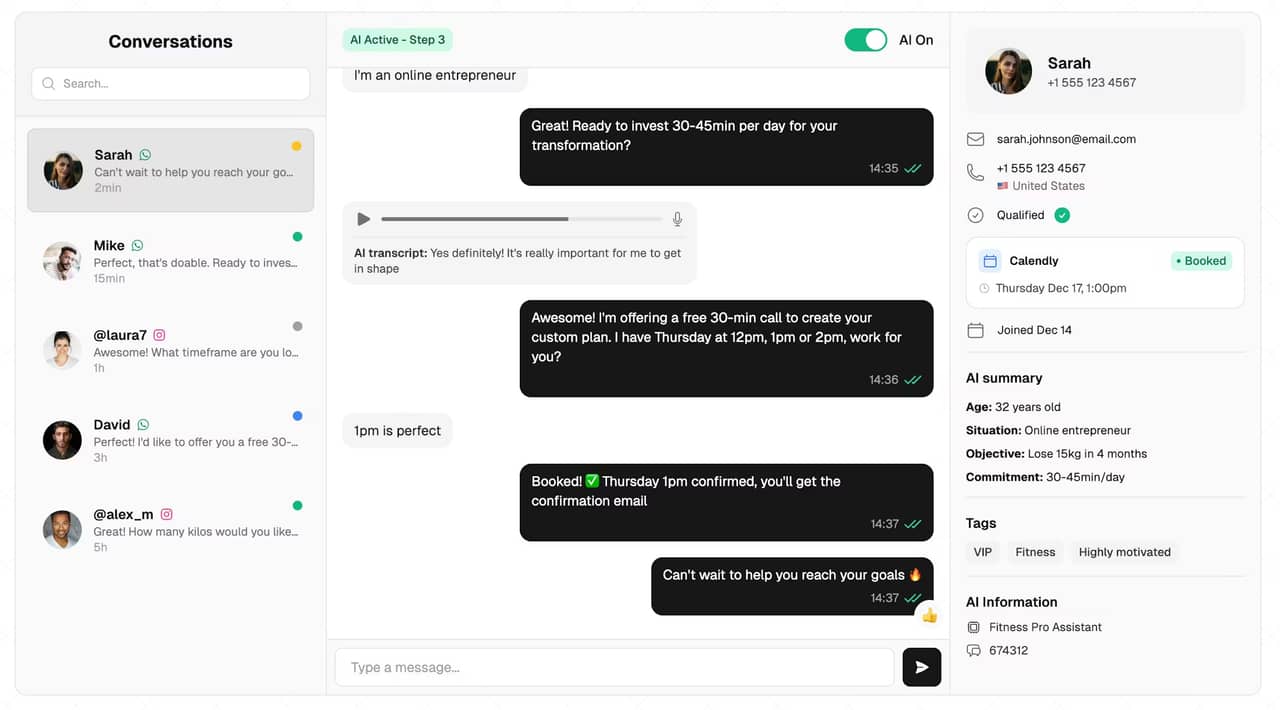
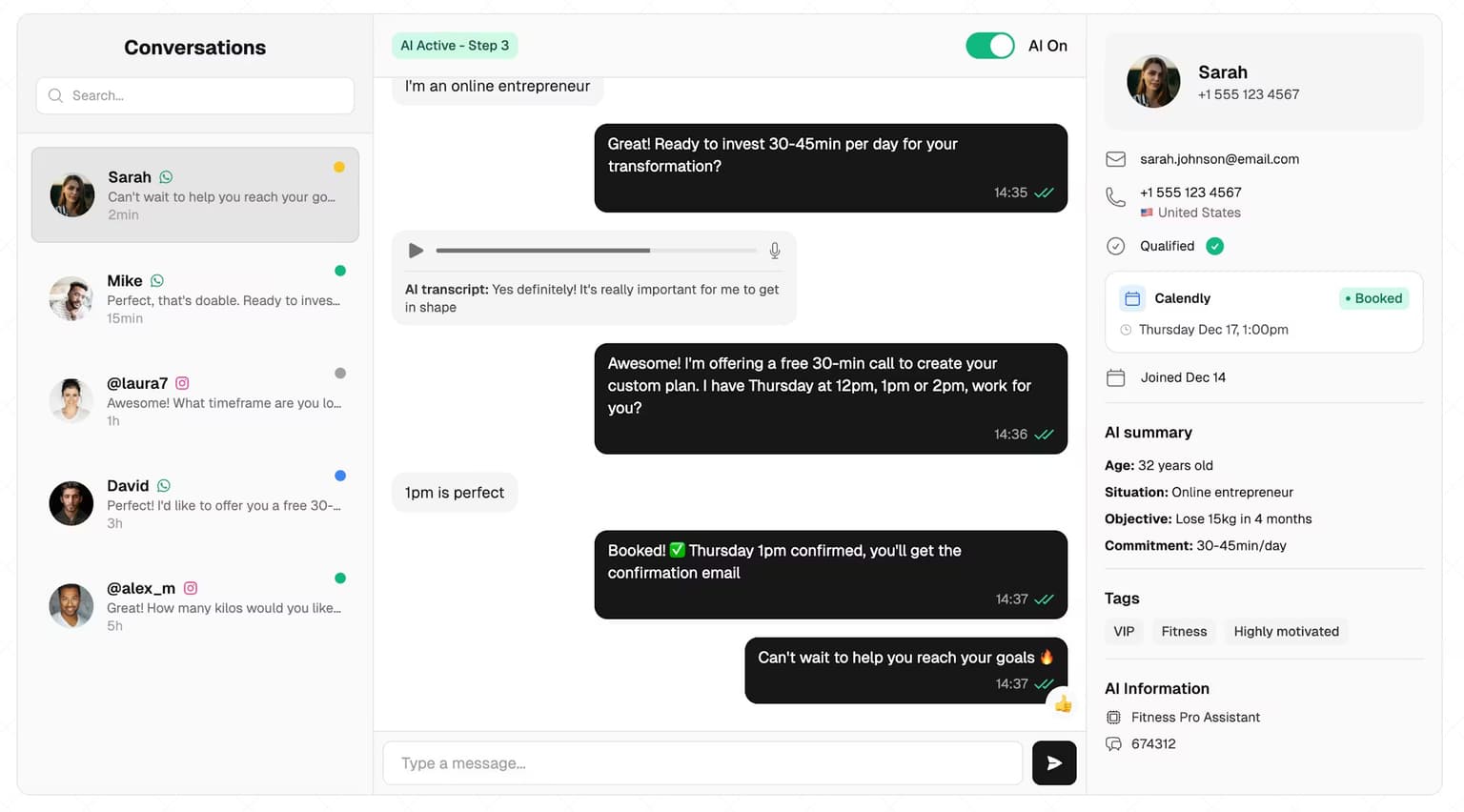
The best tools add one more layer on top: AI that reads the conversation, asks qualifying questions, and books the call automatically. That is the difference between a system that organizes leads and one that actually creates them. If you also run Instagram, the same logic applies there, which is why many coaches pair this with an Instagram CRM to keep both channels in one pipeline.
Why Coaches Need a WhatsApp CRM (Not Just the Business App)
Here is the uncomfortable truth: WhatsApp is your highest-intent channel, and most coaches leak leads out of it every single day.
The free WhatsApp Business app is fine for a handful of chats. It gives you labels, quick replies, and a greeting message. But it lives on one phone, it can't be shared cleanly with a team, and it has no pipeline view, no qualification logic, and no real follow-up engine. Once you are getting dozens of inbound messages a week from ads, stories, and referrals, that phone becomes a bottleneck, and speed is exactly where deals are won or lost.
In our study of 828K DM conversations, WhatsApp turned out to be the strongest DM channel for booking calls: WhatsApp responders qualified at roughly 34%, and among engaged leads, nearly 19% booked a call — meaningfully higher than Instagram. The catch is that those numbers only show up when leads get answered fast and followed up. A single follow-up message more than doubles booked calls (+106% among engaged leads). Speed matters too: AI replies in under 5 seconds, versus an industry average first response of 42 hours.
Booked-call rate among engaged WhatsApp leads: one follow-up vs none
A WhatsApp CRM is what makes this repeatable. It shows you which leads never got a reply, tracks who is due for a follow-up, and (with AI) handles both automatically. You stop relying on memory and start running a system. For the mechanics of that follow-up rhythm, see our guide to AI lead follow-up, and for the wider speed data, the lead response time statistics.
One positioning note, because it changes which tool you pick: for high-ticket coaches, the goal of a WhatsApp CRM is not to close in the chat. It is to qualify the lead and fill your calendar with sales calls. The actual close happens on the call, with you or your closer. A tool that tries to hard-sell in the DM usually converts worse and feels pushy.
The 3 Types of WhatsApp CRM
Not every "WhatsApp CRM" is built for the same job. There are three broad categories.
Type 1: Broadcast and support platforms
Tools like Wati, SleekFlow, Trengo, and Respond.io are built around the WhatsApp Business API for broadcasts, shared team inboxes, and support ticketing. They are powerful and mature, with no-code chatbot builders and campaign tools. For a solo coach, they can be overkill and their pricing (platform fee + per-message charges + per-seat) adds up fast.
Type 2: Generic sales CRMs with a WhatsApp integration
Traditional sales CRMs bolt WhatsApp on as one channel among email and calls. They are fine if your business already runs on a big CRM, but the WhatsApp experience is usually clunky and priced for sales teams, not creators. See CRM sales automation for where that workflow fits.
Type 3: AI-powered DM CRMs
Tools that combine lead tracking, contact profiles, and conversation history with AI that qualifies leads and books calls automatically. The CRM is built around the AI, not the other way around. For coaches, creators, and agencies selling via booked calls, this is almost always the highest-leverage choice, because it doesn't just tidy your pipeline, it feeds it. This is the same category as an AI setter or DM setter.
The 7 Best WhatsApp CRM Tools for Coaches (2026)
Here is a side-by-side view, then a breakdown of each.
| Tool | Type | Best for | AI qualification + booking | Price |
|---|---|---|---|---|
| SetSmart | AI-powered DM CRM | Coaches & agencies booking calls | Full AI qualification + booking | Trial, then $97/mo |
| WhatsApp Business app | Native labels | Very low volume, solo | None | Free |
| Wati | Broadcast + support | Teams running campaigns | Chatbot flows, add-on AI | ~$49–$299/mo + usage |
| ManyChat | Flow builder | Comment-to-DM & lead magnets | Button flows, limited AI | Free, then $14–$69/mo |
| Respond.io | Omnichannel inbox | Larger support/sales teams | Workflow automation | Paid team plans |
| TimelinesAI | Shared inbox + sync | Syncing WhatsApp to a CRM | Basic automations | Per-user plans |
| Zoho CRM | Generic sales CRM | Businesses already on Zoho | Via integration | Free tier + paid |
1. SetSmart — Best WhatsApp CRM for coaches booking calls
SetSmart is an AI-powered DM CRM built for exactly this job: turning WhatsApp (and Instagram and Messenger) conversations into booked sales calls. It connects through the official WhatsApp Business API, holds natural GPT-powered conversations, qualifies each lead against your criteria, and proposes calendar slots right in the chat.
What it does well:
- GPT AI that qualifies leads through real conversation, not rigid button flows.
- In-chat booking with Calendly and GoHighLevel.
- Automatic follow-ups (the 4h and 23h pattern that doubles booked calls).
- A CRM dashboard with lead status, contact profiles, and full conversation history.
- Multi-channel: the same pipeline covers WhatsApp, Instagram, and Messenger.
- Official Meta Business Partner, so business numbers stay safe.
Limitations: It is focused on qualifying and booking, not on mass broadcasting or support ticketing. If your main need is sending 50,000 marketing templates a month, a broadcast platform fits better.
Pricing: Free 7-day trial, then $97/month including 1,000 messages, with usage-based pricing above that. One flat plan, no per-seat math.
Best for: Coaches, consultants, and agencies who want their WhatsApp inbox to fill a calendar of qualified sales calls automatically.
2. WhatsApp Business app — the free starting point
The native WhatsApp Business app is free and gives you labels, a catalog, quick replies, greeting and away messages, and basic stats. For a coach just starting out with a handful of chats, it is enough.
Limitations: It lives on one phone, has no proper pipeline view, no clean team access, and no AI. Follow-ups are entirely manual. Once volume grows, it becomes the bottleneck.
Pricing: Free.
Best for: Very low-volume solo operators who aren't ready to invest yet.
3. Wati — best for broadcast-heavy teams
Wati is a well-known WhatsApp Business API platform with a shared inbox, no-code chatbot builder, broadcast tools, and click-to-WhatsApp ad capture. It is a mature product for teams running campaigns at scale.
Limitations: The pricing is platform fee plus per-message charges plus per-seat add-ons, so the real cost climbs quickly. Its chatbots are flow-based rather than true conversational AI, so qualification is more rigid.
Pricing: Roughly $49/mo (Growth) to $299/mo (Business) on annual billing, plus Meta's per-message rates and extra seats. See our full Wati pricing breakdown for the real numbers.
Best for: Support and marketing teams that broadcast heavily and need ticketing.
4. ManyChat — best for lead-magnet flows
ManyChat is the go-to for comment-to-DM and "DM the keyword" lead-magnet flows across Instagram and WhatsApp. It has a huge automation builder and basic contact management with tags and custom fields.
Limitations: It is a flow builder, not a conversational CRM. It lacks a visual sales pipeline and true AI qualification, and its WhatsApp features sit behind higher tiers plus Meta fees. See ManyChat for WhatsApp for the specifics.
Pricing: Free plan, then paid tiers at $14, $29, and $69/month depending on contacts, plus WhatsApp usage. Full detail in our ManyChat pricing guide.
Best for: Creators who want lead-magnet automations and don't need a real pipeline yet.
5. Respond.io — best for larger omnichannel teams
Respond.io is an omnichannel customer conversation platform: WhatsApp, Instagram, Messenger, email, and live chat in one inbox, with workflow automation and reporting.
Limitations: It is priced and designed for teams, and it is more of a support/operations tool than a coach's booking machine. The learning curve is steeper than you need for a solo offer.
Pricing: Paid team plans (billed per platform and usage).
Best for: Growing teams that handle high message volume across many channels.
6. TimelinesAI — best for syncing WhatsApp to an existing CRM
TimelinesAI adds a shared inbox on top of WhatsApp and syncs conversations into CRMs you already use. If your business runs on a sales CRM and you just want WhatsApp chats logged there, it fills that gap.
Limitations: It is a bridge and inbox, not a sales engine with AI qualification and booking built for creators.
Pricing: Per-user plans.
Best for: Teams that already have a CRM and want WhatsApp threads mirrored into it.
7. Zoho CRM — best if you already live in Zoho
Zoho CRM is a full sales CRM with a WhatsApp integration. If you already run your business on Zoho, connecting WhatsApp keeps everything in one system.
Limitations: The WhatsApp experience is a secondary channel bolted onto a generic CRM, so the DM workflow feels clunky compared with a purpose-built tool. Overkill for a solo coach.
Pricing: Free tier for small use, then paid sales-CRM plans.
Best for: Businesses already committed to the Zoho ecosystem.
WhatsApp CRM vs Instagram CRM: do you need both?
Most coaches don't run WhatsApp in isolation. Leads come from Instagram stories and comment-to-DM, then some move to WhatsApp; ad traffic often lands straight in WhatsApp via click-to-WhatsApp ads, and organic traffic arrives through a WhatsApp link in your bio. If you manage each channel in a separate tool, your pipeline is split and your follow-ups fall through the gaps.
The cleaner setup is one CRM that covers both. That way a lead who DMs you on Instagram and later messages on WhatsApp is a single contact with one history, not two half-conversations. Tools like SetSmart unify WhatsApp, Instagram, and Messenger into one pipeline, which is why the WhatsApp automation and Instagram CRM workflows converge for creators selling high-ticket. If you only sell through WhatsApp today, a WhatsApp-only tool is fine to start; just make sure it won't trap you when you add channels.
How to Set Up a WhatsApp CRM
Getting started is faster than most coaches expect. Here is the sequence.
Step 1: Pick a tool based on your actual goal
Booking sales calls? Choose an AI DM CRM (SetSmart). Broadcasting to a big list? A platform like Wati. Running lead-magnet flows? ManyChat. Don't buy a support ticketing suite to answer 30 DMs a week.
Step 2: Connect through the WhatsApp Business API
Link your WhatsApp Business number to the tool via Meta's official Cloud API or a BSP. This is what unlocks a desktop inbox, team access, and automation the consumer app can't do. Budget a few minutes and a one-time verification. If you're weighing costs, our WhatsApp Business API pricing guide explains Meta's per-conversation rates.
Step 3: Import contacts and define your pipeline
Bring in existing contacts via CSV or an integration, then set your lead stages: new, engaged, qualified, call booked, closed. Add custom fields for the qualification data your offer needs (goal, budget, timeline).
Step 4: Turn on qualification and follow-ups
With a manual CRM you'll tag leads and set reminders yourself. With an AI tool, the assistant asks qualifying questions, tags each lead automatically, and sends timed follow-ups. Because a single follow-up doubles booked calls, this step is where most of the ROI lives. This is the core job of an appointment setter, done by software.
Step 5: Monitor the dashboard and take the calls
Watch qualified leads land on your calendar, review each conversation before the call, and close on the call yourself. For the day-to-day playbook, see our WhatsApp marketing guide for coaches.
Common WhatsApp CRM Mistakes to Avoid
- Choosing a broadcast tool when you need a booking tool. If your goal is sales calls, a campaign platform's flow-based chatbot will frustrate you. Match the tool to the job.
- Ignoring per-message and per-seat costs. A "$49/mo" platform can become $250+ once you add Meta's message rates and extra users. Read the real pricing before committing.
- Trying to close in the chat. For high-ticket, the DM qualifies and books; the call closes. Pushing for the sale in WhatsApp lowers conversion.
- Skipping follow-ups. Over half of conversations die before they get going. Automated follow-ups are the single biggest lever you have.
- Keeping everything on your phone. A personal-app pipeline can't be shared, backed up, or automated. Move to a proper WhatsApp CRM as soon as volume grows.
FAQ
What is a WhatsApp CRM?
A WhatsApp CRM is a tool that connects to your WhatsApp Business number and lets you manage conversations as a sales pipeline: a desktop inbox, lead tracking, contact profiles, tags, and follow-ups. The best ones add AI that qualifies leads and books calls automatically, instead of you managing everything from the phone app.
Is there a free WhatsApp CRM?
The native WhatsApp Business app is free and offers labels and quick replies, and Zoho has a free CRM tier. But free options lack a real pipeline, team access, and AI qualification. For meaningful WhatsApp CRM functionality, expect to pay somewhere from $14 to $99/month depending on the tool and your volume.
Can you integrate WhatsApp with a CRM?
Yes. Through the official WhatsApp Business API you can connect your number to a CRM so every chat is logged, contacts are synced, and your team works from one dashboard. Purpose-built tools like SetSmart do this natively; tools like TimelinesAI bridge WhatsApp into a CRM you already use.
What is the best WhatsApp CRM for coaches?
For coaches selling high-ticket via booked calls, SetSmart is the strongest fit because it qualifies leads with AI and books the call in-chat, then tracks everything in one CRM. For broadcast-heavy teams, Wati; for lead-magnet flows, ManyChat; for large omnichannel support, Respond.io.
Does WhatsApp have a built-in CRM?
Not really. The WhatsApp Business app has lightweight labels and a catalog, which is closer to a contact organizer than a CRM. It has no pipeline view, no shared team inbox, and no automation or AI. To run WhatsApp as a real sales pipeline you need a dedicated WhatsApp CRM connected via the Business API.
How much does a WhatsApp CRM cost?
It ranges from free (the Business app) to $97/month for an all-in AI DM CRM like SetSmart, up to several hundred dollars a month for broadcast platforms once you add Meta's per-message fees and extra seats. A flat-rate plan is easier to predict than platform-plus-usage pricing if your volume swings during launches.
WhatsApp CRM vs WhatsApp Business app: what's the difference?
The Business app is a free, single-phone tool with labels and quick replies. A WhatsApp CRM is a desktop system connected via the Business API that adds a pipeline, team access, follow-up automation, and (in the best tools) AI qualification and booking. The app is where you start; a CRM is what you graduate to when leads outgrow your phone.
Ready to automate your DMs?
Start your free 7-day trial and let AI handle your lead qualification 24/7.
Try SetSmart free