Hire an Appointment Setter: Costs + Red Flags (2026)

To hire an appointment setter as a coach, decide first whether you need someone to answer inbound DMs or someone to dial a list, pay a small monthly floor plus a commission on cash collected from the calls they booked, look for candidates where setters already work (your closer's network, setter communities, Upwork), test the best two or three on a paid trial with your real conversations, and give them access to your inbox without handing over your password. The setter's job ends when a qualified lead shows up on your calendar. The sale happens on the call, with you or your closer.
Most pages that rank for this search are marketplaces listing profiles, agencies selling their own setters, or job boards. Useful if you already know what you want. This guide is for the coach, course creator or creator-led business that sells a high-ticket program on a sales call and gets its leads from Instagram, WhatsApp or ads: what to pay, where to look, how to test, the red flags that cost coaches months, the access and contract basics, and when an AI setter answers the DMs instead of (or next to) a human.
Do you need to hire an appointment setter yet?
Direct answer: hire a setter when leads are waiting for replies, not when you want more leads. A setter converts conversations you already have into booked calls; they do not create demand on their own (unless you hire an outbound dialer, which is a different job).
You are ready when most of these are true:
- Leads wait. New DMs sit unanswered for hours, or you reply in batches at night. Response time is the first thing that slips when you do everything yourself, and it is the one buyers punish fastest, as our lead response time statistics show.
- The offer already sells on calls. People who get on a call with you buy at a rate you can predict. A setter scales a working process; they cannot fix an offer nobody wants.
- Your calendar has gaps while your inbox has threads. That is the exact gap a setter fills.
- You can fund 60 days. Even a commission-heavy setter needs a ramp period, and you need time to judge them.
You are not ready if you get a handful of DMs a week, if you have never closed a sale on a call, or if you cannot say in one sentence who your program is for. In those cases, fix the content and the offer first.
One number explains why the inbox is worth a hire. In the 828K AI DM conversations we analyzed, 53% of conversations died before message 3, and a single follow-up doubled booked calls. Most of the revenue a setter recovers comes from those two moments: the reply that keeps the conversation alive, and the follow-up nobody had time to send.
Inbound DM setter vs outbound appointment setter: know what you are hiring
Direct answer: the title "appointment setter" covers two different jobs. A coach selling from Instagram and WhatsApp needs an inbound DM setter, a writer who qualifies in text. Most profiles on job boards and marketplaces are outbound phone setters.
| What changes | Inbound DM setter | Outbound phone setter |
|---|---|---|
| Where leads come from | Comments, story replies, "DM me the keyword", ads that open a chat | Lead lists, form fills, old leads to re-dial |
| Daily work | Reply fast, ask qualifying questions, send voice notes, follow up, send the booking link | Dial, leave voicemails, book on the phone |
| Skill to test | Writing in your voice, reading intent in short messages | Phone presence, volume, objection handling out loud |
| Biggest risk | Sounding like a bot or a stranger on your account | Burning leads with too many calls |
| Usual title in ads | DM setter, Instagram setter, chat setter | Appointment setter, outbound setter, telemarketer |
Our guide to what a DM setter does walks through a real conversation, and the appointment setter role guide covers the job from the setter's side (tasks, salary ranges, setter vs closer). If you want the whole function done for you by a firm, our ranking of appointment setter companies compares agencies, most of which are built for B2B phone work.
How much does it cost to hire an appointment setter?
Direct answer: there is no standard rate. What you pay depends on the model (hourly, per call, commission, a monthly floor plus commission, or an agency fee), and the published figures are job ads and vendor guides, not market surveys. Here is what we could verify on November 21, 2026.
- Hourly. Hourly budgets in Upwork job posts for appointment setters ran from about $4 an hour for offshore roles to about $30 an hour, with most between $10 and $25, often plus a bonus per booked appointment. Fiverr's own 2026 cost guide puts appointment setters at $15 to $75 an hour: $15 to $25 at entry level, $25 to $45 mid level, $45 to $75 for experts.
- Floor plus commission (a real coaching ad). A men's relationship coaching company, MM Coaching Limited, advertised on Workable a setter role with a guaranteed floor of $1,000 a month plus 10% of the cash collected from the setter's sets, uncapped. Note the job: dialing about 150 warm ad leads a day, so it is a phone role.
- Agency placement. Clickx sells a "commission only" setter placement for a one-time $3,499, with a free replacement if the setter is not booking or not a fit within 8 weeks. Its own page admits that setters typically require a small base salary or a draw against commissions, and says a solid setter typically books 3 to 8 qualified calls per week.
- Done-for-you agencies. They charge monthly retainers or per-meeting fees; our comparison of appointment setting services vs AI breaks down how those contracts work.
The pay models compared
| Model | How it works | Good when | Watch out for |
|---|---|---|---|
| Hourly | You pay for time in the inbox | Trial weeks, launches, very new offers | No link between pay and booked calls |
| Per booked call | A flat fee each time a call lands on the calendar | Rarely, and only with a strict "qualified" definition | Calendar stuffing: unqualified calls that never show |
| Per showed call | The fee is paid only when the lead attends | You have steady lead flow and a clear qualification bar | Disputes over what "qualified" meant |
| Commission on cash collected | A percentage of the money actually paid by leads the setter booked | High-ticket programs with a proven close rate | Setters leave if the close rate is low or slow |
| Floor + commission | A modest monthly floor plus a percentage of cash collected | Most coaches: it pays for effort and for results | You owe the floor even in a slow month |
Do the math before you post the job
Work out what one booked call is worth to you before you agree to any number. Take your own figures: the price of your program, how many qualified shows you close, and how many booked calls show up.
Example with made-up round numbers: a $3,000 program, you close 1 in 4 qualified shows, and 2 in 3 booked calls show up. Twelve booked calls give you about eight shows and two sales, so $6,000 collected. A 10% commission on cash collected costs you $600 that month, about $50 per booked call. If a setter asks for more than that per booked call, they are asking for more than the call is worth to you at your current close rate. Run the same math with your real numbers; the answer tells you which pay model you can afford.
Two rules make any model safer:
- Pay on cash collected, not on contracts signed, and agree in writing what happens to the commission if a client is refunded.
- Define "qualified" in writing before the first day: budget range, timeline, the problem you solve, and who decides. Our coaching intake form lists the questions coaches use, and the same questions work in a DM.
Where to find an appointment setter
Direct answer: the best setters for coaches usually come from people who already know your world. Start with your own network, then go to communities and marketplaces, and use agencies when you would rather pay a fee than run the hiring yourself.
- Your closer's network. Setters and closers work in pairs; a good closer knows two or three setters who are looking.
- Your past clients and community. A former client who got results already speaks your language and believes in the program. Train the skill; you cannot train the belief.
- Setter and closer communities. Many setters train and look for work in paid communities (Skool groups, Discord servers, Facebook groups). Quality varies widely, so the trial matters more than the pitch.
- Marketplaces. Upwork ranks first on Google for this search; Fiverr sells packages. Most profiles we saw are phone and B2B setters, so filter for "Instagram", "DM" or "chat" experience and ask for screenshots of real conversations with the names hidden.
- Job boards. Indeed and ZipRecruiter are built for job seekers. They work if you want a part-time or full-time employee, less so for a commission-based contractor.
- Placement firms and agencies. You pay for the sourcing and sometimes for a replacement guarantee. Read what "qualified" and "replacement" mean in their terms.
A quick filter for any candidate: ask them to describe the last lead they disqualified and why. Setters who can explain a "no" are the ones who protect your calendar.
How to vet an appointment setter: a paid trial in 7 days
Direct answer: do not hire from a call. Hire from what they write. A three-step process takes about a week and shows you more than any interview.
Step 1, the written test (day 1). Send each candidate three real inbound messages from your account, anonymized, and ask for the reply they would send. Good test messages:
- "How much is your program?" as the very first message.
- "I've tried everything and nothing works for me."
- "Can you just send me the info?"
Read the replies for three things: do they answer the person before asking anything, do they ask one question at a time, and do they move toward a call without pushing the price in the chat. Our Instagram DM scripts show the structure most good replies follow.
Step 2, the roleplay (day 2 or 3). Fifteen minutes, live: you play the lead, they set. Include one lead who should be disqualified. Watch whether they notice.
Step 3, the paid trial week (days 3 to 7). Pay the trial at an hourly rate or a fixed fee, give limited access (see the access section below), and let them work real conversations while you review every thread at the end of the day. Score them on:
| Criterion | What good looks like |
|---|---|
| Speed | New messages answered within the hours you agreed, every day |
| Voice | Leads cannot tell the setter from you |
| Qualification | Every booked lead has the answers you defined as "qualified" |
| Follow-up | Silent leads get a follow-up, and nobody gets five |
| Notes | Each booked call comes with a short summary for the closer |
Red flags when you hire an appointment setter
Direct answer: most bad hires show the warning signs before the first paid day. Walk away from a candidate, or an agency, that does any of these:
- Asks for your Instagram password. There are password-free ways to share an inbox (next section). A setter who insists on your login is a security problem and, if things go wrong, a hostage problem.
- Promises a number of calls in week one before seeing your offer, your content or your lead flow.
- Wants to be paid per booked call with no definition of "qualified". That model rewards a full calendar, not a full bank account.
- Only has phone experience for a DM job. Writing and dialing are different skills.
- Tries to close in the chat. Pushing the price or a payment link in the DM skips the call that sells a high-ticket program. The setter books; the close happens on the call, which is how the setter-closer model works.
- Uses one script for everyone and ignores what the lead just said.
- Claims commission on every sale, including buyers who came from your email list and never spoke to them. Agree on attribution: a sale counts when the buyer was booked by the setter.
- Asks you to pay for their training or their "certification". And if you are recruiting, never ask a setter to pay to work for you either: it is the fastest way to attract the wrong people.
Onboarding: the first two weeks
Direct answer: a setter is only as good as the playbook you hand them. Write it once, before day one, and update it every Friday.
The playbook fits in one document:
- The offer: who it is for, who it is not for, the price range you allow them to mention (if any), and what the call is.
- Qualification rules: the questions, the answers that qualify, the answers that disqualify, and what to say to a disqualified lead (a free resource, a lower-priced product, a polite no).
- Booking rules: which calendar link, how far ahead, and what to do when a lead asks for a time outside your hours.
- Voice: ten real replies you wrote, so they copy your tone, and the words you never use.
- Handoff: the short summary each booked call needs (situation, goal, what they tried, urgency) so you or your closer start the call informed.
Week one, the setter drafts and you approve. Week two, they send directly and you review a sample each evening. After that, a weekly review is enough: replies sent, calls booked, shows, qualified shows, and three conversations you pick at random.
Give your setter inbox access without sharing your password
Direct answer: use Instagram's Shared access, Meta Business Suite, or a seat in your DM tool. All three let you remove the setter in one click without changing your password.
Instagram Shared access. Instagram lets you invite people you trust to use your account without your password, from Profile, then Menu, then Shared access. Inbox access is separate and off by default: under Manage, then Inbox access, you switch it on for each person. A few details from Instagram's help center that matter for a setter:
- Invitees have 7 days to accept the invite.
- You can manage and revoke access at any time and see the actions taken on your account.
- People who message you can see that the account is shared when inbox access is on.
- Inbox access also opens your chats with Meta AI, so keep anything private out of it.
- The feature is only available to eligible accounts.
Meta Business Suite. For professional accounts managed through a business portfolio, Business Suite lets you add a person with partial access to the Instagram account, limited to the tasks they need.
WhatsApp. The free WhatsApp Business app shares one number across linked devices, which are not real team seats; our guide to WhatsApp Business multiple users explains the device limits and the API route a team needs.
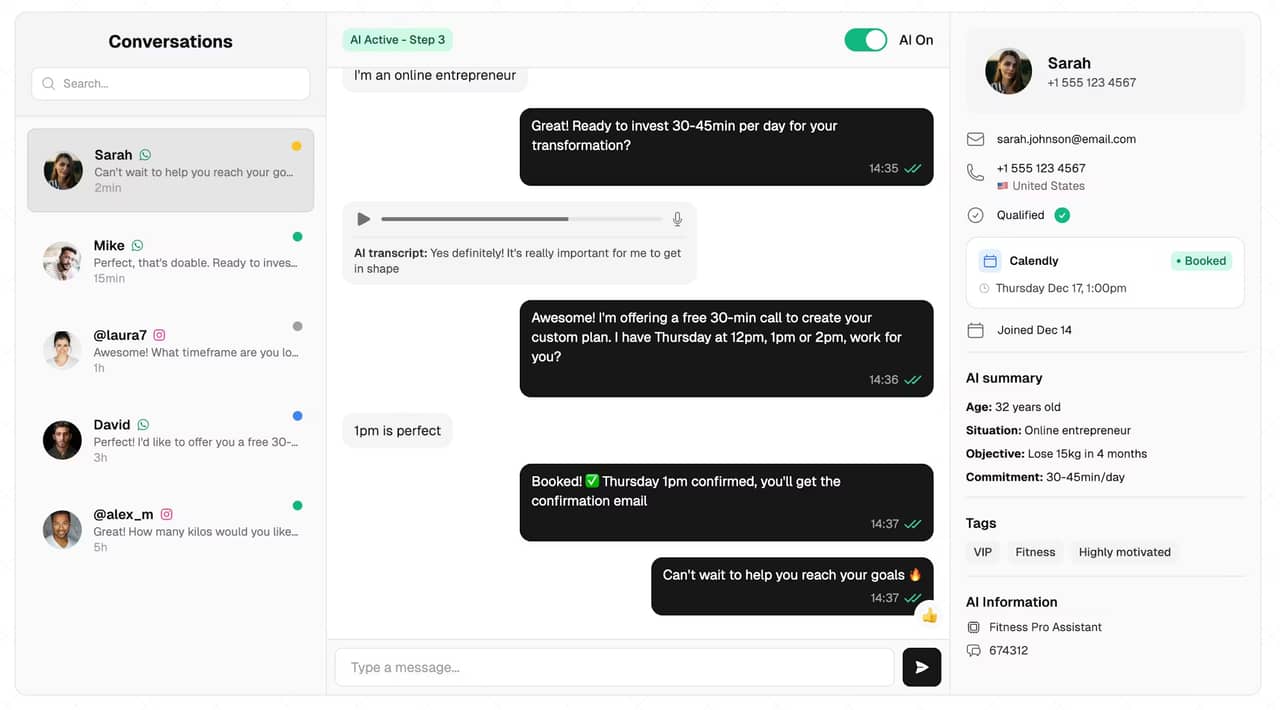
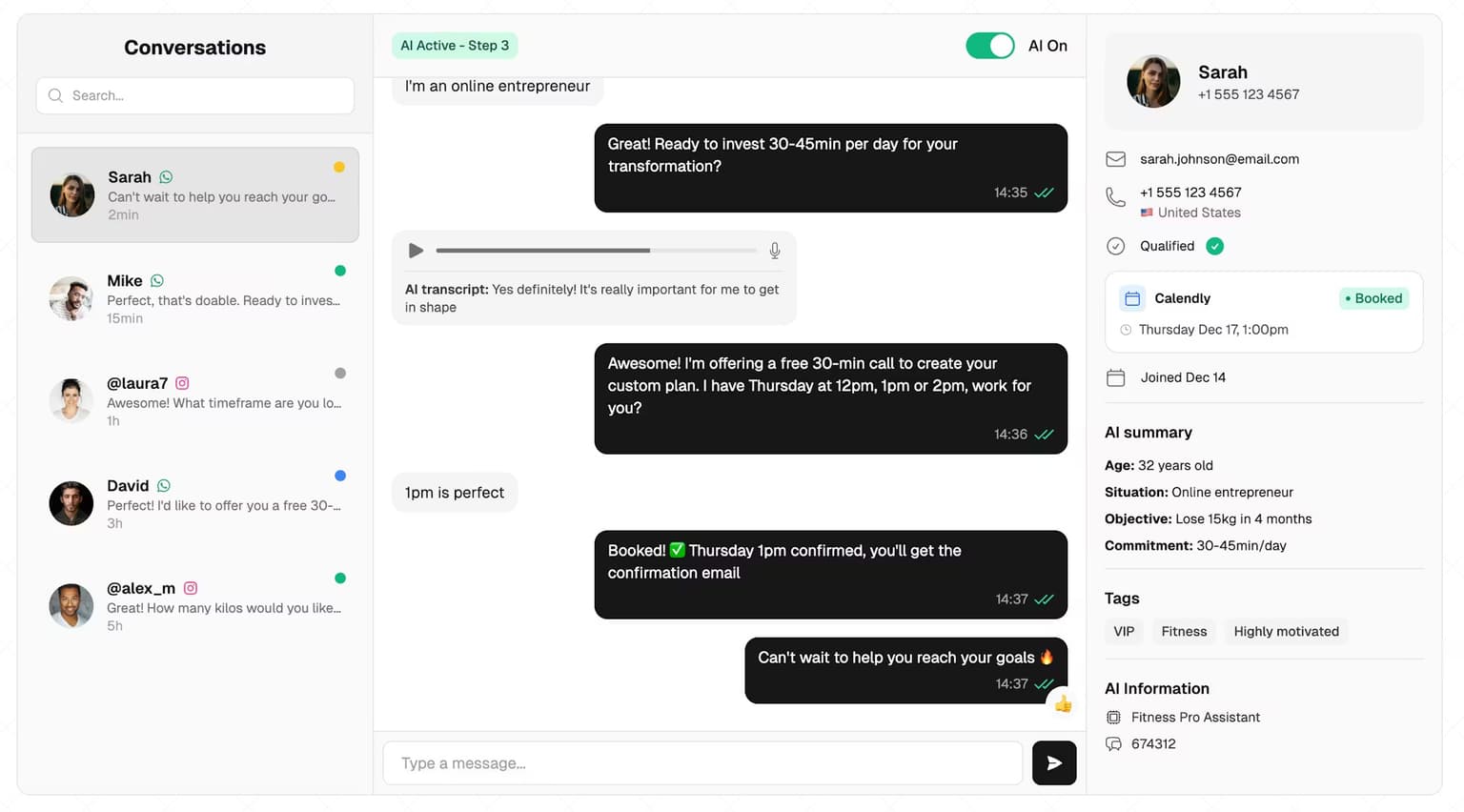
In SetSmart. If your DMs run through SetSmart, invite the setter as a team member by email (up to 20 members and pending invitations per account). You can assign conversations to a specific setter and filter the inbox by "Assigned to", every message shows whether the AI, a template or a teammate sent it, and you can pause the AI on any lead the moment a human takes over. Removing a member cuts their access to conversations, assistants and settings immediately.
Contracts, taxes and the legal basics (US)
Direct answer: most coaches hire setters as independent contractors, and the label alone does not make someone a contractor. Get the classification right, collect a W-9, and write down the pay rules. This is general information, not legal or tax advice: check with an accountant for your state.
- Contractor or employee. The IRS looks at three groups of facts: behavioral control (do you control how the work is done), financial control (how they are paid, who provides the tools, who carries the expenses) and the type of relationship (contract, benefits, how permanent it is, how central the work is). No single factor decides. If it stays unclear, either side can file Form SS-8 for an official answer, which can take at least six months. Fixed shifts, your scripts word for word and your tools only all push toward employee.
- Form 1099-NEC. For payments made after December 31, 2025, the reporting threshold rose from $600 to $2,000 per contractor per year (One Big Beautiful Bill Act; the Federal Register notice is document 2026-07519), indexed for inflation from 2027. Collect a W-9 before the first payment either way.
- Employees. If the setter is your employee, wage and payroll rules apply, which makes a commission-only employee role a risky setup.
What the contract should say, in plain words:
- Scope: the channels, the hours, the response time you expect.
- The definition of a qualified lead and of a show.
- Pay: the floor, the commission rate, the base it is calculated on (cash collected), when it is paid, and what happens on refunds.
- Attribution: which sales count as theirs.
- Data and confidentiality: lead conversations stay yours, no copying contacts, deletion on exit. If you sell to people in the EU, a written data processing agreement is part of GDPR compliance.
- Exit: notice period and the day access is removed.
When an AI setter replaces or backs up a human setter
Direct answer: an AI setter does the parts of the job that need speed and consistency (the first reply in seconds, at any hour, the qualifying questions, the follow-ups, sending the booking link), and a human does the parts that need judgment and relationship. The close stays on the call either way.
| What you need | Human setter | AI setter | Hybrid |
|---|---|---|---|
| Reply at 2 am | Only if you pay for night shifts | Yes | Yes, the AI covers it |
| Many conversations at once | Limited by hours and attention | Yes | Yes |
| Judgment on unusual leads | Strong | Follows your rules | The human takes over |
| Hiring, training, turnover | Your time, every time someone leaves | Set up once, then edit the instructions | One human to manage instead of a team |
| Cost structure | Floor, commission or hourly | A monthly plan with a message allowance | Both, with a smaller human role |
The hybrid is where most coaches who already have a setter end up: the AI answers every new DM instantly, qualifies and follows up, books the qualified leads, and hands the edge cases to the human, who now spends their time on the conversations that need a person. Coaches without a setter often skip the hire entirely. Our AI setter guide explains how this works across Instagram, WhatsApp and Messenger, and our test of the best AI setters compares the tools.
SetSmart is built for that job: it answers Instagram, WhatsApp and Messenger DMs in your voice, asks your qualification questions, follows up with leads who go quiet, and books the call in the chat through Calendly, Cal.com, iClosed or GoHighLevel. It never sells in the DM; it fills your calendar with qualified sales calls. SetSmart Pro starts with a free 7-day trial, then costs $97/month with 1,000 messages included; the Light plan is $25/month for 250 messages, without a trial.
Mathis Ladoue, an online fitness coach with 22.4K followers, put it this way: "I book 15 to 25 calls per week... without managing a single setter."
Ari had run a human setting team for almost a year and was skeptical of AI in his DMs. After he plugged SetSmart into his Instagram, he told us: "I've always been skeptical of AI being in my DMs. Right when I integrated SetSmart, I went from $50,000 to $72,000 to $110,000 last month. This is the future."
FAQ
How much does it cost to hire an appointment setter?
It depends on the pay model. Upwork job posts for appointment setters mostly budget $10 to $25 an hour, Fiverr's 2026 cost guide puts experts at $45 to $75 an hour, and coaching companies often pay a monthly floor plus a commission on cash collected, for example $1,000 a month plus 10% in one ad we read. Placement firms add a fee, such as Clickx's one-time $3,499.
Is appointment setter a legit job?
Yes. Coaches, agencies and sales teams pay setters to book calls, as employees or contractors. The scams are on the edges: "jobs" that ask you to pay for training first, and offers that are commission only with no leads provided. A legitimate employer gives you leads, a written pay plan and a clear definition of a qualified call.
How much does an appointment setter make per hour?
Hourly budgets in the Upwork job posts we read on November 21, 2026 ran from about $4 to $30, most between $10 and $25, often with a bonus per booked call. Many setters for coaches are paid on commission instead, so their effective hourly rate depends on lead flow and the close rate on the calls they book.
Should I pay an appointment setter per appointment or on commission?
For a high-ticket coaching offer, a small floor plus a commission on cash collected from the calls they booked aligns the setter with real sales. Paying per booked appointment rewards a full calendar, even with leads who never show or never qualify; if you do it, pay only for qualified shows and define "qualified" in writing.
What is a virtual appointment setter?
A virtual appointment setter is a remote setter who books calls for you from wherever they live, by DM, chat or phone. For a coach, it usually means a contractor who answers Instagram and WhatsApp messages in your name, qualifies leads and sends your booking link.
Can AI replace an appointment setter?
For inbound DMs, AI can do most of the setter's daily work: reply in seconds at any hour, ask qualification questions, follow up and book the call in the chat. A human still adds value on unusual leads, partnerships and relationship-heavy conversations, which is why many coaches run AI first and keep a human for the exceptions. In both cases, the sale happens on the call.
Ready to automate your DMs?
Start your free 7-day trial and let AI handle your lead qualification 24/7.
Try SetSmart free