WhatsApp Business Multiple Users: Team Setup (2026)

Direct answer: the free WhatsApp Business app does not have real multi-user accounts. One number lives on one main phone, and you can mirror it on up to four extra linked devices, so a maximum of five screens can open the same inbox. That is enough for a solo coach and one assistant sharing a laptop, but it is not team access: there are no separate logins, no way to assign a chat to a specific person, and no reliable way for two people to answer at the same time without stepping on each other.
The moment you need genuine WhatsApp Business multiple users, one number worked by a whole team with their own seats, you are looking at the WhatsApp Business API and a shared inbox on top of it. This guide explains the exact device limits, why linked devices are not seats, the two honest routes to a team inbox, what each costs, how to keep your chat history when you migrate, and how to pick the setup that matches your volume.
WhatsApp Business multiple users: the short answer
There are two different questions hiding inside "can WhatsApp Business have multiple users", and mixing them up is where most guides go wrong.
- Multiple devices, one account: yes, natively, up to five screens (one phone plus four linked devices). Everyone sees the same single account.
- Multiple users, separate seats, one number: no, not in the free app. That is an API feature, delivered through a shared-inbox or AI platform.
| What you want | Route | Real cost | Good for |
|---|---|---|---|
| You plus one helper on the same account | Linked devices (free app) | Free | Solo coach, occasional cover |
| A team sharing one number with logins | Business API + shared inbox | Per-message fees plus a tool | Coach plus setters or VAs |
| A team that also qualifies and books | Business API + AI setter | Per-message fees plus a tool | Any team running ads or high volume |
If you only need a second pair of hands now and then, the free app's linked devices are enough. If you are building a setting team on one number, skip straight to the API section, because linked devices will let you down in a way that costs you booked calls.
How many users can WhatsApp Business have? The device limits
The free WhatsApp Business app is tied to a single account, which is tied to a single primary phone number. From that main phone you can extend access in two ways.
Linked devices. You can link up to four additional devices to one account, using WhatsApp on a computer (web or desktop app) or on a companion phone or tablet. Combined with the main phone, that is five active screens on the same account at once. Each linked device connects independently, so if the main phone goes offline the linked devices keep working for a while.
Companion mode. A second phone can be linked as a companion device rather than registering its own number, which is how two phones end up showing the same business inbox. It still counts against the four-device allowance and it is still one shared account, not two users.
That is the whole ceiling: one number, five screens, one identity. There is no admin panel, no per-person login, and no record of which teammate sent which reply. Everyone who opens the account is, as far as WhatsApp is concerned, the business itself.
For a lot of coaches this is genuinely fine. If it is just you plus a part-time assistant covering evenings, link their laptop and move on. The friction only starts when the inbox gets busy enough that two people need to work it in parallel, or when you want to know who handled which lead.
Linked devices are not team seats (the trap)
This is the single most important thing to understand before you build a team around the free app, because it looks like multi-user access until the day it bites you.
Linked devices share one identity with no boundaries. In practice that means:
- No assignment. Every open chat is visible to everyone. There is no "this lead is mine", so two people happily reply to the same person within a minute of each other, and the lead sees a confused double answer.
- No accountability. Because messages are not attributed, you cannot see who answered fast, who dropped the ball, or who never followed up. Coaching a setter is impossible when you cannot see their work.
- Collisions on typing. Two people drafting replies in the same thread overwrite each other's read state and create a messy back-and-forth. It works for two people who coordinate by voice; it falls apart at three.
- A hard device wall. Five screens total. A coach with two setters and a VA is already at the edge, before anyone adds a personal laptop.
- One weak security model. Everyone shares the same account with no individual permissions, so offboarding someone means unlinking a device and hoping, not revoking a seat.
The free app was designed for a single business owner who occasionally answers from a laptop. It was never designed for a team, and stretching it into one is where quiet revenue leaks start. If your labels and chat organisation are already creaking under the load, that is usually the first sign you have outgrown it, and a proper WhatsApp CRM or shared inbox is the fix rather than a sixth device.
The real multi-user route: the WhatsApp Business API
Actual multi-user access on one number comes from the WhatsApp Business API, not the app. The API is the official interface that lets software send and receive messages on your number, and every shared-inbox platform, team helpdesk, and AI assistant plugs into it. This is also the difference between the free WhatsApp Business app and the tier that supports a team.
Once your number runs on the API through a platform, "multiple users" finally means what you expected:
- Separate logins. Each setter, VA, or coach gets their own account and password. No shared phone, no passed-around handset.
- Assignment and routing. New conversations get routed to a person or a team, either manually or by rule, so two people never answer the same lead.
- Internal notes and visibility. Teammates leave notes on a conversation, hand off cleanly, and you can see who did what.
- No five-device ceiling. Add as many seats as your plan allows; the phone is out of the loop entirely.
- The verified badge path. The WhatsApp green tick runs through an API account, not the free app.
There is a catch worth stating plainly: once your number is registered on the API, it leaves the free Business app. A number lives in one place at a time. So this is a deliberate migration, not something you toggle on and off. You also take on per-message fees (more on cost below) and a one-time Meta business verification.
You reach the API two ways. You can go through a raw BSP (a provider such as Twilio or 360dialog) and build your own inbox, which is developer territory and rarely worth it for a coaching business. Or you use a platform that wraps the API, the inbox, the seats, and the automation into one product you log into, which is what almost everyone actually does. If you want the deeper mechanics of the channel first, our WhatsApp API explainer covers what it is and who needs it.
How to add multiple users to WhatsApp Business, step by step
The right sequence depends on whether you have already outgrown the free app. Here is the honest path most coaching teams take.
- Fix the number's role first. Choose one business number that the whole team will share, and keep personal WhatsApp on a separate number so nobody's family chats end up in the client inbox.
- Start with linked devices if you are small. In WhatsApp Business, open Settings, tap Linked devices, tap Link a device, and scan the QR code from the teammate's WhatsApp Web or desktop app. Repeat up to four times. This is your free, no-migration option for a solo operator plus light cover.
- Recognise the ceiling. When two people need to reply in parallel, when you cannot tell who handled a lead, or when you pass five devices, the free app is done. Do not fight it with a sixth workaround.
- Register the number on the API through a platform. Pick a shared-inbox or AI-setter tool, connect the number (this migrates it off the free app), and complete Meta business verification. Back up your chats first.
- Invite your team as seats. Inside the platform, add each setter, VA, or coach as their own login with the right permissions.
- Set assignment and automation. Route new conversations to the right person, and turn on automatic qualification and follow-up so leads are answered even when the team is asleep. Our WhatsApp automation guide walks through what to automate first.
The jump from step 2 to step 4 is the real decision. Everything before it is free and reversible; everything after it is a proper system that scales.
What each route costs
The free app costs nothing, no matter how many linked devices you use. Costs only appear when you move to the API, and they come in two layers.
Meta's per-message fee. Since mid-2025, WhatsApp bills per template message rather than per 24-hour conversation, with the rate set by the recipient's country and the message category. The crucial detail for an inbound coaching business: replies you send inside the 24-hour customer service window, after a lead messages you first, are free. Because your leads DM you first from ads, link stickers, and your bio, most of your traffic sits inside that free window. The full rate card and the provider markups nobody warns you about are in our WhatsApp Business API pricing breakdown.
The software on top. The shared inbox, the automation, or the AI assistant is where the monthly subscription lives. Prices vary a lot between tools built for ecommerce broadcast blasts and tools built for booking sales calls, so match the tool to the job rather than the sticker price. A flow builder like ManyChat for WhatsApp is strong at button menus and lead magnets; an AI setter is built to hold an open conversation and book a call.
One thing to ignore: anyone selling you the classic verified badge for a fee. The verification path runs through your API account inside Meta's own tools, and Meta Verified for Business is a subscription Meta prices by region. Check it inside Business Manager, not a blog post.
Keeping your chat history when you migrate
The question every coach asks before switching: do I lose my conversations? Handled correctly, no meaningful loss, but the details matter.
- Between free-app devices, nothing is lost. Linking a laptop or companion phone just mirrors the same account. Unlinking it does not delete anything from your main phone.
- Migrating to the API is a fresh start on the platform side. Your old on-device chat history stays on the phone, but the API inbox begins collecting new conversations from the switchover. Export or back up anything you need to reference before you migrate.
- Back up first, always. Run a manual WhatsApp backup before any move, so a failed migration never costs you a client's thread.
- Plan the cutover. Do it in a quiet window, not during an ad launch, so no lead lands in the gap while the number changes hands.
If you are weighing whether the migration is worth it at all, the deciding factor is almost never the history; it is whether your team is losing leads inside the free app today.
Which setup fits your team size
Pick by how many people touch the inbox and how fast DMs arrive, not by ambition.
Just you, or you plus occasional cover: free app, linked devices. Link a laptop for yourself and your assistant, set the away message so nobody waits overnight, and keep going. Anything more is premature.
You plus one setter, low volume: free app, but watch the seams. Two coordinated people can share linked devices if they talk to each other. The day you see double replies or a missed lead, you have your answer.
A real setting team (two or more setters, VAs, a second coach): API plus a shared inbox. Separate logins, assignment, and accountability stop being nice-to-haves and start being the thing that prevents leads slipping through. This is also the point where click-to-WhatsApp ads become viable, because paid clicks arrive faster than any five-device account can absorb.
Any team running ads or high inbound: API plus an AI setter. When volume is paid or large, you want the number answered in seconds, qualified, and booked before a human even opens the thread. The team then handles the calls, not the triage.
For coaches specifically, keep the goal straight: the WhatsApp inbox exists to fill your calendar with qualified sales calls, not to close in the chat. Qualification and booking happen by message; the close happens on the call, with you or your appointment setter. Choose the multi-user setup that gets the right people onto that calendar fastest.
Where a shared inbox stops being enough
Adding seats solves the "who can answer" problem. It does not solve the two things that actually cost coaches money: speed and follow-up. A three-person team still sleeps, still gets busy, and still forgets to nudge the lead who went quiet after two messages.
In our analysis of 828K real WhatsApp and Instagram DM conversations, WhatsApp responders qualify at 34% of engaged chats and a single well-timed follow-up doubles booked calls. Neither of those depends on how many seats you buy; they depend on answering fast, every time, and following up without fail, which is exactly what a tired human team cannot guarantee.
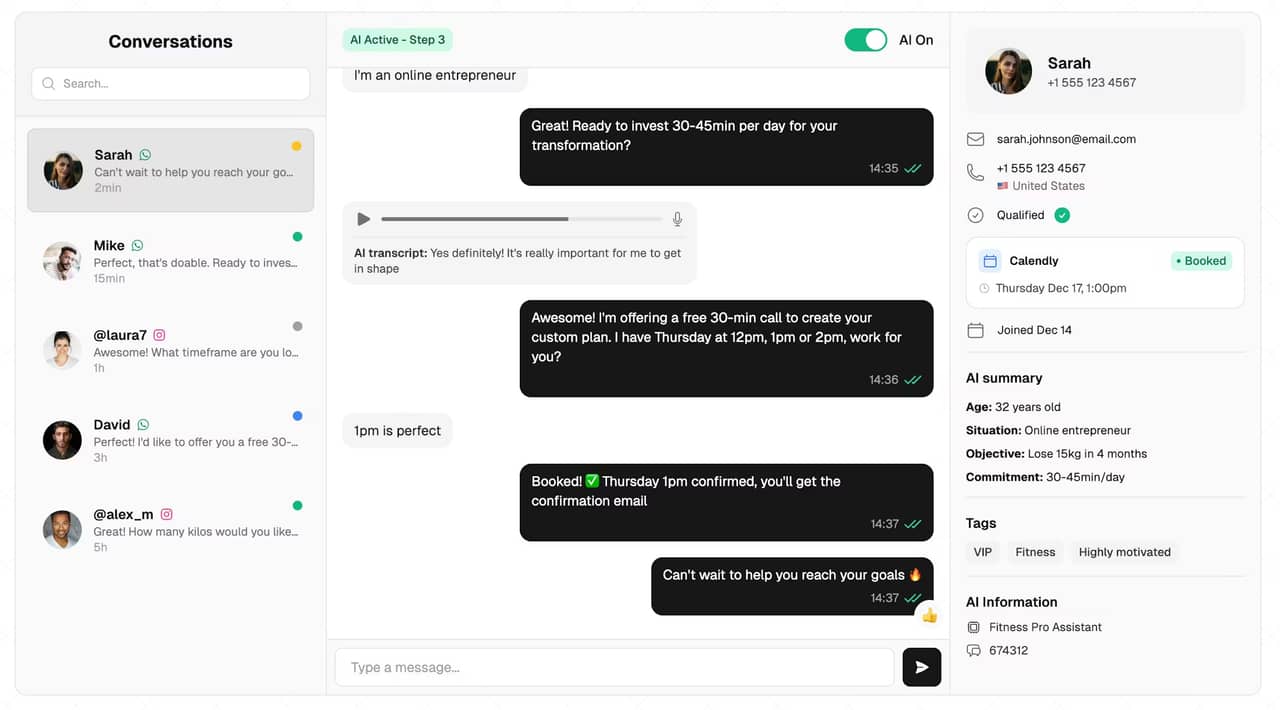
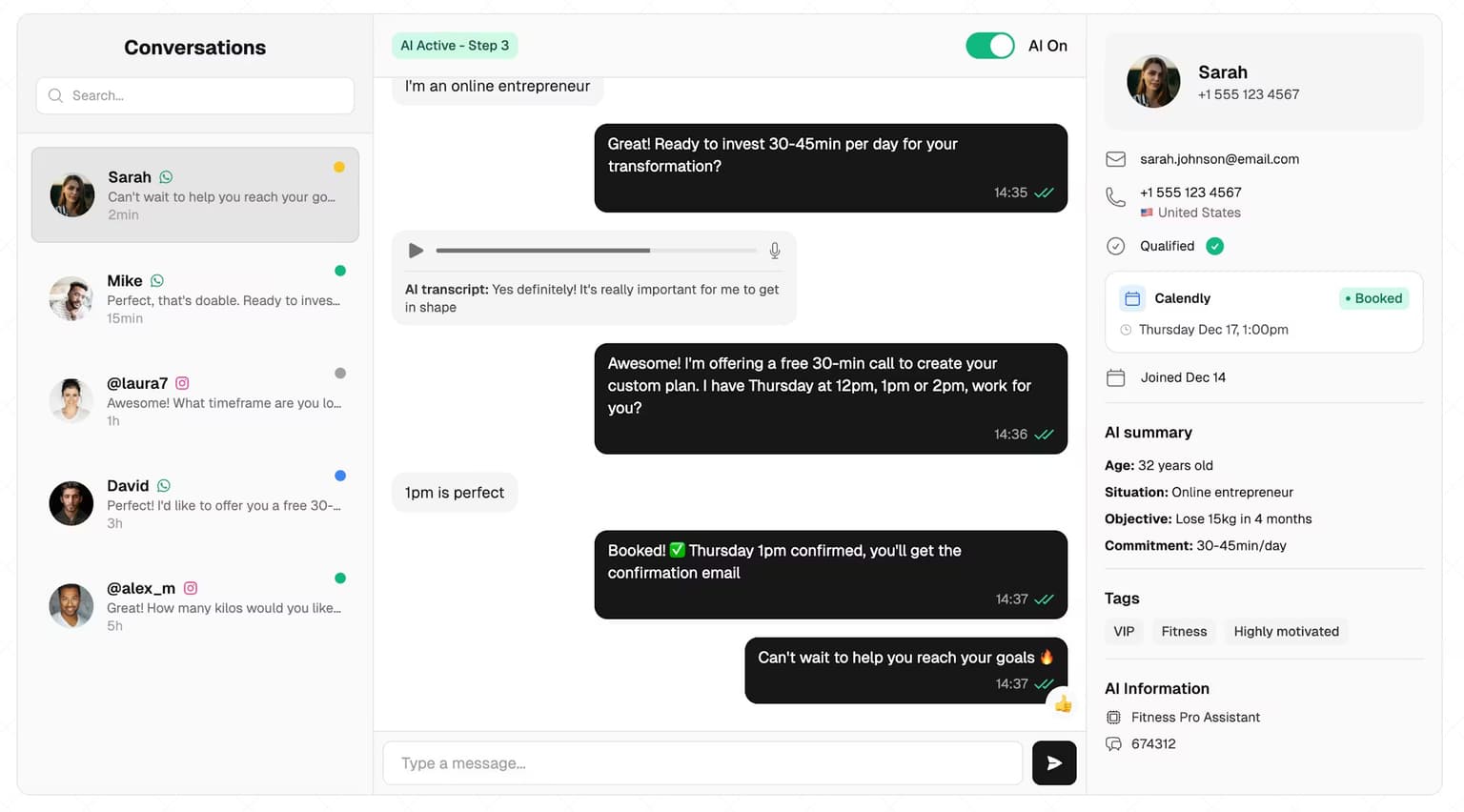
That is the job an AI setter does on top of the API, alongside your seats rather than instead of them. It answers in seconds at any hour, asks your two or three qualifying questions the way a human DM setter would, proposes calendar slots once someone is a fit, and follows up automatically when a thread goes cold, then hands warm, booked leads to your people. Unlike a scripted WhatsApp chatbot or the fixed automated messages in the free app, it reads what the lead actually wrote. SetSmart is built for this across WhatsApp, Instagram, and Messenger, with a free 7-day trial, then $97/month including 1,000 messages.
Whichever route you choose, read our wider WhatsApp marketing playbook for how the channel fits the rest of your funnel, and size the seats to your team, not your hopes.
FAQ
Can you have multiple users on WhatsApp Business at the same time?
On the free app, only in a limited way: one account can be open on a main phone plus up to four linked devices, so five screens share the same single account at once. There are no separate logins or assignment, so it is shared access rather than true multi-user seats. Real multi-user access, with individual logins for each teammate, requires the WhatsApp Business API through a shared-inbox or AI platform.
Can WhatsApp Business have multiple users on the same number?
Yes, but the how depends on the tier. On the free app, several people can open the one account via linked devices on the same number, with no per-person logins. On the API, a whole team shares one number with proper seats, assignment, and accountability. The number itself stays single; what changes is whether people share one identity or each get their own.
Is WhatsApp Business multiple users free?
Sharing the free app across linked devices is free with no message charges. Genuine team access, with separate logins on one number, runs on the WhatsApp Business API, which adds per-message fees (replies inside the 24-hour window are free) plus a monthly subscription for the shared-inbox or AI tool you use.
How many devices can use one WhatsApp Business account?
Five in total: one primary phone plus up to four linked devices, which can be computers, tablets, or a companion phone. Companion mode lets a second phone mirror the account, but it counts against the four-device allowance and is still one shared account, not a second user.
How do I add a team member to WhatsApp Business?
For light use, link their computer or phone as a linked device by scanning the QR code in Settings, then Linked devices. For a real team, move the number to the WhatsApp Business API through a platform and invite each person as their own seat with assignment rules. The linked-device route shares one identity; the API route gives each teammate a real login.
Can two people use WhatsApp Business on different phones with the same number?
Yes, through companion mode or linked devices, both phones can open the same account and number. But they share one identity with no assignment, so they will collide on the same chats if they are not carefully coordinated. For two people to work the number reliably and independently, use the API with individual seats.
Ready to automate your DMs?
Start your free 7-day trial and let AI handle your lead qualification 24/7.
Try SetSmart free