WhatsApp API: What It Is & Who Needs It (2026)

The WhatsApp API is what lets software send and receive WhatsApp messages automatically, at scale, without a person tapping on a phone. It is the difference between one coach typing replies all day and a system that answers every lead in seconds, qualifies them, and books the call. If you run inbound conversations on WhatsApp and you have outgrown the green Business app, the API is the layer you have been looking for.
But "WhatsApp API" is also one of the most confusing terms in the space. Half the guides online are written for developers who want to send order confirmations for a 50-agent ecommerce team. The other half are BSPs trying to sell you a plan before you understand what you are buying. This article is written for the coach, creator, or agency owner who just wants to know: what is it, do I actually need it, and what will it cost me to run WhatsApp properly in 2026.
We have sent millions of messages through the WhatsApp API, so we will keep this practical: the plain-English definition, how it differs from the free app, who genuinely needs it (and who is wasting money), what a BSP is, what you can build on top of it, and the setup path that does not require you to write a single line of code.
What Is the WhatsApp API?
The WhatsApp API (officially the WhatsApp Business Platform) is a programmatic connection to WhatsApp's messaging network. Instead of a chat screen you tap on, it exposes endpoints that software can call to send messages, receive incoming messages through webhooks, manage templates, and read delivery status. It has no interface of its own. It is plumbing that other tools plug into.
There are two things people mean when they say "the API":
- The Cloud API: hosted directly by Meta on Meta's servers. This is the current, recommended way to access the platform. You do not host anything yourself, and it is free to access at the infrastructure level (you still pay Meta per message and pay your provider). Most tools you will evaluate run on the Cloud API.
- The On-Premises API: the old self-hosted version Meta is sunsetting. You can ignore it. If a provider is still pushing on-prem in 2026, that is a red flag.
The key mental model: the API is not an app you install and it is not a product you log into. It is a set of instructions that a platform like SetSmart, ManyChat, Wati, or a custom-coded bot uses to control WhatsApp on your behalf. When someone says "we're on the WhatsApp API," they mean their number is connected to the platform and their software, not the consumer app, is running the conversations.
Because the API has no interface, you always need something on top of it. That something is either code your developer writes or a no-code platform that turns the raw API into buttons, automations, and a shared inbox. For nearly every coach and creator, it is the second one.
WhatsApp API vs the WhatsApp Business App
This is the comparison that actually matters, because most people confuse the API with the free green WhatsApp Business app you download from the App Store. They are completely different products aimed at completely different users.
The free Business app is a normal phone app. You install it, you tap replies, and it lives on one device (with WhatsApp Web as a mirror). It is perfect for a solo operator handling a handful of chats a day. The API is a backend connection with no app at all, built so software can run thousands of conversations across a whole team.
| Feature | WhatsApp Business App (free) | WhatsApp API |
|---|---|---|
| Interface | Phone app + WhatsApp Web | None (needs a platform on top) |
| Automation & AI | Basic quick replies, greeting, away message | Full AI replies, qualification, booking |
| Team access | One device, no real multi-agent | Shared inbox, many agents |
| Broadcasts | Capped, only to saved contacts | Template broadcasts at scale |
| Click-to-WhatsApp ads | Works, but replies are manual | Auto-reply and route every lead |
| CRM sync | None | Full integration |
| Cost | Free | Per-message + provider fee |
The honest takeaway: if the free app handles your volume and you never feel the pain of manual replies, stay on it. The moment you cannot keep up, you want more than one person on the same number, or you are running paid ads into WhatsApp, the app hits a wall the API was built to break. For a deeper side-by-side, see our WhatsApp vs WhatsApp Business breakdown.
Who Actually Needs the WhatsApp API (and Who Doesn't)
Direct answer: you need the WhatsApp API when the volume or the automation you want is impossible by hand. You do not need it just because it sounds professional.
You probably need the API if you are:
- A coach or creator running click-to-WhatsApp ads and getting more inbound DMs than you can answer in real time.
- Running a team (or a virtual assistant) that all needs to see and reply from the same WhatsApp number.
- Sending broadcasts or reminders to a list bigger than a few hundred people.
- Trying to qualify and book calls automatically instead of typing the same questions all day.
- Connecting WhatsApp to a CRM, calendar, or the rest of your funnel.
You probably do not need the API yet if you are:
- Handling under roughly 20 to 30 chats a day comfortably on your phone.
- Not running ads and not sending broadcasts.
- Fine with replies coming from you personally, in your own time.
The mistake we see most often is coaches paying for a WhatsApp platform before they have the volume to justify it. The API earns its keep when speed and scale start costing you booked calls. And speed is not a soft metric here: in our study of real DM conversations, WhatsApp responders qualify at 34%, the highest of any channel we tracked, but only when someone (or something) actually replies fast enough to keep the thread alive. If leads sit unanswered, the channel's advantage evaporates. That is exactly the gap the API closes.
If you are a solo coach whose whole business runs on Instagram, the API question may not even be about WhatsApp yet. Plenty of our users start on Instagram DMs with an AI setter and add WhatsApp once click-to-WhatsApp ads or a growing list make the second channel worth automating.
What Is a BSP (and How the Cloud API Fits In)?
A BSP, or Business Solution Provider, is a company Meta authorizes to give businesses access to the WhatsApp API. Historically, you could not connect a number to the platform without going through one. Names you will run into include Twilio, 360dialog, Gupshup, AiSensy, and Wati.
Two things changed the picture and are worth understanding before you sign anything:
- The Cloud API opened direct access. With Meta hosting the API in the cloud, some platforms now onboard you onto Meta's infrastructure directly rather than reselling a legacy BSP stack. This usually means faster setup and cleaner pricing.
- Most coaches never deal with a raw BSP at all. A platform like SetSmart, ManyChat, or Wati already sits on top of the Cloud API and handles the BSP relationship for you. You sign up, connect your number, and you are running. You get the API's power without ever touching a developer console.
So when you compare tools, you are really comparing two layers: the provider (who gives you API access and charges the Meta per-message fee, sometimes with a markup) and the application (the inbox, the AI, the automation you actually use every day). Some tools bundle both. Our WhatsApp Business API pricing guide breaks down where BSP markups hide and how to avoid overpaying.
One practical note for developers and AI power users: SetSmart also exposes WhatsApp control through an MCP server, so you can drive the API from Claude, ChatGPT, or Cursor in natural language. That is the modern, safe alternative to open-source scripts that scrape WhatsApp Web and put business numbers at risk.
What You Can Build on the WhatsApp API
Once your number is on the API, WhatsApp stops being a manual inbox and becomes a system. Here is what that unlocks, roughly in order of value for a coach or agency:
1. An AI that qualifies leads and books calls
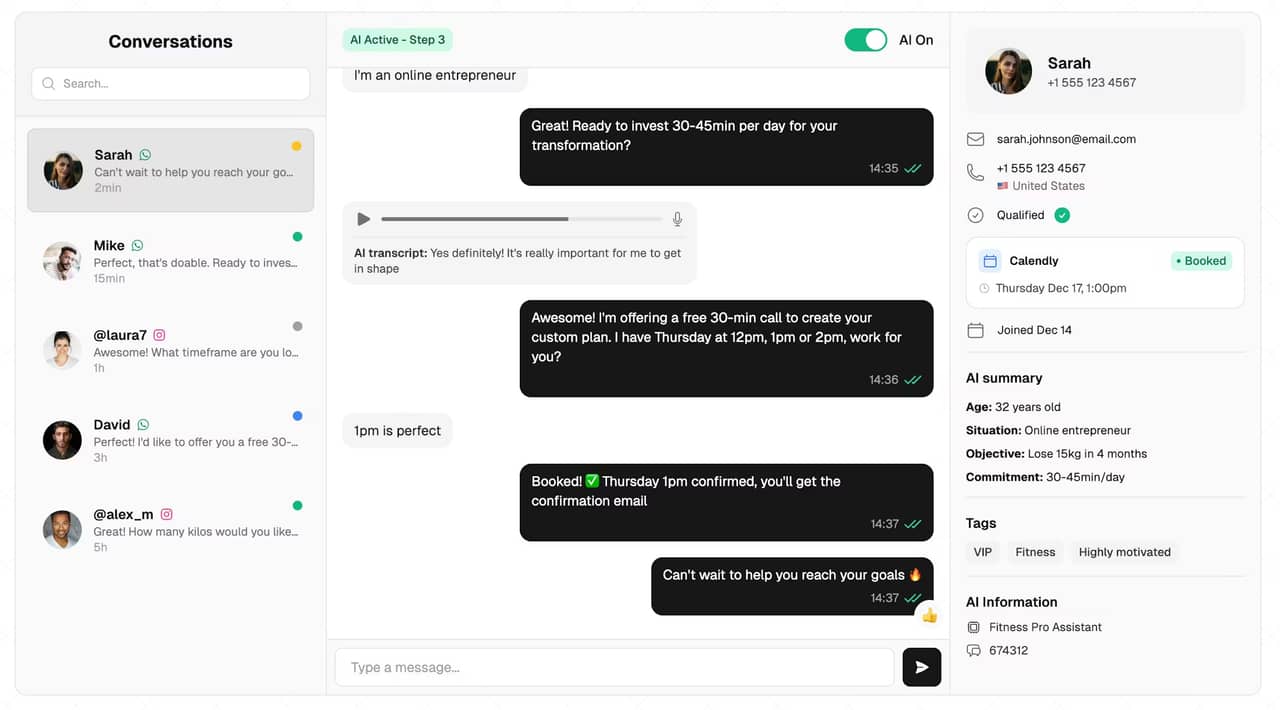
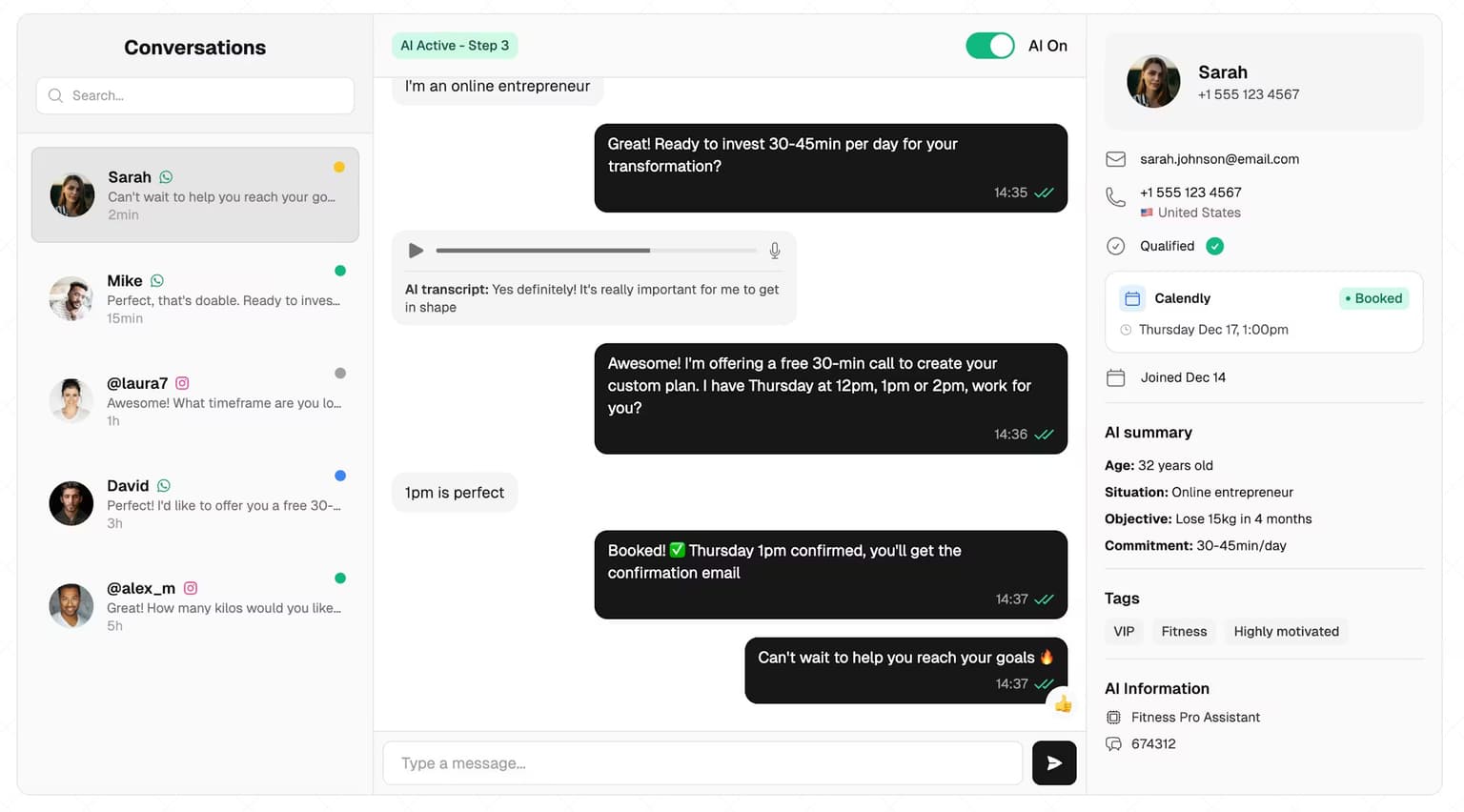
This is the headline use case. Instead of you asking "what's your goal, what's your budget, are you ready to start" over and over, an AI holds the conversation, asks your qualifying questions, and proposes calendar slots in the chat. To be clear about what this does and does not do: the AI fills your calendar with qualified sales calls. It does not close the high-ticket sale in the DM. The close still happens live, on the call, with you or your closer. The API just makes sure the booking half runs itself. A purpose-built WhatsApp chatbot that books calls is the difference between a channel that leaks leads and one that compounds.
2. Broadcasts and re-engagement that don't get you banned
The API lets you send approved template messages to your list at scale, the compliant way. That means launch announcements, webinar reminders, and re-engagement campaigns without the account-ban risk of blasting from the app. See our WhatsApp broadcast guide for limits and templates.
3. Automated follow-ups
Most booked calls are won on the follow-up, not the first message. The API can trigger automated messages at the right moment. In our data, adding a single follow-up more than doubles booked calls, and the API is what makes those follow-ups fire on time, every time, instead of depending on you remembering.
4. Click-to-WhatsApp ad handling
If you run Meta ads with a WhatsApp CTA, every tap opens a chat. On the app, those pile up unanswered. On the API, each one gets an instant reply, gets qualified, and gets routed. This is where the API pays for itself fastest for paid-traffic coaches.
5. Interactive flows and menus
WhatsApp Flows let you build multi-step forms, booking screens, and menus right inside the chat, which only work on the API. Combined with a real CRM view, you get a full pipeline that lives where your leads already are.
How to Get the WhatsApp API (Without Code)
You do not need to be technical to get on the API. The no-code path takes most coaches under a day of active work, plus Meta's review time. Here is the sequence.
- Pick a platform, not a raw BSP. Choose an app that wraps the Cloud API (SetSmart for AI qualification and booking, or a general tool). This is the single decision that determines how painful the rest is.
- Verify your Meta Business account. Confirm your business inside Meta Business Manager. This is the same verification used across Meta's business tools, and it unlocks the WhatsApp Business Platform.
- Register a dedicated number. The number you connect cannot be active on a normal WhatsApp or WhatsApp Business app at the same time. Most people use a fresh SIM or a virtual number. Set your display name here too.
- Get your templates approved. Any message you send outside the 24-hour reply window must use a pre-approved template. Submit your key templates (booking confirmation, reminder, re-engagement) early, since review can take anywhere from minutes to a day.
- Consider the green tick later. The verified green checkmark is separate from API access and is not required to run. See our WhatsApp green tick guide when you are ready.
- Connect your automation. Point the API at your AI, chatbot, or CRM. This is where your setter starts qualifying leads and booking calls on its own.
If you are migrating an existing number from the free app, plan for a short window where the number is unavailable during the switch, and warn your team.
What the WhatsApp API Costs in 2026
There is no monthly fee to access the Cloud API itself. Your real cost has two parts:
- Meta's per-message fee. As of July 1, 2025, Meta bills per message (not per conversation). Marketing templates run around $0.025 per delivered message in the US, rates vary by country and category, and replies inside the 24-hour customer service window are free. Numbers move, so treat any figure as directional.
- Your platform or provider fee. This is what you pay the app that gives you the inbox, AI, and automation. Some providers also add a markup on Meta's per-message rate.
Because the per-message model punishes sloppy sending, the cheapest setup is not the one with the lowest sticker price, it is the one that sends fewer, better messages and keeps conversations inside the free window. We break down the country rate card, BSP markups, and five ways to cut the bill in the WhatsApp Business API pricing guide, and cover a popular BSP's plans in our Wati pricing review.
For SetSmart specifically, WhatsApp is included in the plans (no separate per-seat BSP invoice to manage): the Pro plan is $97/month with a free 7-day trial, and message volume scales from there. You can compare tiers on the pricing page.
The API Is the Plumbing, Not the Strategy
Here is the part most guides skip. Getting on the WhatsApp API is a means, not an end. The API does not book calls. What books calls is a fast, well-written conversation that qualifies the lead and proposes a time, running on top of the API.
We have the data to prove where the leverage is. Conversations that go deeper (past the first couple of messages) qualify dramatically more often than one-and-done exchanges, and a single timely follow-up more than doubles booked calls. None of that is an API feature. It is a strategy the API lets you run automatically instead of by hand. If you want the full picture, our analysis of 828K real DM conversations shows exactly where leads drop off and what recovers them.
So the right order of operations is: nail the conversation (the questions, the pacing, the follow-up), then use the API to run it at scale. A coach with a sharp qualifying script and an AI setter on the API will out-book a competitor with a bigger ad budget and a manual inbox every time. The same logic applies whether your leads come from Instagram DMs or WhatsApp: automate the conversation, book the call, close it live.
FAQ
Is the WhatsApp API free or paid?
Access to the Cloud API is free at the infrastructure level, but you pay Meta per message you send (marketing templates are the priciest, replies inside the 24-hour window are free) and you usually pay a platform or provider for the inbox and automation on top. So the API itself has no monthly fee, but running it is not free.
What is the difference between the WhatsApp API and the WhatsApp Business app?
The free WhatsApp Business app is a phone app you tap replies in, made for solo operators with low volume. The API is a backend connection with no interface, made for software to run thousands of conversations across a team, with automation, AI, broadcasts, and CRM sync. Different products for different scale.
Do I need to know how to code to use the WhatsApp API?
No. Platforms like SetSmart, ManyChat, and Wati sit on top of the Cloud API and turn it into a no-code product. You connect your number, and the setup, templates, and automation are handled through a normal interface. Coding is only needed if you build a custom integration yourself.
What is a BSP in WhatsApp?
A BSP (Business Solution Provider) is a Meta-authorized company that gives businesses access to the WhatsApp API, such as Twilio, 360dialog, or Gupshup. Since the Cloud API launched, many apps onboard you directly onto Meta's infrastructure, so most coaches never deal with a raw BSP; the platform they use handles it.
Can I send bulk messages with the WhatsApp API?
Yes, but only using pre-approved template messages, and Meta enforces per-number sending limits that grow as your quality rating stays high. Blasting unsolicited messages gets your quality rating downgraded and can get the number blocked, so broadcasts must be opt-in and well-targeted.
Is the WhatsApp API legal and safe for business accounts?
Yes. The WhatsApp API is Meta's official product for businesses, so using it (through the Cloud API or an authorized platform) is fully compliant. What is risky is open-source scripts that automate the consumer app by scraping WhatsApp Web, which violate WhatsApp's terms and can get a business number banned.
The WhatsApp API is not the goal. Booked sales calls are. SetSmart runs on the Cloud API so you skip the developer console entirely: connect your number, let the AI qualify every lead, and watch your calendar fill. Free 7-day trial, then from $97/month.
Ready to automate your DMs?
Start your free 7-day trial and let AI handle your lead qualification 24/7.
Try SetSmart free