Instagram Broadcast Channel: 2026 Setup + Growth
Instagram broadcast channel is the single most underused growth surface Meta released between 2023 and 2026 — and the only one where a creator, coach, or D2C brand can DM their entire audience for free, without rate limits, without WhatsApp's 256-contact cap, and without ManyChat-style template approvals. Most accounts still don't have one. The ones that do treat it like a Stories feed and miss the actual upside: a broadcast channel is the cheapest top-of-funnel-to-DM bridge Meta has ever shipped.
This guide covers how Instagram broadcast channels actually work in 2026, who can create one, the new eligibility and visibility rules, how to grow from zero to your first 1,000 subscribers, the 7 best ways to convert subscribers into 1:1 DM leads, and the templates and pitfalls we've seen across hundreds of creator and ecommerce accounts running them.
TL;DR — Instagram broadcast channels in 2026
- A broadcast channel is a 1-to-many DM feed inside Instagram Direct. You post → all subscribers receive a DM. They can react and reply, but only you (and any collaborators you invite) can publish.
- Free, no contact cap, no message cap, no template approval. The cost is producing content frequent enough to retain subscribers — not Meta fees.
- Only available on Professional accounts (Creator or Business). Eligibility expanded in 2024 from "10K followers + verified" down to all professional accounts in most regions. If you don't see the option, your region or account type is the blocker — not your follower count.
- Subscribers do not count as Instagram followers and can leave silently. The channel grows by promoting it from your existing followers, link-in-bio, and Stories — not from the algorithm.
- Best-in-class use: launch announcements, behind-the-scenes content, polls, and a soft DM funnel ("reply with the word X to get Y"). That last move is what turns a broadcast channel into a lead source.
- Worst use: posting daily without an ask. The channel becomes background noise, mute rate climbs, and Instagram silently down-ranks notifications.
If you only do one thing after reading this: add a "reply with X" prompt to every third broadcast and route the replies into a DM workflow with a tool like the ones in our best Instagram automation tools roundup or our Instagram DM bot guide — once your account is set up for Instagram Business chat.
Did Instagram remove broadcast channels?
No. The opposite — Meta has been quietly expanding broadcast channels in 2025 and 2026. The PAA confusion comes from a few overlapping rollouts that look like deprecations:
- "Broadcast" was renamed "Broadcast Channel" in late 2023 to avoid confusion with the old "Broadcast" message option (which let you send a one-time DM to a list of friends). The old broadcast option was removed; the new Broadcast Channel product replaced it.
- Eligibility expanded twice. Originally invite-only for verified accounts with 10K+ followers; then opened to all 10K+ accounts; then in 2024-2025 opened to all Professional accounts. As of 2026 the "follower threshold" message you might have seen in older guides is gone.
- Visibility settings changed. Channels are no longer hidden by default. A new "Visible to followers" toggle puts a join CTA on your profile and (for some accounts) inside their feed and follow-recommendations.
- Community Channels (peer-to-peer group chats where anyone can post) launched as a separate product. Meta uses "channel" for both — they are not the same thing.
If you can't see broadcast channels yet, three usual causes: you're on a Personal account, you're in a country where the feature hasn't shipped (a small number of EU regions still don't have it), or your app is stale (Force-quit and reopen, then check Settings → Account Type and try the New Message → pencil flow).
Broadcast Channel vs Story vs Close Friends vs DM Group vs Live
The "channel" label gets stretched a lot inside Instagram. Here's the actual product layout in 2026 — useful before you decide whether broadcast is the right surface for the post you're about to make:
| Surface | Who sees it | Who can post | Lifetime | Best for |
|---|---|---|---|---|
| Broadcast Channel | Anyone who joins (typically followers) | You + invited collaborators | Persistent — lives in subscribers' Direct inbox | Launches, BTS, polls, DM funnel |
| Story | Followers (algo-gated) | You | 24 hours | Polls, CTAs, link stickers |
| Close Friends Story | List you control (max 9,999) | You | 24 hours | VIP audience signals, soft offers |
| DM Group Chat | Up to 250 invited members | Everyone in the group | Persistent | Coaching pods, mastermind chats |
| Live | Followers + viewers in the moment | You + invited guests | Until you stop streaming | Workshops, Q&A, launch events |
The mental model: Stories are for the algorithm. Broadcast Channel is for your owned-list, sitting inside Instagram's most-opened surface (Direct). When you cross-post a launch to both, the broadcast channel will usually outperform Stories on open rate and reply rate — because subscribers opted in and notifications default to on.
How Instagram broadcast channels work in 2026
Three things make a broadcast channel different from any other Instagram surface:
1. It lives inside Direct, not your feed
A broadcast channel is a thread in subscribers' Direct inbox, pinned alongside their 1:1 DMs. Every new post pushes a notification. Open rates are stronger than Stories because Direct is where users go to check messages — not to scroll content.
2. It's one-way by default, with a controlled comeback channel
You publish. Subscribers can react with emoji, vote in polls, and reply — but their replies don't go into the channel feed. Each reply lands as a private 1:1 DM in your inbox. That asymmetry is the magic: you broadcast to thousands, and the responses come back as private one-to-one conversations you can qualify and book.
This is also why a broadcast channel pairs so well with an AI DM setter or a DM bot — the private replies are a clean inbound surface and a tool can triage them while you sleep.
3. Promotion is on you — the algorithm doesn't push channels
Unlike Reels or Stories, Instagram does not surface broadcast channels in the explore tab or follow-recommendations (with rare exceptions for verified accounts during launch promotions). You drive sign-ups from your bio, your Stories, your feed posts, and the join CTA Meta places on your profile when the channel is set to "Visible to followers." If you don't promote, growth is zero — that's the trade-off for the high engagement rates.
Who can create an Instagram broadcast channel in 2026?
Eligibility as of 2026:
- Account type: Professional (Creator or Business). Personal accounts cannot create channels. Switch in Settings → Account Type → "Switch to Professional Account."
- Follower count: no minimum. The 10K threshold from 2023 is gone in most regions.
- Region: live in the US, UK, India, Brazil, most of LATAM, most of Southeast Asia, and the majority of EU markets. A small set of EU markets still have a staged rollout.
- Age: 18+ on the account.
- Verified accounts still get extra goodies: the channel join CTA on their profile is more prominent, and Meta sometimes pushes their channel to non-followers during launch windows.
If you've met all the above and still don't see the option, the most common cause we see is a stale app version — fully close Instagram, reopen, and try New Message → pencil icon again.
How to create an Instagram broadcast channel (step-by-step)
The whole setup takes about 4 minutes once you've decided on a name.
Step 1 — Switch to a Professional account
Settings → Account Type → Switch to Professional Account → pick Creator or Business. Creator is the right choice for coaches, course creators, influencers, and personal-brand SMMAs. Business is the right choice for ecommerce stores and any brand that ships orders.
Step 2 — Pick a name (32-character cap)
Make it topic-led, not vanity-led. "Sarah's Channel" is forgettable. "Sarah's Launch Lab" or "Daily Coffee Roasters" tells a new subscriber what they'll get. Names you can change later, so don't agonize — but the first version is what shows up in the join CTA on your profile.
Good name patterns we've seen work:
- Outcome-led: "10K Followers in 90 Days", "Cold-Plunge Coaching"
- Topic-led: "Daily AI Tools", "Roastery Drops"
- Time-bound: "Launch Lab — Spring 2026", "Black Friday War Room"
- Curiosity-led: "Behind the Studio", "What I'm Reading Right Now"
Step 3 — Choose visibility
Three settings:
- Visible to followers (default we recommend): a join CTA appears on your profile, channel notifications go out to a small batch of recent followers each week to seed early growth.
- Hidden link only: subscribers join by tapping a link you share. Use this for paid memberships (including Instagram Subscriptions perks), VIP channels, or beta cohorts.
- Invite only: you manually invite. Best for tight coaching pods and team alpha tests.
If your goal is growth, "Visible to followers" is the only sensible choice. The other two are for narrow tactical use cases.
Step 4 — Write a pinned welcome message
The pinned message is the first thing every new subscriber sees. It should:
- State what they'll get (content + cadence)
- State a soft expectation ("about 3 messages a week")
- Tell them how to mute or leave (lowers anxiety, paradoxically reduces churn)
- Plant a single CTA that turns the channel into a DM funnel — e.g. "Reply to this message with the word READY and I'll send you the free 5-min workshop" (the same template we use in our Instagram DM marketing playbook)
That "reply with X" line is the difference between a channel that's a content tax and one that pays rent in qualified leads.
Step 5 — Promote it from your existing surfaces
Channels don't grow themselves. Drive sign-ups from at least 3 places in the first week:
- A pinned Story Highlight titled "Join the Channel" with a one-tap join CTA
- A link-in-bio entry above your sales link (don't move the sales link below the fold — add the channel as a second link via Linktree, Beacons, or Instagram's native multi-link)
- Two Reels or feed posts that mention the channel and the value subscribers get
We've benchmarked this: accounts who promote in the first week typically hit 200-1,500 subscribers from a 10K-follower base. Accounts who skip promotion sit at 30-80 subscribers permanently.
Instagram broadcast channel limits in 2026 (the real ones)
Meta publishes some of these. Most are learned the hard way. As of 2026:
Posting limits
- No documented daily cap. Most accounts post 1-3 times a day max. Above 4 posts/day we see a measurable spike in mute rate and a slow decline in notification delivery.
- Message types allowed: text, photo, video, voice note, GIF, poll, sticker, and link. Voice notes are capped at the same length as 1:1 voice DMs.
- Link unfurling is intentionally muted — links display but don't generate big preview cards. That's a UX choice by Meta, not a bug.
Subscriber limits
- No follower cap. Channels can scale into the hundreds of thousands of subscribers. Verified Meta channels for major creators have crossed a million.
- No 256-contact limit like WhatsApp broadcast. This is the underrated mechanical advantage versus a WhatsApp broadcast list.
- Subscribers ≠ followers. They are a separate audience. Someone can be a subscriber and not follow you (rare but allowed). Someone can leave the channel and still follow.
Collaborator limits
- Up to 2 invited collaborators at a time can post in your channel. Useful for podcast co-hosts, agency partners, and brand collabs. Collaborator posts show with their handle attached.
Visibility limits
- The "Visible to followers" toggle doesn't guarantee distribution. Meta seeds new subscriber notifications to a fraction of your followers — it's not a broadcast-to-all-followers feature.
- New posts notify subscribers by default, but each subscriber controls their notification preferences. Quiet posters lose notifications. Active, valuable channels keep them.
Content moderation
- Meta's community guidelines apply to channel posts the same way as feed posts. Repeated violations remove the channel.
- DMCA-flagged content takes the channel down. There is no separate review queue.
7 best ways to grow your Instagram broadcast channel
These are the moves we've seen consistently pull subscribers from a cold start to a productive size (~1,000+ engaged subs). Pick 3-4. Doing them all at once burns audience patience.
1. Pin the channel CTA in your bio link
Add the channel as a dedicated link in your bio (Linktree, Beacons, or Instagram's native multi-link), positioned above your sales link. New visitors join before they exit. Since the profile is doing the selling here, tighten the bio copy itself too: our free Instagram bio generator helps if yours reads like an afterthought.
2. Story highlight titled "Join the Channel"
One highlight, one cover, one tap. Most accounts skip this because it feels redundant — it's not. Story highlights are the second-most-tapped surface after the profile photo.
3. Comment-to-channel-join Reels CTA
Post a Reel with a hook → say "Comment CHANNEL and I'll send you the join link." Reply in DMs with the link (or automate with a tool from our Instagram comment-to-DM automation guide). Conversion from Reel-viewer to channel-subscriber is 3-6× higher than passive link-in-bio.
4. End every Story sequence with a channel mention
Don't dedicate a whole Story slot to the channel — just bookend a normal Story sequence with "PS — I'm sending more on this in the channel today, link in bio."
5. Cross-promote from your email list
If you have an email list, send one dedicated email when the channel launches and a soft mention in your next 2-3 sends. Email-to-channel converts well because the audience is already warm.
6. Collaborate with a peer
Invite a peer creator as a collaborator for a week. Their followers see their handle attached to your posts, click through, and a percentage subscribe. Better than a follow-for-follow because the audience overlap is already curated.
7. Pay-to-promote with a single ad
Run a small Reels ad ($30-100 budget) pointing to the join link or, better, to a Reel whose comment-trigger pulls into the channel. The CAC per subscriber is usually $0.30-1.00 — cheaper than every other Meta lead-gen channel.
How to convert subscribers into DM leads (the actual funnel)
A broadcast channel by itself doesn't book calls. It feeds your 1:1 DM inbox, much like a daily Instagram Note does. The bridge between "1,000 subscribers" and "30 booked calls this month" is a repeatable funnel (the stage-by-stage version, with conversion benchmarks, is in our Instagram lead generation playbook). Here's the one we see work:
The 3-message rhythm
A reliable cadence we've benchmarked across creator + ecommerce accounts:
- Value post (Monday) — tactical content, no ask. Builds the muscle that subscribers expect a payoff for following.
- Curiosity poll (Wednesday) — a 2-option poll that segments the audience. Example for a coach: "Are you stuck on client acquisition / pricing?" The answer routes them into one of two follow-up DM flows.
- Soft CTA post (Friday) — "If you want my resource / workshop / audit, reply with READY in the channel." Replies land as 1:1 DMs.
Replies on the Friday post are where the work happens. You (or your AI setter) take that inbound DM, qualify the lead, and route to a calendar or a sales conversation. This is the same DM-first flow we cover in Instagram DM automation and how to automate Instagram DMs with AI.
Why the "reply with X" trigger works
Single-word replies clear two of the friction points that kill normal DM funnels: typing fatigue and uncertainty about what to write. A subscriber types one word, knows what happens next, and starts a thread they expect a response in. From there, response speed dominates outcomes — and on Instagram, lead response time is where most accounts leak money.
Why most broadcast channels die
Across our analysis of 828K AI-driven DM conversations on Instagram and WhatsApp (study here), the most consistent failure mode in inbound DM flows isn't bad copy — it's silence. 53% of inbound conversations died before message 3, almost always because the reply didn't come fast enough or didn't ask a follow-up question. The same pattern hits broadcast-channel replies the moment volume picks up: a Friday CTA post brings in 80 replies, the human inbox handles 12, the other 68 cool off by Saturday. Speed plus follow-up is the lever. A single follow-up doubles booked calls in the dataset.
Tools that pair well with Instagram broadcast channels
A broadcast channel is just the top of the funnel. To convert subscribers into qualified leads at scale you need a way to handle the inbound 1:1 DMs that hit your inbox after each broadcast. Five categories of tool worth knowing:
| Tool category | What it does for channels | Examples |
|---|---|---|
| AI DM setter | Triage inbound replies from your "reply with X" CTAs, qualify, book calls | SetSmart, plus alternatives in best AI setters |
| Comment-to-DM automation | Send the join link in DM when someone comments your trigger word on a Reel | ManyChat, SetSmart, see comment-to-DM guide |
| Instagram CRM | Tag subscribers, track DM conversations, see which broadcast posts converted | See our Instagram CRM roundup |
| Multi-link bio | Host both the channel join link and your sales link without buying real estate | Linktree, Beacons, Instagram's native multi-link |
| Analytics | Track subscriber growth, mute rate, reply rate per broadcast | Instagram Insights (native), Iconosquare, Later |
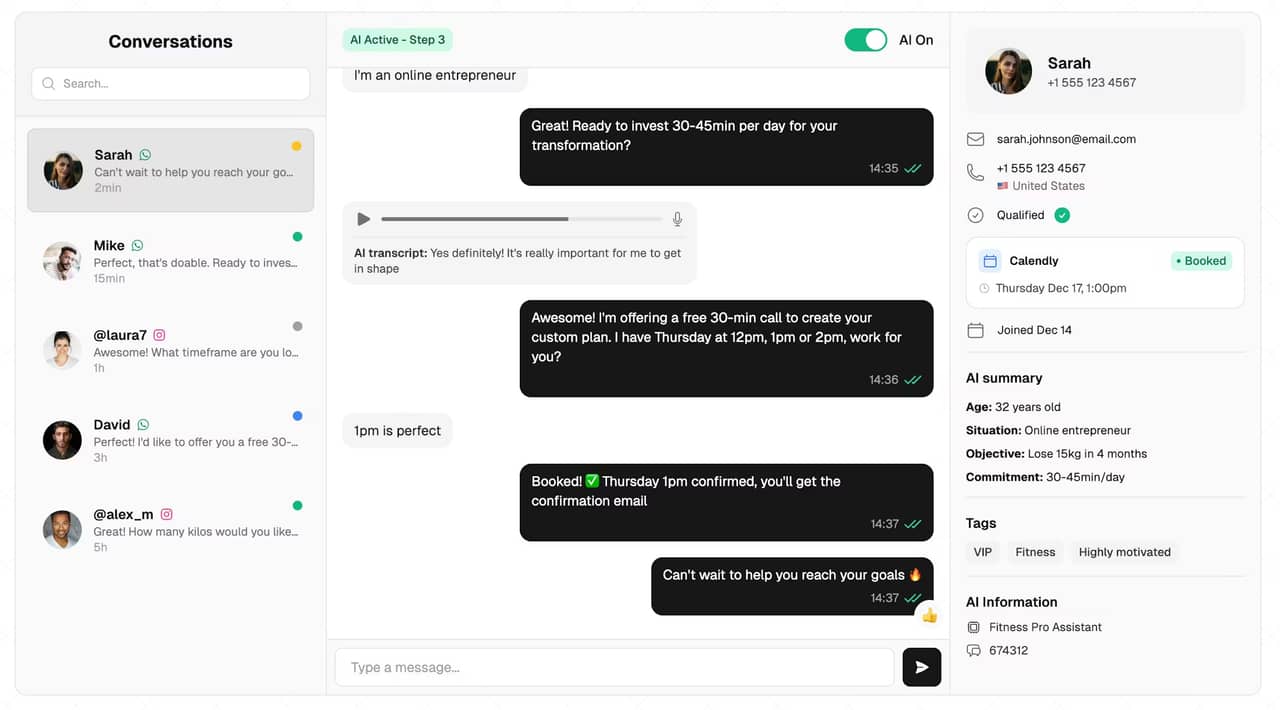
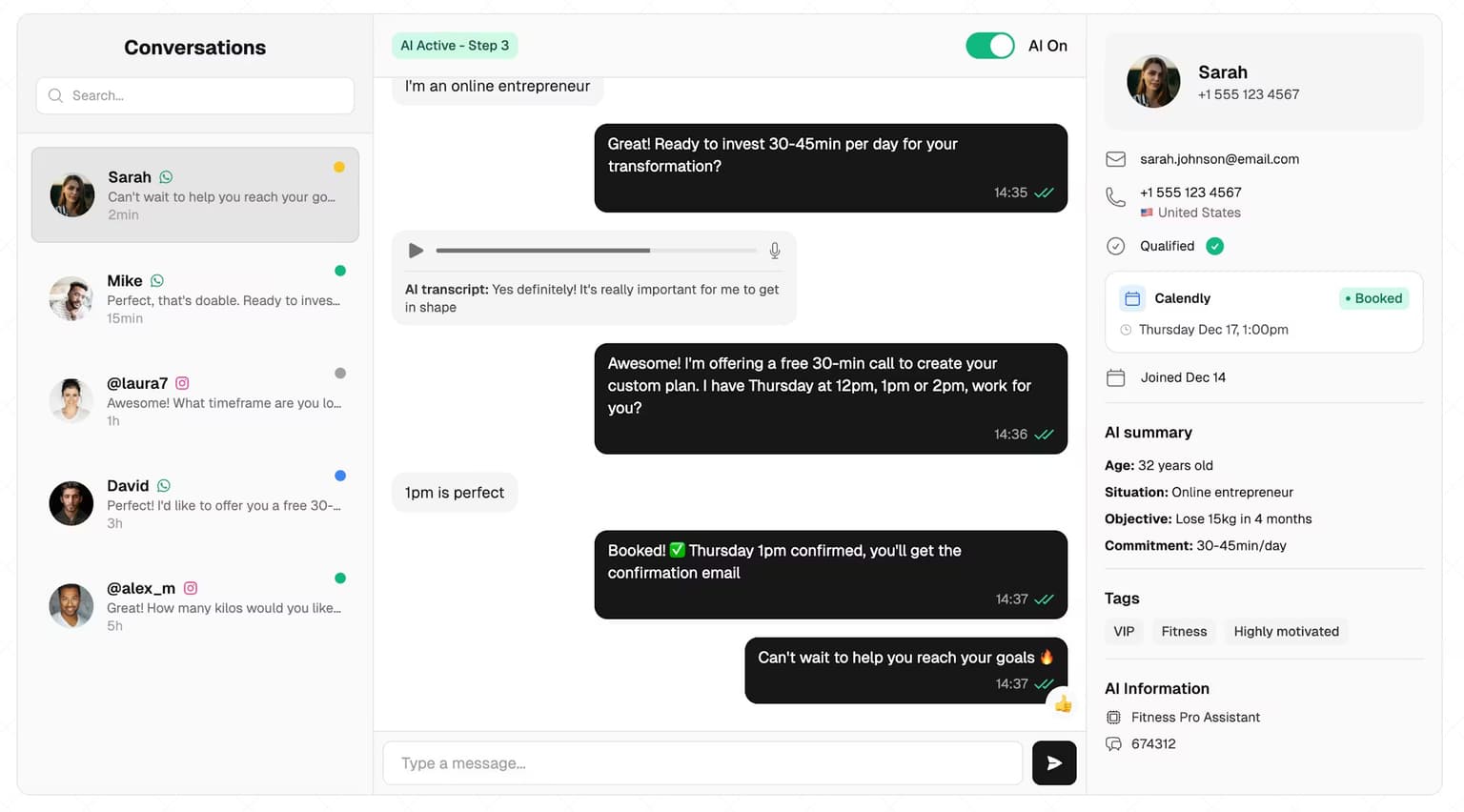
For the AI setter category specifically — SetSmart connects to Instagram Direct via the official Meta Messenger API, picks up the 1:1 replies that come from a channel CTA, qualifies them in DM, and books the qualified ones to your calendar. Free 7-day trial, then $97/month for the Pro plan (1,000 messages included).
3 paste-ready broadcast channel templates
Don't post without an ask. These three templates cover the most common channel-to-DM funnel moves we see work across coaches, course creators, and ecommerce brands.
Template 1 — The "reply with X" lead magnet (Friday CTA)
Quick one — I just put together a 5-minute walkthrough of specific outcome the audience cares about.
If you want me to send it over, reply to this message with the word READY and I'll DM you the link. I'll close replies on Sunday.
Why it works: single trigger word, time-bound, replies hit your 1:1 DM (private) and not the public channel.
Template 2 — The 2-option poll (Wednesday)
Honest question for the channel — what's getting in the way right now?
🅰️ Not enough qualified leads in DMs 🅱️ Plenty of leads but they ghost before booking
Pick one — I'm going to share the playbook for whichever wins by Friday.
Why it works: segments the audience for free, and the winning option becomes a Friday content post with a built-in CTA into the same DM funnel.
Template 3 — The launch announcement (one-shot)
Doors are open: Offer Name is live until Date.
Subscribers get bonus that's exclusive to channel. Tap the link to grab a spot.
👉 Sales page URL
Replies here go straight to my DMs — if you've got a question before you join, send it through.
Why it works: rewards subscribers with a real exclusive (don't fake this — people notice), keeps the reply channel open for objection-handling.
When NOT to use an Instagram broadcast channel
A broadcast channel is the wrong surface if any of these apply:
- You post less than once a week. Subscribers mute, then notifications get throttled. A dormant channel is worse than no channel.
- Your audience is mostly off-Instagram. A coach whose leads come from LinkedIn and email won't get ROI from building an Instagram-only owned list.
- You need 2-way community. Broadcast channels are one-way by design. For peer-to-peer, use a Community Channel or a DM group chat.
- Your offer is regulated (gambling, alcohol, supplements, financial advice). Meta's community guidelines are stricter on channels because every post is treated as a 1-to-many broadcast.
- You don't have a DM funnel set up downstream. If subscribers reply with "READY" and you can't answer them within 24 hours, the channel actively hurts you. Set up the DM bot or AI setter first, then launch the channel.
7-day broadcast channel launch plan
If you're starting from zero, here's the cleanest week we've seen work:
Day 1 — Setup
- Switch to Professional account (if you haven't)
- Create the channel, pick a topic-led name
- Set visibility to "Visible to followers"
- Pin a welcome message with a "reply with X" line at the bottom
Day 2 — Promote (light)
- Add the channel join link as the top entry in your bio
- Create a Story highlight titled "Join the Channel"
- Post one Reel that mentions the channel near the end
Day 3-4 — First content posts
- One value post (no ask)
- One poll (2-option, segments audience)
- Reply personally to every reaction and reply (build the muscle for when volume scales)
Day 5 — First soft CTA
- Friday "reply with X" post for a free resource
- Triage replies into your DM workflow (manual is fine at this volume)
- Route 2-3 qualified replies to a 15-min call
Day 6 — Cross-promotion
- DM ~5 peer creators about a future collaborator slot in the channel
- Pin your best-performing post so new subscribers see it immediately
Day 7 — Measure and tune
- Open rate per post (Instagram Insights shows this)
- Subscriber count delta vs. Day 1
- Number of qualified DM leads sourced from channel replies
- Mute rate (Insights doesn't show this directly; eyeball it from "new subs" minus "lost subs")
- Decide cadence for week 2 based on the open-rate vs. mute-rate trade-off
Common mistakes that kill a broadcast channel
Five patterns we see in channels that flatline:
1. Posting daily without a payoff
Subscribers tolerate frequency only if every 3rd post pays them back (poll, exclusive resource, soft CTA they actually want). Daily value posts without rhythm burn the audience.
2. Treating the channel as a Stories feed
If your channel posts are the same content as your Stories, subscribers churn — there's no exclusivity. Channel content needs to feel different: longer-form text, behind-the-scenes voice notes, audience-only polls, early access to launches.
3. Ignoring the 1:1 DM replies
Every channel post that ends with "reply with X" generates inbound 1:1 DMs. If you don't handle them within 24 hours, subscribers stop replying. From there the channel becomes a one-way speaker and the funnel breaks. At minimum, set up an Instagram auto reply so every reply gets an instant acknowledgment, and pair the channel with a DM-first qualification flow before scaling subs.
4. Promoting only at launch
Channels do not grow themselves. Two-thirds of the new subscribers in any given month come from active promotion (Stories, Reels, link-in-bio, ads). The "Visible to followers" toggle helps but doesn't substitute for promoting.
5. Naming the channel after yourself
"Sarah's Channel" vs. "Sarah's Launch Lab" — same person, different perceived value. A topic-led name keeps the channel from feeling like a vanity feed and tells new subscribers what they're getting.
Instagram broadcast channel vs WhatsApp broadcast
The most common question we hear from coaches and D2C brands running both channels: which surface should I broadcast on? Short answer — they solve different problems.
| Dimension | Instagram Broadcast Channel | WhatsApp Broadcast |
|---|---|---|
| Contact cap | None — scale to millions of subs | 256 per broadcast list (Business app) |
| Cost | Free, no per-message fee | $0.005-0.05/conversation (BSP) once you scale past the free app |
| Templates | No template approval — post anything | Meta-approved templates required for marketing |
| Audience source | Your Instagram followers | Phone-number opt-in (your most committed audience) |
| Reply handling | Goes to your 1:1 DM | Goes to your 1:1 WhatsApp chat |
| Best for | Top-of-funnel + warm audience nurture | High-intent re-engagement, abandoned cart, post-purchase |
The cleanest stack we see in 2026: Instagram broadcast channel for top-of-funnel and content nurture, then push your highest-intent subscribers into a WhatsApp broadcast list (or a 1:1 WhatsApp automation flow) for the higher-conversion late-funnel work. Use both, not one or the other.
How SetSmart connects to Instagram broadcast channels
SetSmart doesn't post to your broadcast channel directly — the Instagram Graph API doesn't expose channel posting yet. What SetSmart does is handle the inbound 1:1 DMs that come from your channel CTAs.
A subscriber sees your Friday "reply with READY" broadcast, replies, and the reply lands as a 1:1 DM in your Instagram inbox. SetSmart picks up the DM via the Messenger API, qualifies the lead with your business criteria, books a call if they're a fit, and routes the ones that aren't into a nurture sequence.
The two pieces that pair best:
- Comment-to-DM: turn channel-related Reel comments into channel-join DMs (covered in our comment-to-DM automation guide).
- Channel reply → 1:1 DM triage: every broadcast channel "reply with X" lands as a normal Instagram DM that SetSmart handles like any other inbound. No extra setup beyond connecting the Instagram account.
Pricing: Free 7-day trial, then $97/month for the Pro plan (1,000 messages, all channels, qualification + booking + nurture). No multi-tier plan — same price for a 5K-follower coach and a 500K-follower brand.
Other options live alongside SetSmart in our best Instagram automation tools roundup if you want to compare. The thing that matters more than the tool choice is having a downstream funnel before you launch the channel — broadcast channels punish accounts that broadcast without a reply system.
FAQ
How do I create an Instagram broadcast channel in 2026?
Switch to a Professional account (Creator or Business), open Instagram Direct, tap the pencil-and-plus icon, choose "Create broadcast channel", pick a topic-led name (max 32 chars), set visibility to "Visible to followers", and write a pinned welcome message that includes a "reply with X" CTA. Total time: ~4 minutes.
Who can create an Instagram broadcast channel?
As of 2026, all Professional accounts (Creator or Business) in supported regions, regardless of follower count. The original 10K-follower minimum from 2023 has been removed in most markets. If you don't see the option, you're either on a Personal account, in a region with a staged rollout, or running an outdated app version.
How do you join an Instagram broadcast channel?
If the creator has set the channel to "Visible to followers", a join CTA appears on their profile near the bio — tap it and confirm. Otherwise the creator shares an invite link (Story sticker, link in bio, or DM). You don't need to follow the account to join, though most channels are followers-only by default.
What's the difference between an Instagram broadcast channel and a community channel?
A broadcast channel is one-way: only the owner (and invited collaborators) can post. A community channel is peer-to-peer: anyone in the channel can post. Broadcast channels are best for creators and brands broadcasting to a list. Community channels are best for shared-interest discussion groups.
Can collaborators post in my broadcast channel?
Yes — you can invite up to 2 collaborators at a time to post in your channel. Their posts show with their handle attached. Useful for podcast co-hosts, brand collabs, and agency partnerships.
Why isn't Instagram broadcast channel available to me yet?
Three most likely reasons: (1) you're on a Personal account — switch to Creator or Business; (2) you're in a region with a staged rollout (a handful of EU markets still); (3) your Instagram app version is stale — force-close and reopen.
Can I send DMs from a broadcast channel?
You can't send a 1:1 DM from a broadcast channel to a subscriber. But when a subscriber replies to a broadcast post, that reply lands as a 1:1 DM in your inbox — and from there you can have a normal back-and-forth conversation. That asymmetry (broadcast out, 1:1 replies in) is the whole funnel logic.
How many people can subscribe to an Instagram broadcast channel?
No documented cap. Verified Meta channels for major creators have crossed a million subscribers. The bottleneck is your ability to drive subscriber sign-ups from your existing surfaces (bio, Stories, Reels, ads), not Meta's infrastructure.
Ready to automate your DMs?
Start your free 7-day trial and let AI handle your lead qualification 24/7.
Try SetSmart free