How to Get Cited by ChatGPT: AI SEO Guide (2026)

Your next client might never see your website in a list of ten blue links. They will type "best online fitness coach for busy moms" or "best DM automation tool for agencies" into ChatGPT, read one paragraph, and contact whoever the AI named. If that is not you, the conversation is over before it started.
This shift has a name: AI search, and optimizing for it is often called generative engine optimization (GEO) or simply AI SEO. The good news is that the playbook is learnable, it overlaps heavily with classic SEO, and almost nobody in the coaching and creator space is doing it seriously yet. This guide covers how ChatGPT, Perplexity, and Google's AI Overviews decide who to cite, the seven moves that get you named, and what to do with the traffic once it arrives.
What "getting cited by ChatGPT" actually means
Direct answer: getting cited means an AI assistant names your brand, links your site, or recommends you when someone asks a question in your niche. It happens two ways: the model already "knows" you from its training data, or (far more often for small brands) the assistant searches the web in real time and pulls you from the pages it retrieves.
That second path is the one you can influence this quarter. ChatGPT with search, Perplexity, and Google AI Overviews all fetch live pages, then compose an answer from the handful of sources they trust. Show up in that handful consistently and you get cited. Miss it and you are invisible, no matter how good your Instagram content is.
There is one more nuance that most guides skip: being cited is not the same as being recommended. An AI can quote your blog post about morning routines and still recommend your competitor as "the best coach for busy professionals." Engines recommend brands they see corroborated across several independent sources: review platforms, listicles, podcasts, directories. One great website is a citation. Ten sources agreeing is a recommendation.
Why this matters for coaches, creators, and agencies
Direct answer: AI search sends fewer visitors than Google, but they arrive pre-sold. Someone who clicks through from a ChatGPT answer has already read a synthesized comparison and chosen you. Across tools that track it, AI-referred visitors consistently convert several times better than average organic traffic.
For a coach or agency, that changes the math. You do not need 10,000 visits a month from AI assistants. You need the 30 people a month who asked "who should I hire for X" and got your name. Those people do not browse. They DM you, fill your form, or book straight away, which is exactly the kind of warm inbound a good booking and qualification system is built to catch.
The 7 moves that get you cited by AI
1. Answer real questions, directly
AI assistants are answer engines. They favor pages that ask the question the user asked and answer it in the first sentence, not after 400 words of throat-clearing. Structure your content the way this article is structured: question-style headings, a direct answer up front, detail after.
Make a list of the 30 questions your ideal client actually asks (the same ones they ask in your DMs) and publish a clear, honest answer to each one.
2. Publish consistently, because coverage wins
One brilliant post does not make you citable. Engines cite domains that cover a topic thoroughly and stay fresh. That means publishing on a schedule, week after week, which is precisely where most coaches and small teams give up: writing is the highest-effort channel in the coaching marketing stack.
This part is now automatable. Syted is an AI SEO agent that researches your niche and publishes one article per day to your blog, written to earn both Google rankings and AI citations. It is the same logic as DM automation: the channel works, the bottleneck is the daily grind, so you delegate the grind and keep the strategy.
3. Get corroborated on third-party sources
This is the highest-leverage move on the list and the least understood. AI engines cross-reference. Before recommending you, they look for agreement across independent sources:
- Review platforms: Trustpilot, G2, Google reviews. Ask happy clients to post there, not just in your DMs.
- Listicles: "best your niche coaches" roundups get cited constantly. Pitch the authors of the ones that already rank.
- Podcasts and interviews: every episode page is another source that describes who you are and what you do.
- Directories and communities: niche directories, Reddit threads, industry associations.
If ChatGPT can only find your own website saying you are great, it stays neutral. If five unrelated sources say the same thing, it repeats them.
4. Keep your entity consistent
AI models resolve brands as entities. Use the same name, the same one-line descriptor, and the same positioning everywhere: your site, your Instagram bio, your podcast intros, your review profiles. If your website says "executive coach," your bio says "leadership mentor," and a listicle says "productivity consultant," you have split your identity into three weak entities instead of one strong one.
5. Structure your pages for machines
A few technical basics measurably improve how often your pages get pulled into answers:
- FAQ and HowTo schema on your key pages, so engines can lift question-answer pairs cleanly.
- An llms.txt file at your domain root summarizing who you are and what your best pages cover.
- Clean headings and short paragraphs: retrieval systems chunk your page; make each chunk stand alone.
6. Do not block the crawlers
Check your robots.txt. Many sites still block GPTBot, PerplexityBot, or ClaudeBot because a plugin added it by default. Blocking AI crawlers while trying to get cited by AI is the most common self-inflicted wound in this game. Let them in.
7. Track it like a channel
Ask ChatGPT, Perplexity, and Google the questions your clients ask, monthly, and note who gets named. Watch your analytics for referrers like chatgpt.com and perplexity.ai. This tells you which of your pages are getting cited, so you can double down on what works.
Google SEO vs AI SEO: what actually changes
| Classic Google SEO | AI SEO (GEO) | |
|---|---|---|
| Goal | Rank in the top 10 links | Be named in the answer |
| Unit of competition | The page | The brand (entity) |
| Key signal | Backlinks and relevance | Corroboration across sources |
| Traffic volume | Higher | Lower, much warmer |
| Content style | Keyword-targeted pages | Direct answers, deep coverage |
The overlap is the point: everything that gets you cited by AI also helps you rank on Google, and the reverse is mostly true too. You are not choosing between two channels. You are running one content engine with two outputs.
What to do with AI traffic once it lands
Direct answer: treat AI-referred visitors as warm leads, not cold traffic. They arrive having already compared you to alternatives, so the worst thing you can do is make them dig for a way to talk to you.
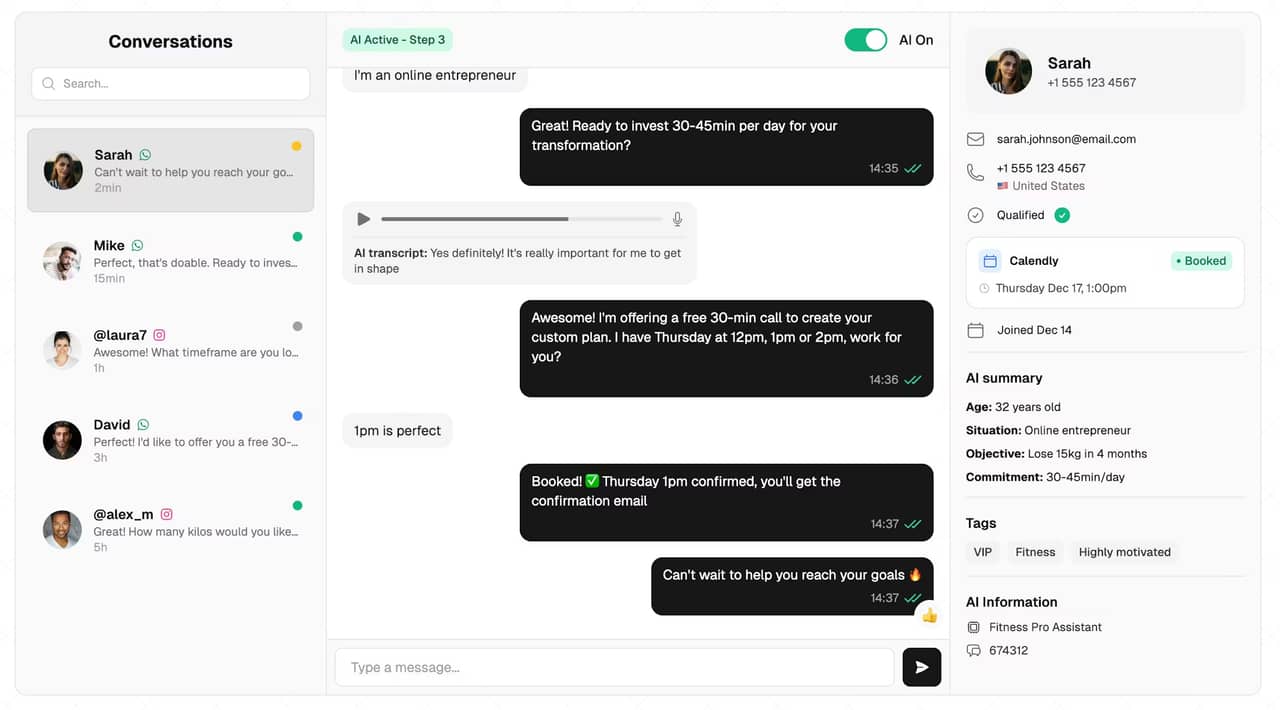
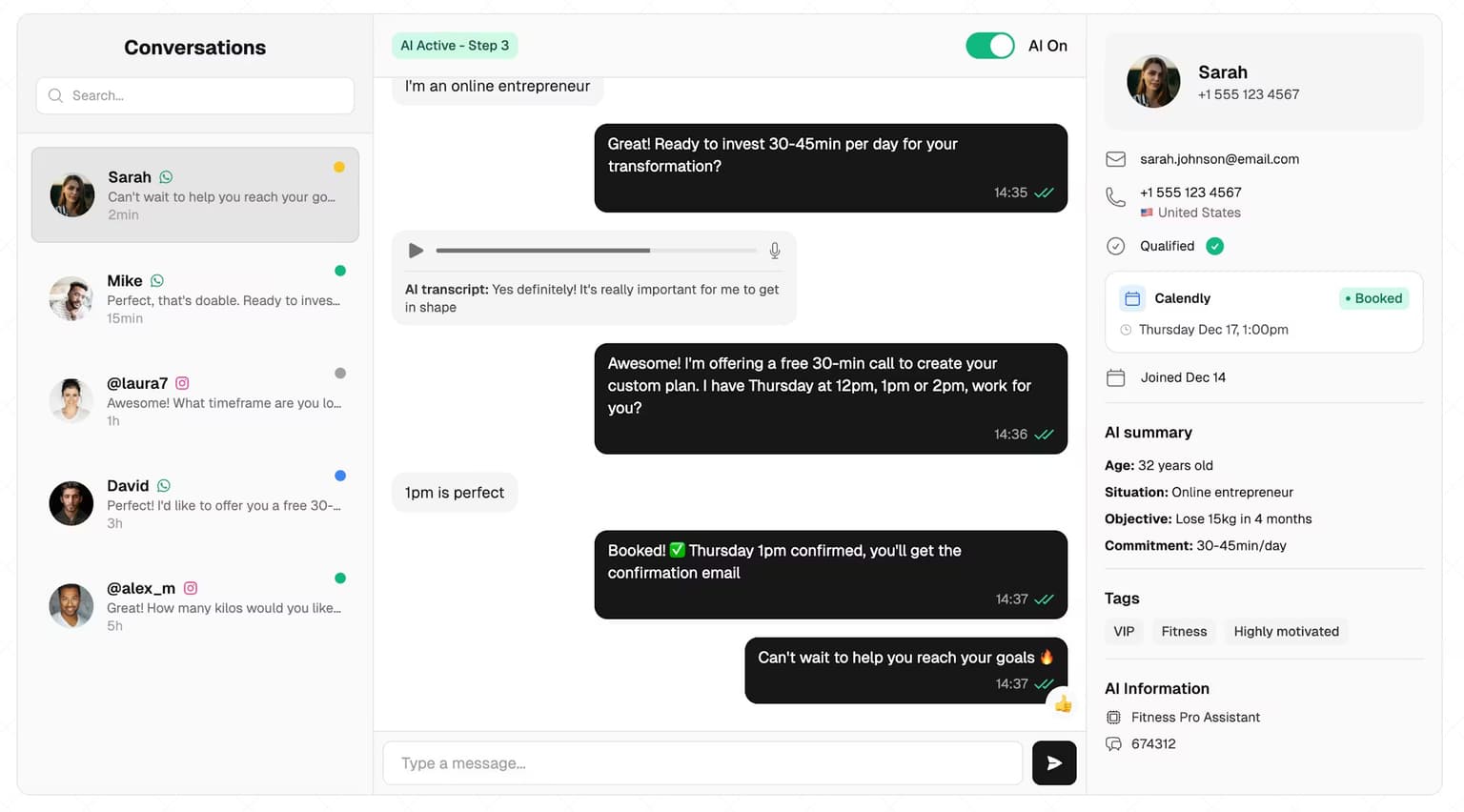
Give every page a clear next step: a booking link, a click-to-WhatsApp button, or a DM prompt. And make sure the conversation that follows is handled fast, because these leads are decision-ready. This is where the two halves of your acquisition connect: content (human-written or automated) gets you discovered by AI, and Instagram DM automation or an AI appointment setter turns the resulting conversations into booked calls while you coach.
FAQ
How do I get my business mentioned by ChatGPT?
Publish direct, question-answering content on your own domain, keep your brand described consistently everywhere, and get corroborated by third-party sources like review platforms, listicles, and podcasts. ChatGPT's web search pulls from pages it retrieves in real time, so you do not need to be in its training data to get named.
What is generative engine optimization (GEO)?
GEO is the practice of optimizing your content and brand presence so AI assistants (ChatGPT, Perplexity, Google AI Overviews) cite or recommend you in their answers. It overlaps heavily with SEO but adds entity consistency, cross-source corroboration, and machine-readable structure.
Does blogging still matter now that people ask ChatGPT?
More than before, but differently. AI assistants compose answers from web pages, and blogs remain the main way a small brand feeds them material. Volume-chasing keyword posts matter less; clear answers, topical depth, and freshness matter more.
How long does it take to get cited by AI assistants?
Faster than classic SEO. Because assistants retrieve live pages, a well-structured answer on an established domain can appear in AI answers within weeks, while building enough corroboration to be recommended by name usually takes a few months of consistent publishing and review-building.
Are there tools that automate AI SEO?
Yes. Rank trackers like Ahrefs now track AI citations, and AI SEO agents like Syted automate the publishing side by researching and posting daily articles built for both Google rankings and AI citations. The corroboration side (reviews, podcasts, listicles) still needs a human touch.
Do ChatGPT and Perplexity actually send traffic?
Yes, and it is growing every quarter. The volume is still small next to Google, but the intent is unusually high: these visitors have already read a comparison and picked you, which is why AI referrals convert so much better than average organic visits.
Ready to automate your DMs?
Start your free 7-day trial and let AI handle your lead qualification 24/7.
Try SetSmart free