AI BDR 2026: How It Works & Where It Breaks

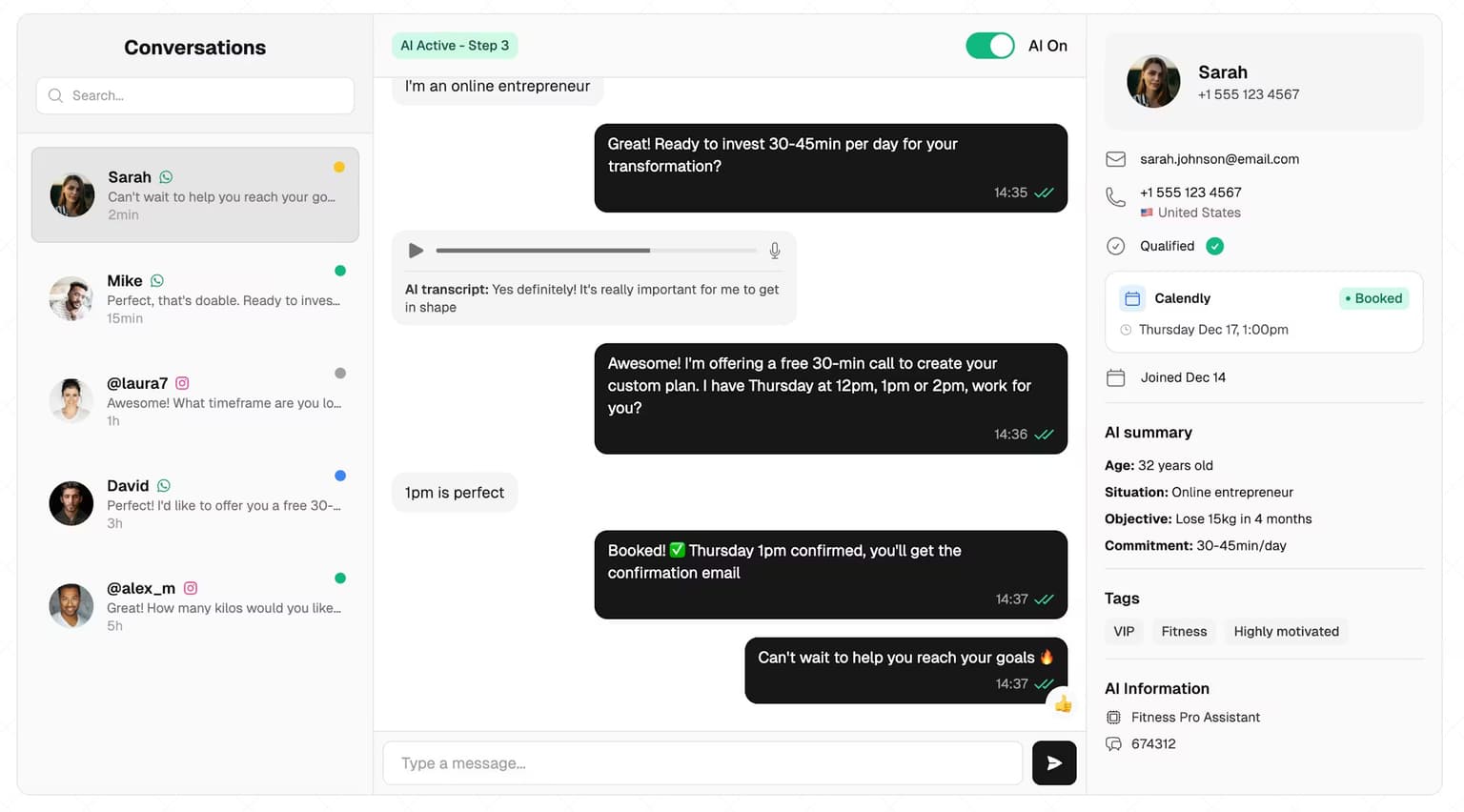
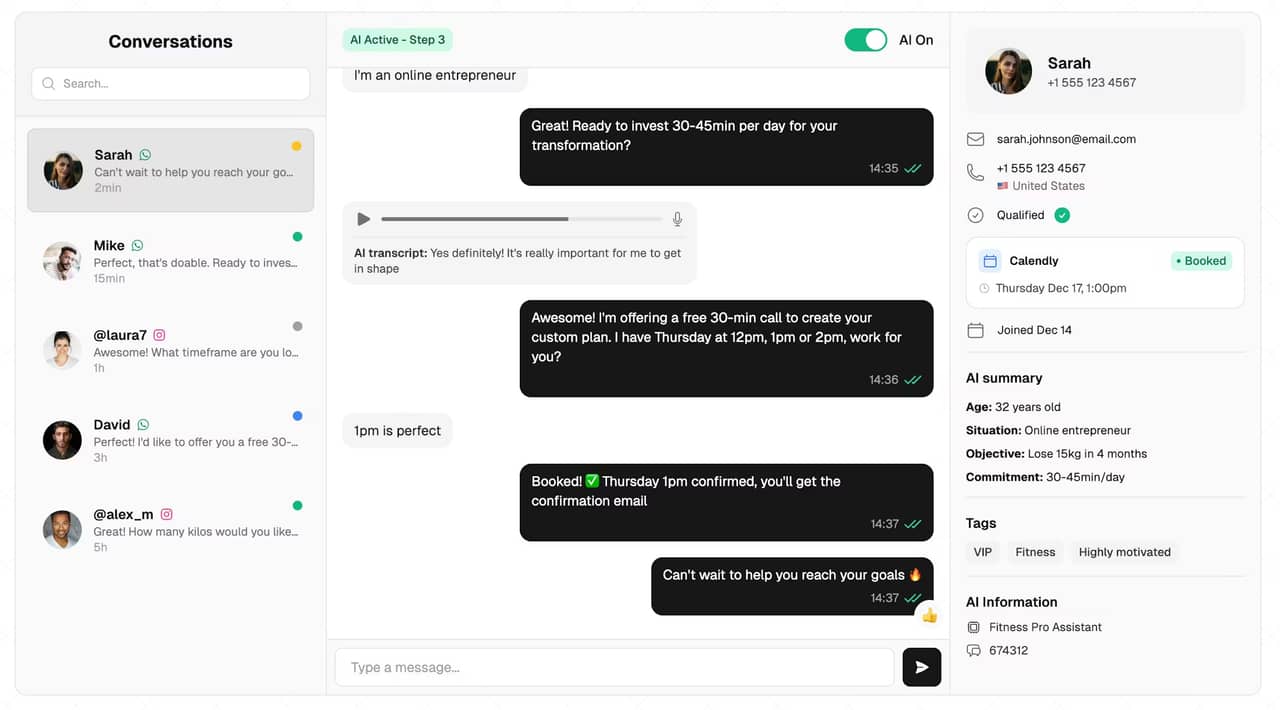
An AI BDR is software that does what a junior business development rep used to do — research accounts, send personalized outreach, qualify replies, follow up, and book meetings — but at a fraction of the cost and 24/7. In 2026, "AI BDR" mostly means email-and-LinkedIn tools (Artisan, AiSDR, Clay, Reply.io). The next frontier — and where most pipeline actually closes for SMB and creator-led businesses — is AI BDRs that work inside Instagram and WhatsApp DMs, where leads already are.
Below: the honest take on what an AI BDR actually is in 2026, what it does well, where it breaks, the real ROI math, the leading tools (with their channel coverage), pricing, and when an AI BDR is — and isn't — the right call.
TL;DR: AI BDR 2026 in 8 questions
| Question | Short answer |
|---|---|
| What does AI BDR mean? | An AI-powered Business Development Rep — software that prospects, opens conversations, qualifies replies, and books meetings without a human in the loop. |
| Is an AI BDR the same as an AI SDR? | Mostly. Most vendors use the terms interchangeably. BDR is more outbound/account-development, SDR more inbound qualification — AI tools usually cover both. |
| What channels do AI BDRs work on? | Today: mostly email + LinkedIn. The fastest-growing category is AI BDRs inside Instagram and WhatsApp DMs (where consumer/creator pipeline lives). |
| Will an AI BDR replace a full-time human BDR? | For prospecting, first-touch outreach and basic qualification — yes, today. For complex objection handling, multi-stakeholder B2B and phone closes — no. |
| How much does an AI BDR cost? | Email AI BDRs run $400-$2,000/mo per "agent". DM-based AI BDRs (Instagram/WhatsApp) run $99-$300/mo. Human BDRs cost $5,000-$8,000/mo all-in. |
| Best AI BDR tool right now? | Depends on channel. Email/LinkedIn: Artisan, AiSDR, Reply.io. Account research: Clay. Instagram/WhatsApp DMs: SetSmart and the AI setter category. |
| How long until ROI? | 2-6 weeks for email AI BDRs (warmup needed). 1-2 weeks for DM AI BDRs (no warmup, conversations start instantly). |
| Where do AI BDRs break? | Cold email deliverability, multi-stakeholder enterprise deals, anything above $25K ACV needing rapport, and free-text objections that go off-script. |
What an AI BDR actually is in 2026
A traditional Business Development Rep does five things: build a list, write outreach, send messages, handle replies, and book meetings on the closer's calendar. Until 2023, doing this at scale required hiring 3-10 humans at $50K-$80K/year each.
An AI BDR is software that absorbs those five tasks into a single autonomous agent. Modern AI BDRs are not chatbots and not flow-builders. They are LLM-driven agents (usually GPT-4-class or Claude-class models) wrapped in:
- A data layer — your ICP definition, account list, CRM enrichment, intent signals.
- A messaging layer — channel-specific outbound (email warmup, LinkedIn, Instagram DM, WhatsApp).
- A reply-handling layer — natural-language responses to objections, follow-ups, qualification questions.
- A scheduling layer — calendar integration to book the meeting once a lead is qualified.
- A reporting layer — pipeline metrics that feed back into your CRM.
The category is no longer "experimental." Salesforce, HubSpot, Outreach and Apollo all shipped agentic AI BDR features in 2025. The interesting differentiation in 2026 is which channel your AI BDR is native to — because the deliverability, latency and qualification dynamics are radically different across email, LinkedIn, Instagram, and WhatsApp.
AI BDR vs AI SDR vs AI sales rep: what's the difference?
These terms are used interchangeably by most vendors, but technically:
| Role | Primary job | Direction | AI version |
|---|---|---|---|
| BDR | Business development — open new accounts, top-of-funnel | Outbound | Artisan Ava, AiSDR, Reply.io, Clay agents |
| SDR | Sales development — qualify leads (inbound + outbound) | Both | Same vendors mostly — they brand it as "AI SDR" |
| AE / closer | Run discovery, demo, close the deal | Inbound (qualified) | Not yet — humans still close |
| DM setter | Qualify and book leads from social DMs | Inbound (DMs) | AI DM setters like SetSmart |
For SMB, creator-led, and consumer-facing businesses, the most useful framing is: an AI BDR is whatever AI software opens conversations and qualifies leads on the channel where your buyers actually hang out. For a B2B SaaS selling to CFOs, that channel is email. For a high-ticket coach selling to fitness pros, it's Instagram DMs. For a mortgage broker selling to homeowners, it's WhatsApp. The job is the same — the channel changes the tool.
For a deeper definitional take that treats this as a sales-process question rather than a tooling question, our what is an AI sales assistant breakdown covers the broader landscape including AI SDRs, AI closers and revenue-AI platforms.
What an AI BDR can actually do (today)
A modern AI BDR — across whatever channel — is genuinely good at five things.
1. Account research at scale
Pulling firmographics, recent triggers (funding, hiring, news), tech stack, and decision-maker info for 10,000 accounts in an afternoon. Tools like Clay, Apollo and AiSDR plug directly into 50+ enrichment sources. Humans cannot do this at this scale.
2. First-touch outreach personalization
Writing 1,000 personalized opening messages that reference the prospect's company, role, recent post, or trigger. The 2024 generation of AI BDRs sounded robotic. The 2026 generation, when prompted with concrete style examples, passes the "is this AI?" test on first read for 60-70% of recipients.
3. Multi-touch follow-up sequences
This is where AI BDRs shine. From our analysis of 828K conversations, conversations that include even one follow-up qualify at +112% vs no follow-up — and AI never forgets, never gets discouraged, and never decides a lead is "cold" too early.
4. Reply qualification
Reading the reply, classifying it (interested / not now / not me / unsubscribe / objection), responding in-thread, and routing to a human only when criteria are met. This is the operationally hardest part for humans because it's where 80% of BDR time goes — and it's where AI offloads the most labor.
5. Calendar booking
Once a lead crosses the qualification bar, the AI BDR proposes 2-3 slots, confirms timezone, sends a calendar invite, and updates the CRM. No back-and-forth. No "let me check with the AE."
For a tactical breakdown of how AI agents handle steps 4 and 5 specifically — qualification logic, BANT-style frameworks, channel-specific patterns — see our AI lead qualification playbook and our overview of lead qualification tools.
What an AI BDR cannot do (yet)
Vendors will tell you their AI BDR is autonomous. The honest answer is it's autonomous for a specific surface, and there are five places it still breaks.
1. Cold email deliverability
The bottleneck for email AI BDRs in 2026 is not message quality — it's inbox placement. Gmail's 2024 sender requirements (DMARC, list-unsubscribe) plus Microsoft 365's 2025 cold-outreach throttling have made cold email harder than at any point since 2018. AI BDRs that promise "send 10,000 emails per day per agent" are usually getting 30-50% of those into spam. The deliverability layer is now harder than the messaging layer.
2. Multi-stakeholder enterprise deals
When you're selling a $100K contract to a buying committee of 6 people across legal, IT, security, and procurement, the AI BDR can open the door — but it cannot navigate political dynamics, run a custom proof-of-concept, or build executive sponsorship. Humans still do this, and arguably always will.
3. Free-text objections that go off-script
A lead replies "we tried something similar in 2022 and it didn't work because of X — convince me you're different." A good human BDR pulls a case study, names a specific competitor failure mode, and brings the AE in. AI BDRs typically respond with generic value-prop copy, which kills the deal.
4. Phone closes
Voice AI is improving fast (ElevenLabs, Vapi, Hume), but for any deal that requires a 30-minute discovery call, AI is still the warm-up — not the closer. The lift in qualification rate from a single follow-up is well documented (+106% on booked calls in our DM dataset), but the close still needs human voice for anything above mid-market ACV.
5. Brand voice on social DMs (when prompted naively)
Specifically for Instagram and WhatsApp DM AI BDRs: a generic LLM with a one-line system prompt sounds nothing like the creator. The leading tools in this category solve it by ingesting 100+ historical DMs as style examples — without that, the AI BDR breaks the brand voice and looks like a stranger ran your inbox.
Channel coverage: where AI BDRs work (and where the new pipeline is)
This is the most under-discussed dimension of the AI BDR market in 2026.
| Channel | AI BDR maturity | Typical reply rate | Time to first reply |
|---|---|---|---|
| Cold email | Mature (Artisan, AiSDR, Reply.io, Outreach) | 1-3% | 1-3 days |
| LinkedIn outbound | Mature (HeyReach, La Growth Machine, AiSDR) | 5-15% | 1-7 days |
| Instagram DMs (inbound) | Fast-growing (SetSmart, ManyChat-with-AI) | 25-40% | <1 minute |
| WhatsApp (inbound + outbound) | Fast-growing (SetSmart, 360dialog, Twilio) | 30-50% | <1 minute |
| SMS | Mature for support, niche for outbound | 10-25% | 5-30 minutes |
| Voice / cold calls | Early (Vapi, Hume, ElevenLabs Voices) | Variable | Real-time |
The headline: DM-based AI BDRs return replies 8-15× faster than email AI BDRs and at 10-30× the response rate. The reason is structural — email is a triage medium, DMs are a real-time medium. A creator who runs Instagram ads and gets 500 leads a month into DMs cannot use Artisan or AiSDR; those tools were never built for that surface. They can use an AI DM setter — which is functionally an AI BDR for social DMs.
The 6 AI BDR tools to know in 2026 (by channel)
Below is the honest, channel-segmented map of who does what well. Pricing is approximate (verify with each vendor) and feature sets evolve fast.
Email + LinkedIn category
Artisan (Ava)
Founded 2024, San Francisco. Targets B2B SaaS sales teams. Ava is positioned as a fully autonomous BDR — she finds leads, sends personalized email, handles replies, and books meetings. Strengths: end-to-end autonomy on email, good reply handling, slick UX. Weaknesses: deliverability is on you to manage, pricing starts around $1,500/mo per "agent" which is steep for early-stage teams.
AiSDR
Email-and-LinkedIn focused, B2B SaaS niche. Heavy emphasis on personalization at scale and 24/7 reply handling. Strengths: mature LinkedIn integration, multi-language support. Weaknesses: like all email AI BDRs, output quality is bottlenecked by the data you feed it — garbage list in, garbage outreach out.
Reply.io
Long-time player in sales engagement. Added AI BDR features in 2024-2025. Strengths: strong sequence editor, granular control, well-documented APIs. Weaknesses: less "agentic" and more "AI-augmented sequences" — the human still owns the strategy.
Clay
Not a "BDR" per se, but the data backbone for many AI BDRs. Pulls firmographics, intent signals, and trigger events from 100+ sources. Strengths: best-in-class enrichment. Weaknesses: requires a sales engineer or RevOps person to operate well — not plug-and-play.
Instagram + WhatsApp DM category
SetSmart
Native AI BDR for Instagram and WhatsApp DMs. Replaces both ManyChat-style flow builders and human DM setters. Built for creators, coaches, agencies, and consumer brands running paid social into DM funnels. Strengths: <5 second reply latency, real qualification (not flow trees), comment-to-DM automation, full conversation memory across sessions, brand voice training from past DMs. Weaknesses: not a fit for B2B email outbound — focused entirely on DM channels. Pricing: Free 7-day trial, then $97/month flat (1,000 messages included), with no per-seat or per-contact billing.
ManyChat (with AI Steps)
ManyChat in 2026 is still primarily a flow-builder, but its AI Steps feature lets you bolt LLM-powered nodes into a flow. Strengths: massive template library, low entry price ($15/mo). Weaknesses: AI is bolted on top of flow logic, which means the AI BDR experience is brittle once leads go off-script. For a deeper comparison, see our ManyChat alternative breakdown.
For broader DM automation context (not just AI BDRs but the full landscape of DM tooling), our Instagram automation tools and WhatsApp automation guides cover the supporting cast.
AI BDR vs human BDR: the honest ROI math
A useful exercise. Let's compare the unit economics on a typical SaaS or creator-led business doing 100 booked calls per month.
| Metric | Human BDR | AI BDR (email) | AI BDR (DM) |
|---|---|---|---|
| Monthly cost | $5,000-$8,000 | $400-$2,000 | $99-$300 |
| Working hours | 40/week | 168/week | 168/week |
| Avg response time | 2-12 hours | 1-6 hours | <5 seconds |
| Ramp time | 8-12 weeks | 2-6 weeks (warmup) | 3-7 days |
| Turnover risk | High — avg tenure 14 months | None | None |
| Best at | Complex objections, phone, exec outreach | High-volume cold email, account research | Inbound DMs, real-time qualification, follow-ups |
| Worst at | Volume, consistency, follow-up | Deliverability, multi-stakeholder deals | Cold outbound to email/phone |
The non-obvious takeaway: most teams don't replace humans with AI BDRs — they layer them. AI does volume, speed, and follow-up. Humans do nuance, complex objections, and closing. The cost-per-booked-call drops 60-90%, and humans get to focus on the 20% of the funnel where they actually add value.
For the specific dynamics of how response speed compounds in revenue, see our lead response time statistics — the spread between a 5-minute response and the industry-average 42-hour response is roughly 21x in qualification rate.
How much does an AI BDR actually cost?
A real-world pricing map (verify directly — vendors change pricing quarterly):
| Tool | Channel focus | Entry price | Free trial? |
|---|---|---|---|
| Artisan (Ava) | Email + LinkedIn | ~$1,500/mo per agent | Demo only |
| AiSDR | Email + LinkedIn | From $750/mo | Demo only |
| Reply.io | Email + LinkedIn | From $59/mo (basic), AI features higher | 14-day trial |
| Clay | Data + enrichment | From $149/mo | Free starter tier |
| SetSmart | Instagram + WhatsApp DMs | $97/mo flat (1,000 messages) | Free 7-day trial |
| ManyChat + AI Steps | Instagram + Messenger | From $15/mo (no AI), AI adds usage cost | Free plan (25 contacts) |
A note on pricing math: email AI BDRs almost always charge per "seat" or "agent" because they're priced against the human BDR they replace ($5K-$8K/mo). DM AI BDRs almost always charge per message volume because they're built for inbound channels where the cost is conversation-load, not seat-count. Both models are honest — they reflect the underlying economics of each channel.
When an AI BDR is the right call
Five concrete signals that you're a fit for an AI BDR — today, not "in 5 years."
- You have a defined ICP, even loosely. AI BDRs without a target list become spam machines.
- Your sales motion is repeatable. First 3-5 conversations look similar across leads. If every deal is bespoke, AI can't help yet.
- Your average deal size is between $1K and $25K. Below $1K, even cheap AI BDRs hurt margin. Above $25K, you need a human in the door.
- Your team is drowning in follow-up. This is the single biggest tell — AI BDRs are best where humans drop the ball.
- Your channel matches an AI BDR's strength. B2B SaaS → email/LinkedIn AI BDR. Coaches/creators/consumer brands → DM AI BDR.
For coaches and consultants specifically, the playbook usually combines a DM AI BDR for inbound with a human closer for the discovery call. We covered this hybrid model in detail in our how to get coaching clients playbook.
When an AI BDR is the wrong call
Equally important — five signals you should NOT buy an AI BDR yet.
- You're pre-product-market-fit. Your messaging is changing weekly. An AI BDR will scale a message that doesn't work yet.
- You sell strategic enterprise deals. $100K+ contracts, named accounts, custom POCs. AI BDR opens fewer doors than a senior AE on LinkedIn.
- Your CRM is a mess. AI BDRs amplify CRM hygiene problems. Fix the data layer first.
- You don't have content for the AI to use. No case studies, no thought leadership, no social proof. AI can't manufacture authority.
- Your buyers hate automation. Some niches (legal, healthcare, government) penalize anything that smells AI-generated. Run a 2-week pilot before committing.
Real teams running AI BDRs (testimonials)
"Before SetSmart we had a VA replying to Instagram DMs from 9am to 6pm. Leads coming in at midnight got nothing until morning, and half were gone by then. The AI BDR replies in under 5 seconds, qualifies, and books — we doubled booked calls in the first month without hiring." — Théo Riffault, fitness coach
"We tried Artisan for cold email and it was great for B2B SaaS prospecting. For our Instagram side hustle (creator agency) we needed something completely different. SetSmart handles the DMs, Artisan handles the email — same role, two completely different tools." — Mathis Ladoué, agency founder
"I was skeptical of AI BDRs until I tracked the data. We compared 60 days of human BDR (one full-timer) vs 60 days of AI on the same lead source. The AI booked 28% more calls, replied 7x faster, and cost a fifth. The human got moved to closing — that's the right team structure for us now." — Edouard Clerc, B2B SaaS founder
The 5 questions to ask before signing an AI BDR contract
Most AI BDR pitches sound the same. These questions cut through the marketing.
1. What channels do you natively support — and what's your reply latency on each?
If they say "we work on every channel," that's a flag. Best-in-class AI BDRs are channel-specialists. Reply latency on email is fundamentally different from reply latency on DMs.
2. Do you handle the deliverability layer or do I?
For email AI BDRs this is the make-or-break question. "We handle warmup" is a complete answer. "You'll need to set up DMARC and SPF" is your problem to inherit.
3. How do you train brand voice?
The good answer: "We ingest 100+ of your past messages." The mediocre answer: "We use a system prompt." The bad answer: "Our default voice is great." Walk away from the third.
4. Show me the conversation logs.
Any AI BDR vendor that won't show you raw conversation transcripts from a real customer is hiding something. Quality AI BDRs are obsessed with surfacing exactly what their AI sent.
5. What's the escape ramp?
What happens when you cancel? Do you keep the conversation history? Can you export the lead list, the qualification logs, the sequence templates? AI BDR contracts often lock data in — verify before signing.
What an AI BDR is NOT
To close the definition loop — three things AI BDR vendors will sometimes claim that you should ignore.
- Not a CRM. An AI BDR feeds your CRM, but it doesn't replace HubSpot, Salesforce or Pipedrive — and it isn't a substitute for CRM sales automation either. The CRM remains the system of record for pipeline.
- Not a closer. An AI BDR books the discovery call. A human (or, increasingly, a hybrid AI sales assistant) runs it.
- Not a content team. AI BDRs need raw material to personalize from — case studies, ICP research, sales collateral. They don't manufacture authority from zero.
For a broader take on where AI fits in the modern sales stack — from prospecting to enablement to forecasting — see our generative AI for sales overview.
FAQ
What does AI BDR mean?
AI BDR stands for AI Business Development Representative — software that performs the prospecting, outreach, qualification, and meeting-booking tasks that a junior BDR used to handle. In 2026 most AI BDR tools are built around large language models (GPT-4, Claude) wrapped in a data, messaging, and scheduling layer.
Can an AI BDR fully replace a human BDR?
For first-touch outreach, follow-ups, and basic qualification on a defined ICP — yes, today. For complex multi-stakeholder enterprise deals, phone closes, and high-touch executive outreach — no. Most teams in 2026 layer the two: AI handles volume and speed, humans handle nuance and closing.
What's the difference between AI BDR and AI SDR?
In practice, none — most vendors brand the same product as both depending on the buyer's vocabulary. Technically, BDRs focus on outbound and account development while SDRs focus on inbound qualification. AI tools today usually cover both directions.
What's the most affordable AI BDR for startups?
For email/LinkedIn outbound: Reply.io's lowest tier ($59/mo) gets you started, though full AI features cost more. For Instagram and WhatsApp DM-based AI BDR work, SetSmart at $97/month flat (after the free 7-day trial) is one of the lowest-cost options that includes real LLM-powered qualification rather than a flow builder.
How long until an AI BDR shows ROI?
For email AI BDRs: 2-6 weeks. The bottleneck is mailbox warmup — you cannot send cold volume on day one without burning your domain. For DM AI BDRs: 1-2 weeks. There's no warmup; you connect the channel, train brand voice, and the AI handles incoming conversations from day one. Single follow-ups alone lift booked calls by +106% on conversational channels, so most teams see ROI inside the first month.
Will AI BDRs make human BDRs obsolete?
In the near term, no — they'll redistribute the work. Humans will move up to handle the 20% of qualification work where AI breaks (off-script objections, multi-stakeholder politics, complex pricing) while AI absorbs the 80% that's repetitive (account research, first-touch, standard follow-ups). Long term, the BDR job description will look different than it does today, but it won't disappear.
What features define the top AI BDR platforms in 2026?
Three things separate leaders from also-rans: (1) channel-native architecture rather than bolt-on AI, (2) reply handling that doesn't fall apart on free-text objections, and (3) brand-voice training from real historical conversations rather than a one-line system prompt. Tools that score well on all three across email, LinkedIn, Instagram or WhatsApp are the safe picks for 2026.
Ready to automate your DMs?
Start your free 7-day trial and let AI handle your lead qualification 24/7.
Try SetSmart free