Legal Chatbot in 2026: 7 Best Tools Ranked

Most "legal chatbot" lists in 2026 still mix two completely different products into one ranking: consumer chatbots that try to answer "is this contract enforceable in California?" (LegalGPT, LawConnect, DoNotPay) and AI tools that draft motions or do legal research (Harvey, Casetext, Spellbook). For a working law firm that needs a chatbot to capture leads after hours and qualify them in under five minutes, neither category fits. The intake chatbot — a tool a personal injury, family, or immigration firm actually deploys on its site, IG DM, and WhatsApp — is the one almost nobody ranks.
This guide does. It compares the 7 legal chatbot options worth shortlisting in 2026 across all the channels potential clients actually use to reach a firm — website widget, Instagram DM, Facebook Messenger, WhatsApp, SMS — with a 6-dimension scoring rubric, three paste-ready intake scripts, a "which one first?" framework by practice area, a 7-day deployment playbook, and a clear distinction between legal intake chatbots, legal research chatbots, and consumer-facing legal AI.
Short version: a chatbot on the firm's homepage still earns its keep at 11pm when a parent in distress is searching "DUI lawyer near me", but in 2026 the lift comes from putting an AI legal chatbot on the DM and WhatsApp channels where personal-injury and family-law inquiries increasingly arrive. The firms winning at intake in 2026 pair one chatbot vendor for the website with one DM-native AI intake setter for everything else.
TL;DR — the 7 best legal chatbots in 2026
| # | Chatbot | Best channel | Best for | Starting price | Our score |
|---|---|---|---|---|---|
| 1 | SetSmart | IG DM + WhatsApp + Messenger | Firms getting inquiries from DMs & click-to-message ads | Free 7-day trial, then $97/month | 9.2 / 10 |
| 2 | Smith.ai | Website chat + receptionist | Solo & small firms wanting chat + human callback | Starting around $293/month | 8.7 / 10 |
| 3 | LawDroid | Website widget + Messenger | Law firms that want a custom-trained intake bot | Custom (quote on site) | 8.5 / 10 |
| 4 | Apex Chat | Website + SMS handoff | PI / mass-tort firms with paid search | Custom (quote on site) | 8.2 / 10 |
| 5 | Ngage Live Chat | Website + live agent escalation | Firms that want 24/7 human-backed chat | Custom (per-lead pricing) | 7.9 / 10 |
| 6 | Gideon Legal | Website widget + CRM | Mid-size firms wanting workflow + bot bundled | Custom (request demo) | 7.6 / 10 |
| 7 | DoNotPay | Web app / direct-to-consumer | Consumers (NOT firms) needing a self-help legal AI | $36 every 2 months | 7.0 / 10 |
If you only have time for one decision: if more than 25% of your inbound inquiries now arrive via DM, Messenger, or WhatsApp, start with an AI DM intake setter like SetSmart; if your inquiries still arrive almost entirely through Google Ads and organic site visits, start with Smith.ai or LawDroid and add a DM layer later.
What a legal chatbot actually does in 2026
A modern legal chatbot for a working firm is rarely a single product. It's the combination of four jobs running across whichever channel a potential client happens to land on:
- Capture — greet a visitor on the firm's website, IG DM, Messenger, WhatsApp, or after clicking a "Free case review" ad, and collect the basic facts before they bounce.
- Qualify — ask the 4-6 questions that separate a billable matter from a tire-kicker (jurisdiction, incident date, statute of limitations, conflict check, basic facts).
- Route & book — propose 1-2 consult slots, or hand the lead off to the intake paralegal, the attorney on duty, or the right practice group based on case type and ZIP.
- Follow up — send a second message a few hours later and a third the next morning if the prospective client goes quiet, then drip every 7-30 days until they reply, sign the retainer, or unsubscribe.
A legal chatbot is not a case management system, not a docketing tool, not a billing platform, and not a legal research engine. It plugs into all of them — but its only job is the first conversation. See our breakdown of what an AI setter actually does for the wider category.
The four flavours of legal chatbot
There's no single "chatbot for legal" anymore. The market in 2026 splits into four shapes — and conflating them is what makes most "best of" lists useless:
- Website intake widgets — the chat bubble at the bottom right of a firm's site (Smith.ai, LawDroid, Apex Chat, Ngage). Best at after-hours capture from Google Ads, LSAs, and organic traffic.
- DM & Messenger intake bots — IG DM, Messenger, WhatsApp (SetSmart, ManyChat, Chatfuel). Best at converting reels viewers, story replies, click-to-WhatsApp ads, and DM-based inquiries — increasingly common for personal injury, family, and immigration firms running social campaigns. Our Instagram chatbot guide covers the category.
- Workflow-embedded chatbots — a chatbot bundled inside a legal CRM or matter management tool (Gideon Legal, Lawmatics intake bot, Captorra). Best at structured intake when the firm is already standardised on that platform.
- Consumer-facing legal AI — direct-to-public products that try to answer legal questions or draft simple documents (DoNotPay, LegalGPT, LawConnect). Different audience entirely; included here only so you can disqualify them from your firm's shortlist.
The first three are what a law firm deploys to capture and qualify leads. The fourth is a product consumers use before they ever consider hiring a firm.
Why most legal chatbots broke in 2026 — and what fixed it
Three things changed in the last 18 months that made the 2024-era legal intake chatbot obsolete:
- Click-to-message ads ate a third of the paid-search budget. Personal injury firms running Meta and Google now route a meaningful share of paid traffic straight into WhatsApp or Messenger — not the website. A chatbot that only lives on the homepage misses that traffic entirely.
- Form-fill conversion rates kept dropping. Mobile form abandonment in legal verticals routinely sits above 80%. People type their question into a chat, not a 9-field intake form.
- GPT-4-class models finally became good enough at empathic intake. A scripted "What is your name? What is your phone number?" bot reads as cold for a client describing a car accident or a custody dispute. AI-driven chatbots can mirror tone, ask follow-up questions in context, and only collect contact details once the person feels heard.
Across our analysis of 828K AI-driven DM conversations, 53% of inbound conversations died before message 3 — usually because the response came hours later, when the prospective client had already called the next firm on the list. Speed is the leak. The chatbots ranked above are the ones that plug it in 2026.
How we scored each legal chatbot
Every chatbot in this guide was evaluated on six dimensions. We weight them based on what actually matters for a working firm trying to grow without hiring another full-time intake paralegal:
- Channel coverage (25%) — does it run on website, IG DM, Messenger, WhatsApp, and SMS, or only one channel?
- AI quality (20%) — does it handle off-script questions, mirror tone, and avoid the "I'm a bot" rejection?
- Legal-specific features (15%) — conflict check, statute-of-limitations triggers, jurisdiction routing, e-sign retainer handoff.
- Speed of first response (15%) — under 5 seconds (true AI) vs 30+ seconds (live agent / human-in-loop).
- Integration with case management (15%) — Clio, MyCase, PracticePanther, Lawmatics, Filevine: native or Zapier?
- Price-to-value at small-firm scale (10%) — fits a 1-10 attorney firm budget or only mid-large?
The full rubric is published at the end. None of these vendors paid for placement.
1. SetSmart — best DM & WhatsApp intake chatbot for law firms
Best for: firms (PI, family, immigration, criminal defense) where a meaningful share of inquiries lands in IG DM, Messenger, or WhatsApp — usually from social ads, organic Reels, or referrals via the firm's social pages.
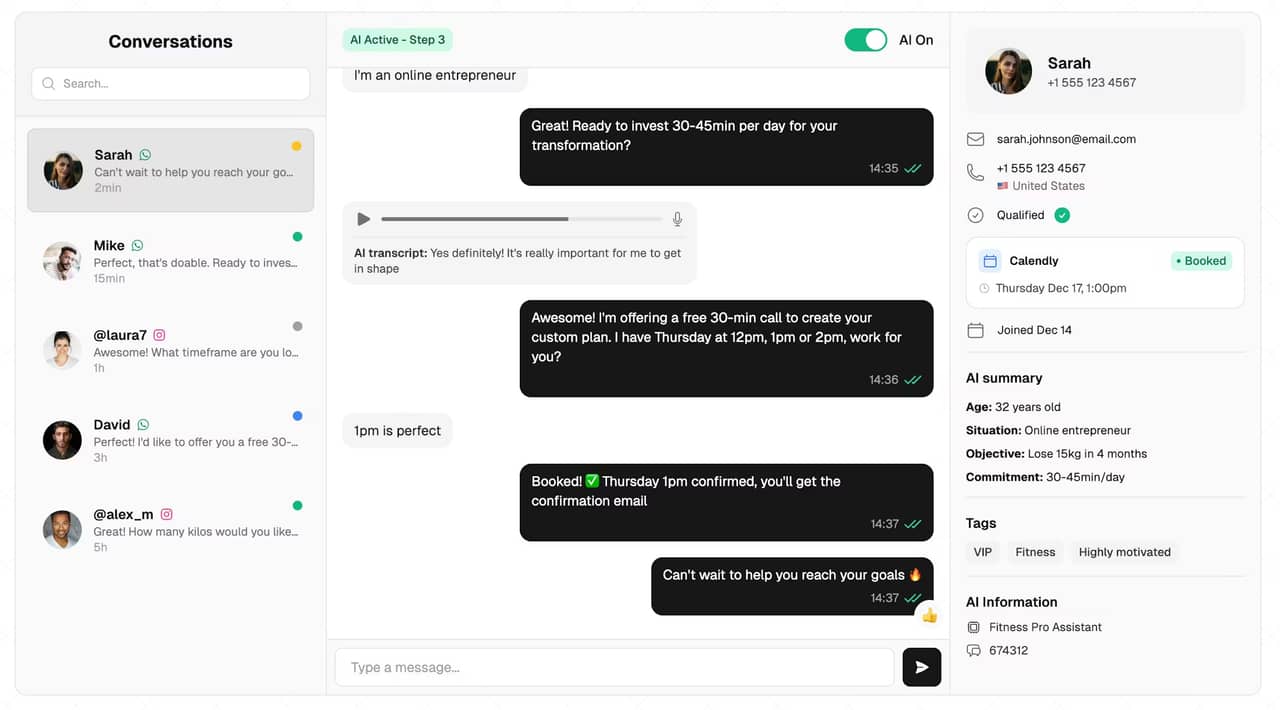
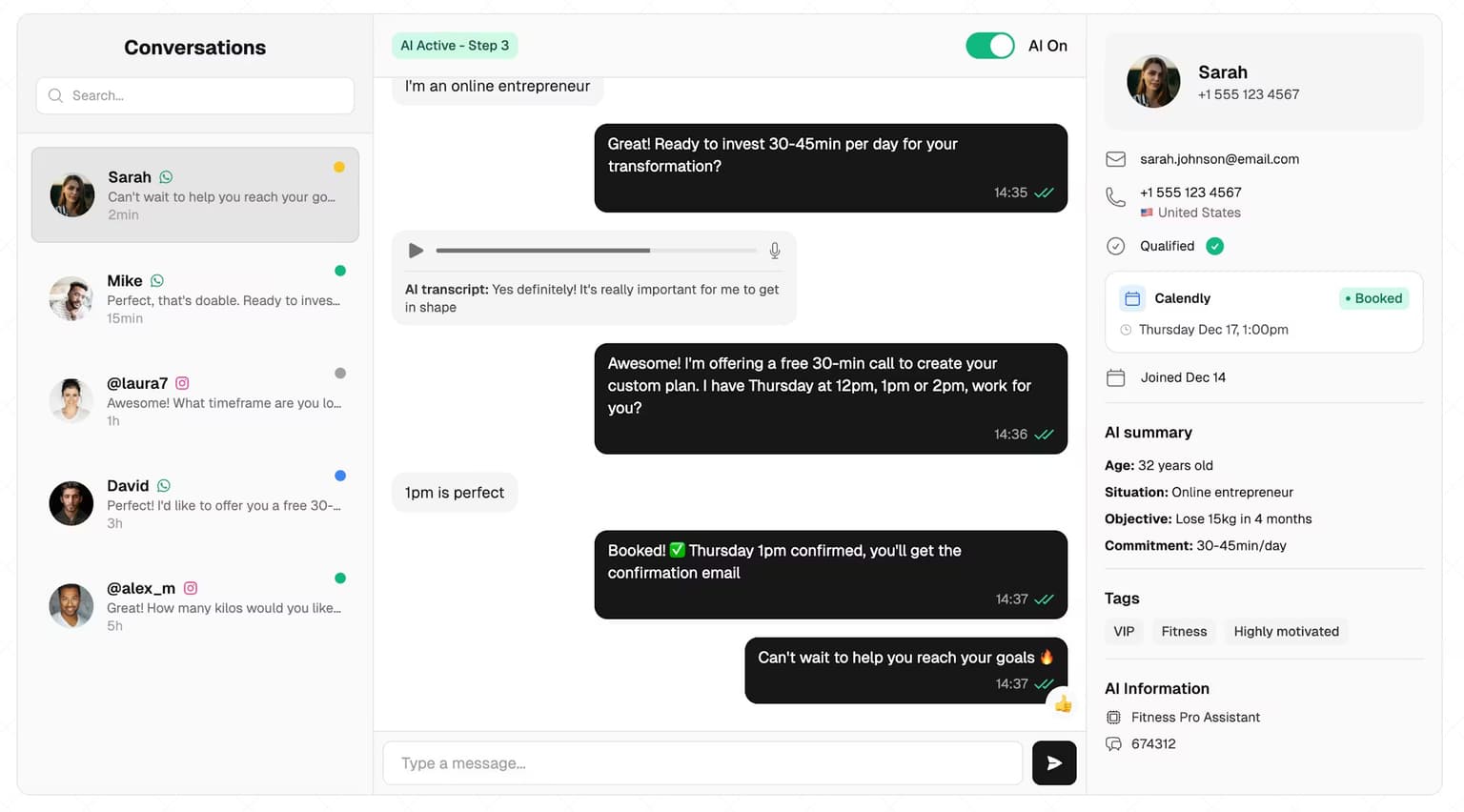
SetSmart is a DM-native AI setter that handles the four intake jobs end-to-end across IG DM, WhatsApp, Messenger, and SMS, with a website widget as an option. It replies in under 5 seconds, asks 4-6 legal-intake-aware qualification questions, hands off to a paralegal on a flagged keyword (e.g. "emergency", "restraining order"), and books a calendar slot for the consult — all from inside the same DM thread. The follow-up sequence runs for 30 days on the no-reply pile, which matters because most prospective clients shop 2-3 firms before signing.
The wedge versus legacy legal chatbots: legacy tools live on the website only and rely on a human team to relay the chat to WhatsApp. SetSmart treats DM and WhatsApp as primary, not as an afterthought. That matches how PI, family, and immigration clients increasingly initiate contact — see also WhatsApp automation for businesses for the broader pattern.
- Channels: IG DM, WhatsApp, Messenger, SMS, website widget
- AI quality: GPT-4-class, prompt-customisable per practice area
- Legal features: tag-based routing (PI vs family vs criminal), keyword escalation, calendar handoff
- CMS integration: Clio, Lawmatics, PracticePanther, MyCase via native or Zapier
- Pricing: Free 7-day trial, then $97/month flat (1,000 messages included)
- Where it loses points: not the cheapest if you only need a website widget; a dedicated web-only tool like Smith.ai will cost less if DMs aren't part of your funnel.
2. Smith.ai — best hybrid chat + human receptionist
Best for: solo practitioners and 2-10 attorney firms that want a chatbot AND a human escalation layer (callbacks, scheduled consults, intake forms) on the website.
Smith.ai pairs an AI chatbot with US-based human receptionists. The bot opens the conversation, qualifies on the basics (jurisdiction, case type, contact details), and hands off to a live agent for anything sensitive or off-script. The receptionist team can schedule consults, send intake forms, and even initiate outbound callbacks within minutes. Smith.ai's legal-specific package includes conflict-check workflows and integrations with Clio, MyCase, PracticePanther, and Lawmatics.
The trade-off vs SetSmart and LawDroid: Smith.ai is great if you want chat handoff to a live human, but it costs noticeably more than software-only options and is mostly website-only. DM and WhatsApp coverage is limited.
- Channels: website widget primarily; SMS and Facebook Messenger via add-ons
- AI quality: AI bot front, human escalation second
- Legal features: legal intake checklist, conflict check, Clio sync
- CMS integration: Clio, MyCase, PracticePanther, Lawmatics, Filevine
- Pricing: legal chat plans typically start around $293/month for a low message volume, scaling with conversations
- Where it loses points: web-only orientation, slower first response (live human in loop), pricier than software-only tools.
3. LawDroid — best custom-trained legal chatbot
Best for: firms with a clear intake workflow and the patience to map it out — the chatbot becomes a near-bespoke fit for the practice.
LawDroid is one of the original law-firm chatbots and has matured into a GPT-driven assistant that can be customised per practice area. It runs on the website, Facebook Messenger, and (with a custom build) in WhatsApp. The strength is configurability: you can build a chatbot per practice group (PI, employment, immigration) with its own qualification logic, conflict-check questions, and routing rules.
The downside: setup is consulting-heavy. You'll typically work with LawDroid's team to ship the first version, which is why pricing isn't published — you get a quote tied to scope. That's the right model for mid-size firms that want a serious bot, but overkill for a solo just trying to capture after-hours leads.
- Channels: website widget, Facebook Messenger, custom WhatsApp
- AI quality: GPT-4, customisable prompts and flows per practice area
- Legal features: conflict check, intake forms, e-sign retainer handoff, jurisdiction routing
- CMS integration: Clio (native), MyCase, PracticePanther, custom via API
- Pricing: custom, generally several hundred dollars per month after setup
- Where it loses points: setup time, no native IG DM, opaque pricing for small firms.
4. Apex Chat — best for personal injury & mass tort firms
Best for: PI, mass-tort, and class-action firms running Google Ads / LSAs where every clicked-to-website lead has to be qualified within 90 seconds.
Apex Chat focuses on the paid-search-to-intake funnel that dominates the PI vertical. The chatbot greets visitors who arrive from a "car accident lawyer near me" ad, qualifies on the basics (date of incident, injury severity, fault, prior representation), and either books a consult or hands the chat to a live agent. The infrastructure is built to handle bursts of paid-traffic-driven inquiries without dropping them.
PI firms generally know Apex by reputation — it's been a mainstay of the legal-marketing stack since the mid-2010s. The 2026 version added GPT-driven dynamic responses on top of the original scripted flow.
- Channels: website primarily; SMS handoff to intake team
- AI quality: hybrid scripted + GPT layer
- Legal features: PI-specific intake scripts, SOL triggers, fault questions
- CMS integration: Litify, Filevine, Needles, custom
- Pricing: custom; usually performance-based (per qualified lead)
- Where it loses points: built for PI/mass-tort; less of a fit for transactional, real estate, or corporate practices.
5. Ngage Live Chat — best for 24/7 human-backed website chat
Best for: firms that want full-time human chat operators behind the bot — not just AI alone.
Ngage Live Chat is a managed chat service that mixes a scripted bot with US-based live operators trained on legal-intake scripts. The bot fires first, the operator takes over on complex matters, and the chat is forwarded as an email / SMS / CRM lead to the firm. Coverage is 24/7/365. For firms uncomfortable with a fully autonomous AI on sensitive intake calls (family, criminal defense), the human-in-the-loop model is reassuring.
The cost: pricing is typically per-lead (per qualified chat transcript), which can add up at PI-vertical volumes. And speed of first response is slower than a true AI bot — a few seconds at minimum for the operator to type.
- Channels: website widget; SMS / email lead delivery
- AI quality: scripted bot + live operator
- Legal features: trained operators, intake scripts per practice area
- CMS integration: most legal CRMs via Zapier / email parsing
- Pricing: custom per-lead model
- Where it loses points: not real-time (human-in-loop), pricing scales with volume.
6. Gideon Legal — best workflow + chatbot bundle
Best for: mid-size firms that want a chatbot plus a workflow / intake-CRM in one product.
Gideon Legal (now part of the broader Gideon platform) bundles a chatbot with an intake workflow tool. The chatbot lives on the website, the form data flows directly into Gideon's CRM, and the firm's intake team works the leads from there. The strength is the no-handoff workflow — you don't need Zapier to glue the chatbot to your intake CRM because they're the same product.
The trade-off: if you already have Lawmatics, Clio Grow, or Filevine for intake, you don't need Gideon's CRM half. And the chatbot is website-focused; DM and WhatsApp coverage is limited.
- Channels: website widget; some CRM-side messaging
- AI quality: GPT-driven with structured intake flows
- Legal features: full intake CRM included
- CMS integration: Clio, MyCase via API
- Pricing: custom; mid-market positioning
- Where it loses points: redundant if you already run a separate intake CRM.
7. DoNotPay — best consumer-facing legal AI (different audience)
Best for: individual consumers (not firms) who want a self-help legal AI to draft a small-claims complaint, dispute a parking ticket, or cancel a subscription.
We include DoNotPay because it's the chatbot most consumers think of when they search "legal chatbot" — and confusing it for a law-firm intake tool is the most common buyer mistake. DoNotPay sells direct-to-consumer at around $36 every 2 months and handles narrow, automatable tasks (chargebacks, small claims templates, refunds, FOIA requests).
If you're a firm reading this guide, DoNotPay is not your tool. It's not built for intake, it doesn't integrate with your CRM, and it's a competitor for some long-tail consumer legal queries you might otherwise capture organically. We rank it #7 only because of brand recognition; for a firm's actual intake stack, ignore it.
- Channels: web app
- AI quality: GPT-driven, narrow task coverage
- Legal features: small-claims templates, FOIA, refund disputes
- CMS integration: none
- Pricing: roughly $36 every two months (consumer subscription)
- Where it loses points: not built for law firms.
Legal chatbot coverage by channel
The single biggest differentiator across the 7 isn't features — it's which channels each chatbot actually runs on. This table is the fastest way to see the gap.
| Chatbot | Website | IG DM | Messenger | SMS | |
|---|---|---|---|---|---|
| SetSmart | Yes | Yes | Yes | Yes | Yes |
| Smith.ai | Yes | No | Partial | No | Yes (via add-on) |
| LawDroid | Yes | No | Yes | Custom | No |
| Apex Chat | Yes | No | No | No | Yes (handoff) |
| Ngage | Yes | No | No | No | Yes (lead delivery) |
| Gideon Legal | Yes | No | No | No | Partial |
| DoNotPay | Web app only | No | No | No | No |
The pattern: 5 of the 7 are website-centric. Only SetSmart covers the DM + WhatsApp side natively. If your firm runs Meta or click-to-message ads, the gap matters.
Which legal chatbot first? — decision framework
Here's how to match the chatbot to the firm's current lead source mix. Pick the row that describes where most of your monthly inquiries actually come from.
| Your main lead source | Start with | Add later |
|---|---|---|
| Google Ads / LSAs (PI, criminal defense) | Apex Chat or Smith.ai | SetSmart on Instagram |
| Click-to-Messenger or click-to-WhatsApp ads | SetSmart | LawDroid on site |
| Instagram Reels & DMs (family, immigration) | SetSmart | Smith.ai for website |
| Mostly organic website + referrals | Smith.ai or LawDroid | SetSmart if DMs grow |
| Mid-size firm with intake team already | Gideon Legal or LawDroid | SetSmart for DM channels |
| Solo & brand new (any practice) | SetSmart (cheapest entry) | Smith.ai when revenue allows |
The simplest rule: if your monthly inquiry mix is more than 25% DM / WhatsApp / Messenger, lead with a DM-native tool. Otherwise lead with a website tool and add DM second.
3 paste-ready legal intake chatbot scripts
The actual chatbot copy matters more than the vendor. The three scripts below — one per channel — are the ones that consistently outperform generic "How can I help you today?" openers on legal intake. Paste them into your chosen tool and adjust the placeholders.
Website widget — personal injury
"Hi — sorry you're here. If you were injured in the last two years and someone else may be at fault, you may have a case. Tell me three quick things so I can route you to the right attorney:
- What kind of incident? (car, work, slip-and-fall, dog bite, other)
- When did it happen? (date or week is fine)
- Were you treated by a doctor or hospital?
If we're a fit, I'll book a free 15-minute consult with one of our attorneys for today or tomorrow. Your reply is confidential and doesn't create an attorney-client relationship until we sign a retainer."
This opens with empathy, qualifies on the three things every PI firm needs (case type, recency / SOL, treatment / damages), and reassures on the confidentiality boundary — the #1 reason chats stall on legal sites.
Instagram DM — family law
"Hi — thanks for the DM. I'm the intake bot for . To make sure I send you to the right attorney, can I ask three quick things?
- Are we talking divorce, custody, or both?
- Which state / county?
- Is anything urgent (e.g., a court date, restraining order, or child in immediate danger)?
If you'd rather talk to a person, just say 'human' and I'll page our paralegal."
Three questions, one safety valve ("say 'human'"), one urgency keyword that escalates immediately. Family-law intake on IG DM tends to be heavily emotional; the chatbot's job is to triage, not to counsel. The "say 'human'" escape hatch dramatically lifts completion rates.
WhatsApp — immigration
"Hi , this is the WhatsApp intake line for . To save you time, four quick questions:
- What's your country of origin?
- Are you currently in the US? (Yes / No)
- Which visa or case type are you asking about? (work, family, asylum, other)
- Do you have a deadline or USCIS notice with a date?
Once I have these, I'll either book a consult or send you our free eligibility guide if a paid consult isn't the right fit yet."
The "free eligibility guide" option is critical for immigration intake — many inquiries come from people who don't yet need (or can't afford) a paid consult but who will, in 6-18 months. Capturing them on a guide list is worth more long-term than disqualifying them outright. See our WhatsApp automation guide for the broader WhatsApp playbook.
AI vs scripted legal chatbot — what's actually different in 2026
The single most common buying confusion in 2026 is between a scripted chatbot and an AI one. Both call themselves "chatbots". They behave very differently when a prospective client goes off-script — which on legal intake is most of the time.
| Capability | Scripted bot | AI chatbot (2026) |
|---|---|---|
| Handles off-script questions | No (falls through) | Yes |
| Mirrors client emotional tone | No | Yes |
| Adapts qualification per case type | Only if flow is built | Yes, dynamically |
| First response time | Instant | Under 5 seconds |
| Risk of giving "legal advice" | Low (constrained) | Medium (needs guardrails) |
| Setup time | Days (flow building) | Hours (prompt tuning) |
The 2026 picture: AI chatbots win on every dimension except the "legal advice" risk — and that's manageable with the right system prompt and a clear disclaimer. Every chatbot in our top 5 is now AI-driven; pure scripted bots have effectively been retired in the legal vertical.
How to deploy a legal chatbot in 7 days
A realistic timeline for a solo or small firm rolling out their first legal chatbot:
- Day 1 — Pick the channel. Decide whether you're starting on website, DM, or both. If you're not sure, look at where last month's 20 inquiries actually arrived. Lead with that channel.
- Day 2 — Sign up and connect. Trial the tool, connect your Meta / Google Business / website. SetSmart and ManyChat take under an hour to connect; LawDroid and Smith.ai take a kickoff call.
- Day 3 — Write the intake script. Use one of the three scripts above as your base. Adapt to your practice area, jurisdiction, and the one or two things you wish you knew before every consult.
- Day 4 — Define escalation keywords. "Emergency", "restraining order", "USCIS deadline", "court tomorrow", "child", "weapon", "police". Any of these should bypass the bot and page you or a paralegal immediately.
- Day 5 — Configure handoffs and the calendar. Hook the chatbot to your Calendly / TidyCal / firm scheduler. Test booking with three fake personas (qualified, unqualified, urgent).
- Day 6 — Soft launch. Turn it on during business hours only for the first 48 hours. Watch the first 10 transcripts. Fix obvious wording problems.
- Day 7 — Full launch and 30-day follow-up sequence. Go 24/7. Turn on the no-reply follow-up sequence (2 follow-ups in the first 24 hours, then +7 / +14 / +30 days). See our AI lead follow-up guide for the cadence specifics.
By the end of week 2, you'll have enough transcripts to identify the 3-5 things prospective clients ask that your script doesn't yet handle. Iterate from there.
Solo practitioner vs mid-size firm — different chatbot, different stack
The right legal chatbot depends as much on firm size as on practice area.
- Solo or 2-person firm. Pick one tool that covers your dominant channel. SetSmart at $97/month if you're DM/WhatsApp-heavy. Smith.ai if you're website-heavy and want a human-backed receptionist as a safety net. Don't try to deploy three chatbots at once.
- 3-10 attorney firm. Run one chatbot per channel: SetSmart for DM/WhatsApp, Smith.ai or LawDroid for the website. The two together cost less than one full-time intake hire and cover 24/7.
- 10+ attorney firm. Add a workflow / intake-CRM layer (Lawmatics, Clio Grow, Filevine, Gideon Legal) on top of the chatbots. The chatbot captures, the intake CRM organises and routes by practice group. Pair this with lead qualification questions tuned to each practice area.
The mistake at every firm size is buying the most expensive tool first. Start lean, prove the ROI on week-1 transcripts, then layer.
5 legal chatbot mistakes that quietly kill conversion
The recurring patterns we see when firms audit a chatbot that "isn't working":
- The chatbot asks for the phone number first. Don't. Ask about the case first. People type case details to a bot they'd never type into a stranger's call. Ask for contact info only after the case is qualified.
- No escalation keyword. A prospective client typing "emergency" or "restraining order" should not still be answering "What's your last name?". Build a hard escalation rule for safety keywords.
- No follow-up on the no-reply pile. Legal inquiries that go quiet at message 2 are still convertible — many shoppers contact 3 firms simultaneously. A single follow-up the next day recovers a meaningful share of them.
- The bot pretends to be human. Don't. Identify as "the intake bot". Trying to pass as human reads as deceptive and creates ethics-rule exposure (ABA Model Rule 7.1 / 8.4(c) in some jurisdictions).
- No disclaimer about attorney-client relationship. Add a one-liner: "Sharing details here doesn't create an attorney-client relationship until we sign a retainer." Most ethics boards expect it on any AI-driven intake channel.
A linked failure pattern that affects intake across verticals: slow response time. See lead response time statistics for the data on how response speed correlates with intake conversion.
Free legal chatbots — what's actually available
Free options for firms wanting to test the category without committing budget:
- ManyChat free plan — works on IG DM and Messenger, can be configured for legal intake with a custom flow. Limited contacts (~1,000) and no native legal templates. See ManyChat pricing and ManyChat alternative for the trade-offs vs paid AI tools.
- Tidio free plan — website widget, 50 conversations / month. Decent for an extremely low-volume solo.
- Chatfuel free tier — IG DM and Messenger, limited to 50 conversations. See Chatfuel pricing.
- Custom GPT (ChatGPT Plus) — for a single attorney, a "Legal Intake GPT" on the public ChatGPT directory can capture lightweight inquiries. No integration with your CRM, no follow-up, no DM/WhatsApp.
None of these are a substitute for a real intake tool above a tiny inquiry volume. They're useful for proving you'd use one before buying.
Legal chatbot vs legal CRM vs case management — the disambiguation
A common buyer-confusion point: people search "legal chatbot" when they really need a legal CRM or a full case management tool. Here's how to tell them apart.
- Legal chatbot — handles the first conversation with a prospective client. Captures contact details, qualifies on the basics, books the consult. Examples: SetSmart, Smith.ai, LawDroid, Apex Chat. Lives on website + DM + WhatsApp.
- Legal intake CRM — organises and routes leads after the first conversation. Tracks the conflict check, the intake form, the e-signed retainer, the consult outcome. Examples: Lawmatics, Clio Grow, Captorra, Lead Docket. Lives in the office.
- Case / matter management — runs the case once the client signs. Tracks deadlines, documents, time entries, billing. Examples: Clio Manage, MyCase, PracticePanther, Filevine. Lives in the office.
The three layers are complementary, not substitutes. A good 2026 stack at a small firm is: chatbot + intake CRM + case management — three tools, each doing one thing well. For the broader playbook on stacking sales-side AI, see generative AI for sales and the parallel CRM sales automation write-up.
Real firms running this stack
Three composite examples (firm names anonymised, workflow real) of how working firms combine the tools above:
- PI firm, 4 attorneys, Texas. Apex Chat on the website (Google Ads traffic) + SetSmart on Instagram and click-to-WhatsApp ads + Lawmatics for intake. Result: chats answered in under 5 seconds, paralegal team works only the qualified pile, after-hours intake equals weekday intake for the first time.
- Solo family lawyer, California. SetSmart on Instagram and Facebook DMs (organic + a small ad budget) + a Tidio chat widget on the website + Calendly for booking. Result: ~30 inbound DMs per month converted, no after-hours staff, monthly cost under $130 all-in.
- Immigration firm, 8 attorneys, Florida. SetSmart for WhatsApp and IG DM (90% of their inquiries) + Smith.ai as a website backup + Filevine for case management. Result: 24/7 intake in EN and ES, average time-to-consult dropped from 26 hours to under 90 minutes.
The common pattern: one chatbot per channel, one intake CRM, one case management tool. No firm above runs more than two chatbots at the same time.
When NOT to deploy a legal chatbot
Not every firm should. Skip the chatbot if any of these are true:
- You don't yet have a consistent inquiry volume. Below ~10 inquiries per month, a chatbot is over-tooled. Answer the phone yourself for another quarter, see what people actually ask, then deploy.
- Your practice is exclusively litigation-with-fixed-clients. Big-law M&A, transactional, and government work doesn't have an inbound intake funnel. Chatbots don't apply.
- Your bar association explicitly restricts AI-driven intake. Some jurisdictions limit AI in attorney-client communications. Check before deploying.
- You can't answer the conflict-check question reliably yet. A chatbot that books consults for matters with known conflicts is a bigger problem than no chatbot. Get the conflict-check workflow sorted first.
If none of the above apply, you're a candidate.
Legal chatbot vs AI legal research tool — different jobs
A clarification that surfaces in every "best legal AI" thread: a legal chatbot and an AI legal research tool are not substitutes. They sit in different parts of the practice.
- Legal chatbot. Front of house. Talks to prospective clients. Examples: the 7 above.
- AI legal research tool. Back of house. Talks to attorneys. Drafts memos, finds case law, summarises depositions. Examples: Harvey AI, Casetext CoCounsel, Spellbook, Thomson Reuters AI-Assisted Research, Lexis+ AI.
You'll likely want both, eventually. But they don't compete for the same budget line, and confusing them is the source of most "ranked best legal AI" lists that don't help anyone.
FAQ
What is a legal chatbot?
A legal chatbot is an AI-driven assistant that handles the first conversation with a prospective client on a law firm's website, Instagram DM, Facebook Messenger, WhatsApp, or SMS. It captures contact details, qualifies the matter on jurisdiction / case type / timing, and either books a consult or hands the conversation off to a paralegal or attorney. Modern legal chatbots in 2026 are GPT-driven, respond in under five seconds, and run 24/7.
Is there a free legal chatbot for my law firm?
Yes — ManyChat's free tier (IG DM + Messenger), Tidio's free website widget (50 conversations/month), and Chatfuel's free tier all work for very low inquiry volumes. None of them have legal-specific intake features, conflict-check workflows, or CRM integrations included. They're useful for proving you'd benefit from a paid tool, not as long-term solutions above ~10 inquiries per month.
Can a legal chatbot give legal advice?
No, and it shouldn't try. A well-built legal chatbot identifies itself as a bot, qualifies the matter on basic facts, and explicitly states that sharing details doesn't create an attorney-client relationship until a retainer is signed. ABA Model Rule 7.1 (communications about services) and 8.4(c) (deceit) in many states make impersonation or giving substantive legal advice a real ethics risk. Treat the chatbot as intake, not as advice.
What's the difference between a legal chatbot and an AI legal research tool like Harvey?
A legal chatbot talks to prospective clients at the front of the firm — capturing inquiries and qualifying them. An AI legal research tool like Harvey, Casetext CoCounsel, or Spellbook talks to attorneys at the back — drafting memos, summarising case law, redlining contracts. Different audiences, different jobs, different price points. Most firms will eventually want both, but they don't compete for the same budget line.
How much does a legal chatbot cost in 2026?
Pricing ranges widely. DM-native AI tools like SetSmart start at a flat $97/month for 1,000 messages. Website-focused services like Smith.ai usually start around $293/month and scale by conversation volume. Enterprise tools like LawDroid, Apex Chat, and Ngage Live Chat are quoted custom — typically a few hundred to a few thousand dollars per month depending on volume and whether human escalation is included. Free tiers exist (ManyChat, Tidio, Chatfuel) for low-volume testing.
Do I need a legal chatbot if I already have a human receptionist?
If your receptionist is available 24/7 and answers within 60 seconds at all hours, probably not. In practice most firms can't staff that. The chatbot covers the gap: after hours, weekends, and the first 30 seconds when a prospective client lands on the site or DMs you. It's a complement, not a replacement — the chatbot qualifies, the receptionist (or paralegal) takes the high-stakes calls.
Will a chatbot affect my firm's ethics compliance?
A properly configured chatbot is compliant in most US jurisdictions. The key requirements: identify clearly as a bot (don't pretend to be a person), include a disclaimer that sharing details doesn't create an attorney-client relationship, don't give substantive legal advice, and escalate sensitive matters (emergencies, conflicts, fee questions) to a human. Check your specific state bar's guidance on AI in client communications — some states (Florida, California, New York) have issued explicit opinions in 2024-2026.
Ready to automate your DMs?
Start your free 7-day trial and let AI handle your lead qualification 24/7.
Try SetSmart free