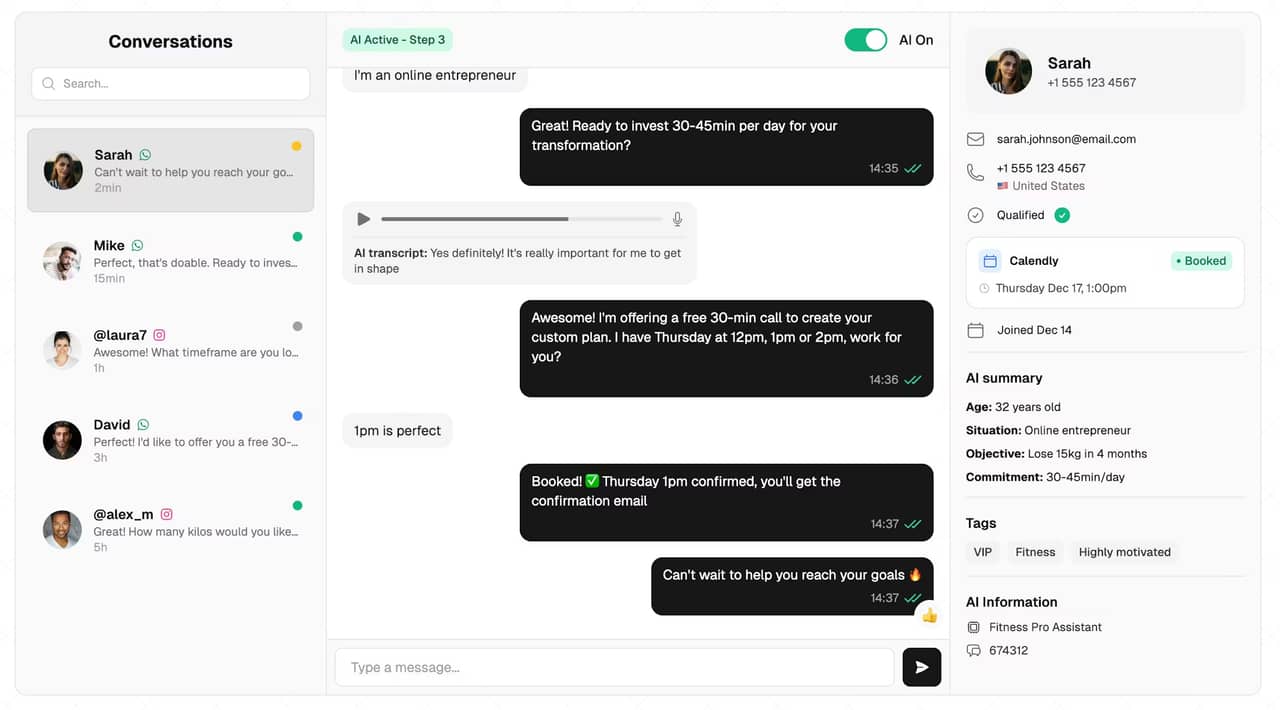
B2B Lead Nurturing: 7 Tactics + DM Examples 2026

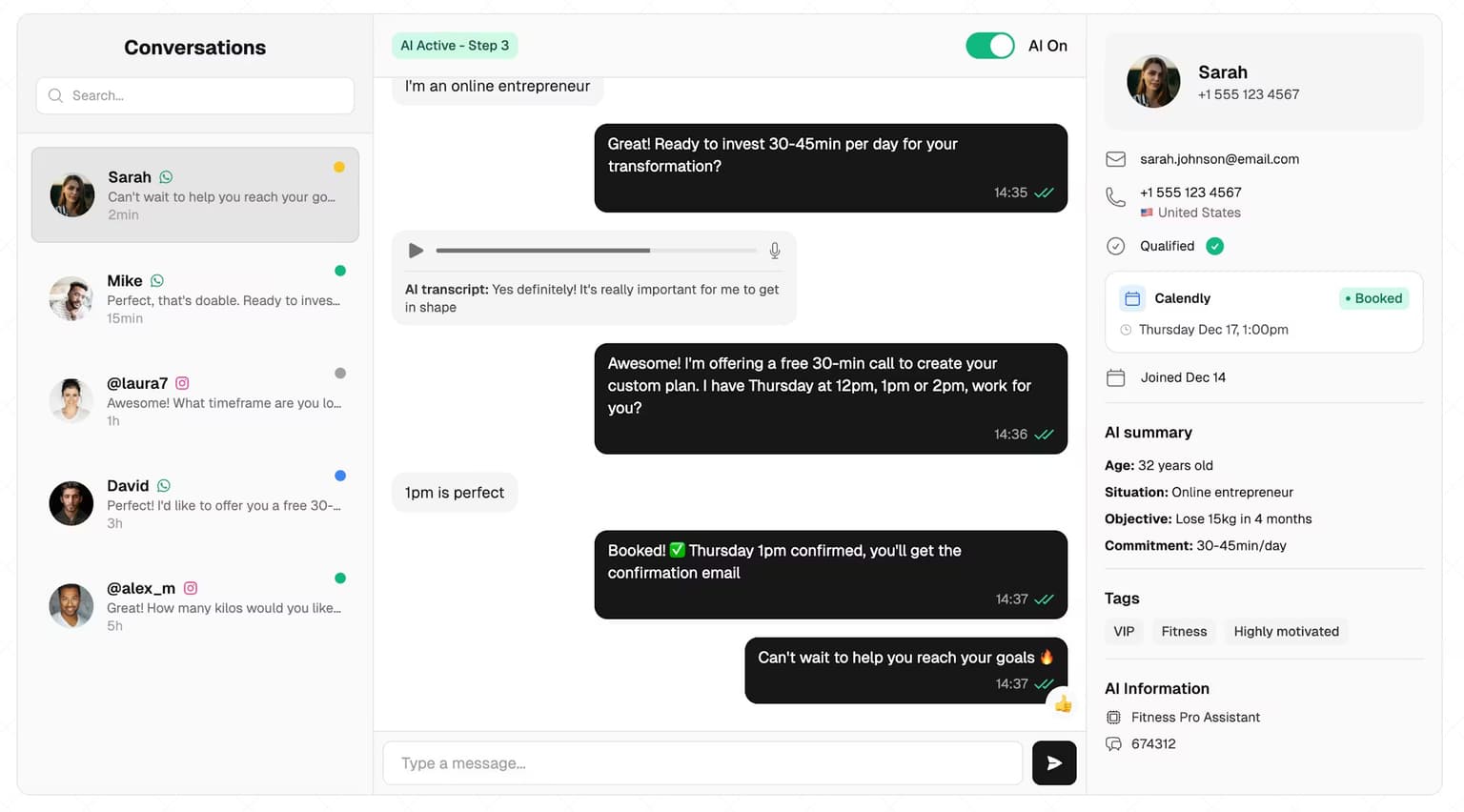
Most "B2B lead nurturing" guides in 2026 still describe the same 2017 playbook: a 7-email drip from HubSpot, a quarterly newsletter, a "re-engagement campaign" that opens at 4%. Pipeline-360, VWO, Monday, Leadfeeder, Oracle — every top-ranking guide assumes your B2B buyer lives in Outlook. They don't. They live in Slack, LinkedIn DMs, WhatsApp, and (yes) Instagram, and they've already opened your competitor's reply by the time your nurture email lands in the Promotions tab.
This guide ranks the 7 B2B lead nurturing tactics that actually book demos in 2026 — across email, LinkedIn, WhatsApp, and Instagram DM — with real scripts, an industry-by-industry view, and a 30-day playbook. We'll also cover the rule of 7, the 95-5 rule, AI for B2B lead nurturing, and where the email-only model still wins.
Short version: speed-to-lead is now the #1 nurture lever. Long-form drip campaigns still matter, but a single AI follow-up sent in the channel where the lead actually replied does more for pipeline than 12 weeks of CRM scoring. The teams pulling ahead in 2026 are the ones treating B2B lead nurturing as a real-time conversation problem, not a marketing-automation problem.
TL;DR — 7 B2B lead nurturing tactics ranked by 2026 ROI
| # | Tactic | Channel | Trigger | Time to set up | Pipeline impact |
|---|---|---|---|---|---|
| 1 | Speed-to-lead AI reply | DM, web chat, WhatsApp | New inbound | 1 day | Highest — fixes 53% leak |
| 2 | Multi-touch follow-up cadence (4h + 23h) | DM + email | No reply at hour 4 | 2 days | +106% booked calls |
| 3 | Behavioural drip (intent-triggered) | Email + LinkedIn | Pricing page, demo request | 5 days | High |
| 4 | MQL re-engagement (revival plays) | Email + WhatsApp | 90-day silence | 3 days | Medium-high |
| 5 | Sales-marketing handoff (BANT/MEDDIC) | CRM workflow | Score ≥ threshold | 1 week | Medium |
| 6 | Account-based nurture (ABM) | LinkedIn + email | Target account engages | 2-3 weeks | Medium (enterprise) |
| 7 | Content-led education (newsletter + webinar) | Email + LinkedIn | Subscribe | Ongoing | Low — brand effect |
The first two tactics deliver more pipeline than 3-7 combined. If you only have time for one quarter of nurture work in 2026, it's tactic 1 (speed-to-lead AI reply) and tactic 2 (the 4h + 23h follow-up cadence).
What "B2B lead nurturing" actually means in 2026
B2B lead nurturing is the structured process of staying in contact with a B2B prospect from the moment they show interest until they're ready to buy — across whatever channel they prefer, with content and conversation calibrated to where they are in the buying journey. It sits between B2B lead generation (filling the top of funnel with target accounts and inbound leads) and lead qualification (deciding which leads earn a sales-team hand-off), and its job is the long, unglamorous middle: keep the lead warm, answer objections, send the right asset at the right moment, and re-engage when they go quiet.
Three things make B2B nurture different from B2C nurture:
- Multiple stakeholders. A B2B deal usually has 6 to 11 buyers in the room. Your nurture has to keep the champion engaged AND give them ammunition to convince the CFO, the VP, and the procurement team.
- Long cycles. B2B sales cycles run 60 to 270 days for SMB software, longer for enterprise. Your nurture has to survive holiday seasons, board meetings, and budget cycles without going stale.
- Buying intent is invisible. Most B2B buyers spend 70% of the journey researching anonymously before they ever raise their hand. Your nurture has to capture them when they finally surface — at 4 PM on a Tuesday, in whatever channel they were already in.
In 2026 this last point is what most "B2B lead nurturing strategies" articles still get wrong. The buyer raises their hand on LinkedIn or in a Click-to-WhatsApp ad — and the nurture sequence assumes they'll dutifully open an email seven days later. They won't. The lead has already moved on.
Why B2B lead nurturing broke in 2026 — and what fixed it
The classic B2B lead nurturing machine was built around three numbers: 25% email open rate, 3% click-through, and a 4-week drip cadence. All three of those numbers have collapsed:
- Open rates are now noise. Apple Mail Privacy Protection auto-opens emails. Gmail Promotions tab buries marketing sends. Reported "open rates" of 22% are mostly bots.
- Reply rates are sub-1%. Average B2B cold email reply rate sits at 0.7% in 2026. A 14-day "drip" of 7 emails to a single lead now gets the same response as one well-timed DM.
- Buyer attention has shifted to DMs. B2B buyers — especially founders, agencies, and SaaS PMs — now do half their vendor research in LinkedIn DMs, WhatsApp groups, and Slack communities. The mailbox is increasingly the place leads check on Sundays, not the place they evaluate vendors.
What replaced the broken email machine isn't a new email sequence — it's real-time, multi-channel, AI-led conversation. Across our analysis of 828K AI-driven DM conversations, 53% of inbound conversations died before message 3. That's the leak nurture is paid to plug — and the difference between a team that closes it and one that doesn't is whether the very first reply lands in under 5 seconds, in the channel the lead used to raise their hand, with a question that earns a reply.
The teams pulling ahead are blending two things: a fast AI front-line that handles every inbound DM in seconds, and a behavioural drip that fires only when the lead does something specific (visits pricing, books a demo, opens a proposal). The 7-email drip on a calendar timer is no longer pulling its weight.
The B2B buyer journey: rule of 7, 95-5 rule, and the gap they leave
Two old rules of thumb drive most B2B nurture thinking — and both leave a gap your competitors are exploiting in 2026.
The rule of 7 says a buyer needs to "see" your brand 7 times before they buy. It's a 1930s movie-marketing rule that survives because the math feels intuitive. Useful as a reminder that one touch isn't enough, but in B2B SaaS the real number is 30+ touches across content, ads, peers, communities, and a couple of demos. Treating "rule of 7" as a literal target leads to brittle 7-email sequences that ignore where the lead actually is.
The 95-5 rule (popularised by the LinkedIn B2B Institute and Ehrenberg-Bass) says that on any given day, only 5% of your target B2B audience is in-market — the other 95% are not buying. The takeaway most marketers draw is: spend most of your budget on brand to reach the 95%, and only a small slice on activation for the 5%. That's right strategically. But operationally it leads to nurture programs that are mostly content broadcasts to the 95% — and almost no infrastructure for capturing the 5% the moment they raise their hand.
The gap both rules miss: the 5% who are in-market today don't read seven of your emails. They Google a comparison, click a Click-to-WhatsApp ad, message you, and decide in 48 hours. If your nurture only catches them on touch 7, you've already lost them. B2B lead nurturing in 2026 is two parallel programs:
- Brand-and-content nurture for the 95% — newsletters, podcasts, LinkedIn thought leadership, SEO. This is what most articles describe.
- High-speed activation nurture for the 5% — AI-led DM replies, real-time qualification, automated follow-ups when leads ghost. This is what's missing from most teams.
The cookbook below is heavy on the second program because it's where the marginal pipeline lift in 2026 is largest.
The 7 B2B lead nurturing tactics that book demos in 2026
1. Speed-to-lead AI reply (the single highest-ROI nurture move)
The first message a B2B lead sees from you used to be an autoresponder ("Thanks, we'll be in touch within one business day"). In 2026 that 24-hour window is fatal: the average industry response time is still 42 hours, but the lead's attention window is closer to 5 minutes. An AI front-line that replies in under 5 seconds — across IG DM, WhatsApp, web chat, and (with Make/Zapier) form fills — is now the single highest-ROI nurture move you can deploy.
What the AI does on first reply matters more than people think:
- Acknowledge what the lead actually asked (not "Hi! Thanks for reaching out").
- Ask one qualifying question (use case, team size, or timeline — not all three).
- Suggest a next step (calendar link, pricing page, or another question).
A well-tuned AI setter handles 80-90% of the volume, escalates the messy 10-20% to a human, and never sleeps. For most B2B teams this single change does more for pipeline than the next three nurture programs combined — see lead response time statistics for the per-minute decay curve.
2. The 4-hour + 23-hour follow-up cadence
The second-highest-leverage nurture tactic in B2B is also the one most teams skip: when a lead replies, asks a question, then goes silent — send one follow-up 4 hours later, and a second 23 hours after that. Two messages, no more.
This isn't a guess. In our dataset, conversations with even a single follow-up booked +106% more calls than conversations with none. The 4h + 23h cadence works because it catches the lead before context is lost (4h) and again the next morning when they re-open their phone (23h). It also avoids the spam pattern of 5+ pings that B2B buyers hate.
A clean AI lead follow-up cadence looks like:
- Hour 0: lead asks "what's pricing?", AI answers and asks "what's your team size?"
- Hour 0+0: lead replies "12 people" → AI sends a tier recommendation and a calendar link
- If no reply by hour 4: AI sends "Quick check — does that 12-person plan fit, or is something missing?"
- If still no reply by hour 23: AI sends "Last nudge from me — happy to drop the link to a 15-min walkthrough if helpful."
That's the entire program. Stop after 2 follow-ups. Anything more is annoying.
3. Behavioural drip campaigns (intent-triggered, not calendar-triggered)
Email is not dead — but the calendar-triggered 7-email drip is. Replace it with behavioural drip: emails (or DMs) that fire only when the lead does something specific.
Useful triggers in B2B:
- Pricing page viewed but no demo booked → 24h email with a 90-second video walkthrough
- Demo recording watched to 80% → email with the case study most relevant to their stage
- Proposal sent but unopened after 48h → DM nudge from the AE: "Did the proposal land OK?"
- Free-trial day 3 with low usage → checklist + 1:1 offer
- Free-trial day 6 (last day) → conversion email with the peer-comparison stat
This is where B2B marketing automation earns its keep. The trigger-to-message latency should be under 15 minutes. If your stack takes 24h to fire a behavioural email, the behaviour signal is already cold.
4. MQL re-engagement (revival plays for silent leads)
About 70% of B2B MQLs go silent within 60 days. Most teams write them off. They shouldn't — a well-built re-engagement program is one of the cheapest sources of pipeline in 2026.
Three revival plays that work:
- The "still relevant?" check. Single email or DM 90 days post-silence: "Hey Name, you looked at product back in month. Genuine question — is problem still on your radar, or has the priority shifted?" This earns a reply roughly 1 in 6 times because it doesn't sell.
- The competitor-trigger. When a competitor gets bought, raises a round, or kills a feature, fire a one-off email to every silent MQL who evaluated them. "Saw competitor just event. If you're rethinking, here's what changed for us." Conversion rates on these spikes hit 8-15%.
- The asset-based revive. Send a single high-value resource (industry benchmark, pricing study, a teardown) with no CTA. Track who clicks. The clickers go back into active nurture.
Use WhatsApp automation for the silent leads who originally came in via mobile — a WhatsApp DM gets opened in the first 15 minutes ~80% of the time, vs an email getting opened maybe never.
5. Sales-marketing handoff (BANT/MEDDIC routing)
The single largest leak in most B2B nurture programs isn't email open rates — it's the handoff from marketing to sales. A great BANT lead qualification score that takes 4 days to land in the AE's inbox is functionally identical to no qualification at all.
The fix is structural, not creative:
- Define the qualified-lead handoff with explicit criteria (Budget, Authority, Need, Timing or MEDDIC equivalents) — not "marketing thinks it's hot".
- Push qualified leads to the AE's primary work surface (Slack DM, Teams card, mobile push) — not just CRM.
- Auto-create the next-step calendar invite, pre-filled with context — don't leave the AE to copy-paste from the lead record.
- Keep AI on the conversation in parallel until the AE replies — silence after handoff is the second-largest nurture leak after slow first reply.
This is one of the workflows where CRM sales automation pays for itself in a single quarter.
6. Account-based nurture (ABM)
For mid-market and enterprise B2B, account-based nurture replaces lead-based nurture. The unit of work is the account, not the contact. The trigger is account-level intent (3+ people from the same domain visiting your pricing page, an account hitting a specific intent score on Bombora or 6sense, or a key person changing roles).
A working ABM nurture loop:
- 3+ contacts from the target account engage with content in a week
- Marketing sends a one-off "we noticed your team is in market" email to the champion
- Sales runs a personalised LinkedIn outreach to the economic buyer
- A multi-threaded calendar invite goes to 2-3 stakeholders for a strategy call
ABM is high-effort, low-volume, high-conversion. It's not the right play for SMB pipelines under $5K ACV — the math doesn't work. Above $25K ACV in mid-market, it becomes the dominant nurture motion.
7. Content-led education (newsletter + webinar + community)
The slowest tactic on this list, and the one most articles overweight. Content-led nurture — newsletters, webinars, podcasts, founder-led LinkedIn — is essential for the 95% of your audience who aren't in-market today, but it doesn't book demos this quarter. Treat it as the "always-on brand layer" underneath the six activation tactics above.
What works in 2026: founder-written LinkedIn posts (2-3 per week), one focused weekly newsletter with a single insight per send, one quarterly webinar with a real customer speaking. What doesn't: 4-emails-a-month "marketing" newsletters with no point of view. Quality over volume.
B2B lead nurturing email examples vs DM examples (with scripts)
The single biggest 2026 shift in B2B lead nurturing examples is that DMs and email now play different roles in the same nurture. Email handles depth (long content, proposals, contracts). DMs handle speed (fast questions, pings, calendar links). Most "B2B lead nurturing email examples" guides still treat email as the only channel — that's the gap.
| Stage | Email plays this role | DM plays this role |
|---|---|---|
| First reply | Receipt confirmation only | AI in < 5 seconds, qualifying question |
| Education | Long-form post, video walkthrough | Single-link share with one-line context |
| Follow-up at hour 4 | Risky — too soon, looks like spam | Native, expected on the channel |
| Re-engagement (90d) | "Still relevant?" line works | Useful only if lead originally came in by DM |
| Proposal nudge | Resend with summary | DM the champion: "Did the proposal land OK?" |
| Contract / DocuSign | Primary channel | Backup nudge if email goes silent |
Two example scripts you can paste into your nurture today.
Email example — pricing-page intent trigger (sent 24h after the lead viewed pricing without booking):
Subject: Quick question on the pricing page
Hey First name,
I saw you spent some time on our pricing page yesterday — most folks who do that are weighing two or three things at once.
Three quick questions, in order of how much they'd change my recommendation:
- Are you currently using something for problem, or starting fresh?
- Roughly how many people on the team would touch this?
- Is this for a project this quarter or planning for next?
No pressure to reply to all three — even one helps me point you to the right plan.
Calendar link if you want to skip the back-and-forth
DM example — Click-to-WhatsApp ad inbound (sent within 5 seconds of the first message):
Hey First name — thanks for the message. To make sure I send you the right thing, what's your team size? (We help anywhere from 1-person founders to 50-person SaaS teams, but the answer changes a lot.)
These are the patterns that consistently work — see more B2B lead nurturing email examples for 14 templates with scripts across email, IG DM, WhatsApp, and Messenger.
AI for B2B lead nurturing: 3 use cases that change pipeline math
AI for B2B lead nurturing is one of the most-hyped phrases in 2026 marketing — and most of the hype is overblown. AI doesn't replace your nurture program. It removes three specific bottlenecks that used to require humans:
- Real-time first reply at any hour. A tuned AI front-line (best AI setters) handles 80-90% of inbound DMs and qualifies in real time. The lift here isn't that AI is smarter than humans — it's that AI is awake at 11 PM on a Saturday when your buyer is comparing vendors.
- Per-lead message personalisation at scale. Behavioural drips that used to require a marketer to write 30 variants now generate the variants from a few hand-written prompts plus the lead's actual context. Done well, generative AI for sales lifts reply rates 2-3x without sounding like a robot. Done badly, it sounds like every other AI cold email and gets blocked.
- 24/7 follow-up cadence. AI handles the 4h + 23h follow-up loop without forgetting, weekending, or pulling rank on which lead matters. This is where AI sales assistant tools — including the AI BDR category — overlap with traditional marketing-automation. The boundary between "marketing nurture" and "AI BDR" effectively dissolved in 2026.
What AI doesn't do well in B2B nurture: understand multi-stakeholder politics inside an enterprise account, write a nuanced proposal, navigate a difficult procurement conversation. Keep humans on those.
How to set up a B2B lead nurturing program in 30 days
A practical 30-day playbook, not a 12-week consulting deck:
- Day 1-3 — Audit. Map every channel a lead can reach you on (DM, web chat, form, email, phone, Click-to-WhatsApp ad, LinkedIn). For each, write down the current first-reply time. The slowest one is your priority.
- Day 4-7 — Speed-to-lead. Deploy AI on the top inbound channel (usually IG DM or web chat). Target: 100% of inbounds answered in under 5 seconds, 24/7. This single change moves more pipeline than the rest of the program.
- Day 8-14 — Follow-up cadence. Set up the 4h + 23h follow-up loop. Two messages, no more. Same AI handles both.
- Day 15-21 — Behavioural triggers. Pick three high-intent triggers (pricing-page view, demo no-show, free-trial day 3). Build one behavioural email or DM for each. Don't try to build 15 — build 3 and watch the results.
- Day 22-26 — Handoff. Define the marketing→sales handoff explicitly. Push qualified leads to the AE's Slack/Teams in real time. Auto-create the calendar invite.
- Day 27-30 — Re-engagement. Build one revival sequence for silent MQLs (the "still relevant?" play). Schedule it monthly.
That's it. Most B2B teams over-engineer nurture and end up with 30 sequences, none of which work cleanly. Nail the six steps above first; iterate later.
B2B lead nurturing by industry
Same principles, different channel mix and cycle length.
| Industry | Primary channel | Cycle length | Highest-leverage tactic |
|---|---|---|---|
| B2B SaaS (SMB) | Web chat + email + DM | 14-60 days | Speed-to-lead + free-trial day 3 trigger |
| B2B SaaS (mid-market) | Email + LinkedIn + ABM | 60-180 days | Behavioural drip + ABM |
| Agencies (marketing, dev, design) | DM + LinkedIn + WhatsApp | 7-45 days | Speed-to-lead + 4h + 23h cadence |
| B2B manufacturing | Email + phone + WhatsApp (LATAM/EMEA) | 90-270 days | Long-cycle behavioural drip + AE handoff |
| B2B coaching / consulting | DM + email | 3-21 days | Speed-to-lead + content nurture |
| B2B real estate / commercial | DM + WhatsApp + phone | 14-90 days | Speed-to-lead + ABM for big accounts |
Two notes worth pulling out: lead nurturing for B2B manufacturing is the one industry where email is still dominant (engineers actually open emails, and procurement cycles are long enough to reward depth). B2B agencies at the other extreme: every minute of delay on a DM costs a deal, because agency buyers are evaluating five vendors in parallel.
5 B2B lead nurturing mistakes that kill pipeline
- Treating nurture as email-only. The biggest mistake in 2026. If your B2B nurture program is 100% email, you're missing the 5% who are in-market today and live in DMs. Add a single AI-led DM channel and watch the pipeline move.
- Replying once and giving up. A single follow-up doubles booked calls; most B2B teams send zero. The 4h + 23h cadence costs nothing to set up and is the highest-leverage edit you can make this week.
- Treating "rule of 7" as a literal sequence target. Seven generic emails on a calendar timer is the wrong shape of touch. One real-time DM on the day they raise their hand beats six emails sent on autopilot.
- No handoff structure. A perfect MQL that sits in the CRM for 4 days is dead. The handoff matters more than the score.
- Over-engineering. 30 sequences, 12 personas, 6 lead scores — most B2B nurture programs collapse under their own complexity. Three working sequences beat 30 broken ones.
A common subset of #5: building 14 different "lead nurturing strategies for B2B customers" by segment before you've nailed the basic 4h + 23h follow-up across all of them. Get the universal layer working first.
When B2B lead nurturing isn't the bottleneck
Honest section. Sometimes nurture isn't the problem. Don't invest here if:
- You don't have at least 50 inbound leads a month. Below that, the problem is lead generation, not nurture. Pour the budget into lead generation tools and content first.
- Your demos are converting under 10%. The problem is at the demo / closer layer, not the nurture layer. A great nurture into a broken demo just wastes more leads.
- Your AE bench is empty. If qualified leads have nobody to talk to, no nurture program will save you.
- Your ICP is wrong. The world's best nurture sequence into the wrong audience is a $0 program.
Fix those first, then come back to nurture.
B2B lead nurturing software stack in 2026
A working stack for an SMB-to-mid-market B2B team. You don't need all of these — pick the one that maps to your bottleneck.
| Layer | Job | Pick | Starting price |
|---|---|---|---|
| AI front-line (DM) | Speed-to-lead + qualification + 4h + 23h follow-up | SetSmart | Free 7-day trial, then $97/month |
| Marketing automation (email) | Behavioural drip, MQL revival | HubSpot or ActiveCampaign | starting at $20/seat/mo |
| CRM | Lead record, scoring, handoff | HubSpot or Pipedrive | starting at $14/seat/mo |
| Intent / signals | Detect in-market accounts | Clearbit, Bombora, 6sense | enterprise pricing |
| LinkedIn outreach | ABM and 1:1 nurture | Lemlist, La Growth Machine | starting at $39/mo |
| Calendar / handoff | Auto-book + AE routing | Calendly, Chili Piper | starting at $10/seat/mo |
Pricing reflects publicly available figures. Verify against the vendor before signing — enterprise tiers especially are quote-based.
3 real B2B lead nurturing case studies
Théo Riffault — agency owner. Théo runs a marketing agency that gets most of its inbound from Instagram and LinkedIn DMs. Before deploying an AI front-line, his team replied to DMs in batches every evening — average response time 8 hours, ~30% of leads qualifying. After moving to a sub-5-second AI reply and the 4h + 23h follow-up cadence, qualified leads doubled in the first month and his team stopped working evenings.
Mathis Ladoué — coaching business. Mathis was running a 7-email drip in ConvertKit that nobody was reading. He killed five of the seven emails, kept the two that triggered on free-trial day 3 and day 6, and added an AI DM front-line for inbound from his content. Conversion from MQL to booked call went from 4% to 13% in 6 weeks.
Edouard Clerc — B2B SaaS. Edouard runs a small B2B SaaS targeting SMB law firms. His issue wasn't volume — it was that 70% of MQLs went silent within 60 days. He set up the "still relevant?" 90-day re-engagement play and one competitor-trigger email. Combined, those two plays now account for ~22% of his closed-won pipeline — leads he had previously written off.
FAQ
What is B2B lead nurturing?
B2B lead nurturing is the structured process of staying in contact with a B2B prospect across the buying cycle — usually a mix of email, LinkedIn, DMs, content, and behavioural triggers — until they're ready for a sales conversation. In 2026 it's increasingly real-time and AI-led: the highest-ROI tactics are sub-5-second first replies in the channel the lead used, plus a 4-hour + 23-hour follow-up cadence.
What is the rule of 7 in B2B?
The rule of 7 says a buyer needs to "see" your brand 7 times before buying. It originated in 1930s movie marketing and survives as a useful reminder that one touch isn't enough. In modern B2B SaaS, the real number is 30+ touches, and they should be spread across content, ads, peers, and conversation — not 7 generic drip emails on a calendar timer.
What is the 95-5 rule in B2B?
The 95-5 rule (popularised by the LinkedIn B2B Institute and Ehrenberg-Bass) says only ~5% of your B2B audience is in-market on any given day; the other 95% are not. The implication for B2B lead nurturing: most marketing spend should build brand for the 95%, but you still need a sub-5-second activation layer to capture the 5% the moment they raise their hand.
What are the best B2B lead nurturing strategies for SMB SaaS?
For SMB SaaS the highest-ROI strategies are speed-to-lead AI reply (under 5 seconds), the 4h + 23h follow-up cadence, and a small set of behavioural drips tied to free-trial day 3, day 6, and pricing-page intent. Skip the 7-email calendar drip — it's noise. See lead nurturing examples for full scripts.
How is AI for B2B lead nurturing different from marketing automation?
Classic marketing automation runs scheduled emails and basic if/then logic — fine for newsletters and onboarding. AI for B2B lead nurturing adds three things: real-time generation of personalised replies in DMs, qualification questions adapted on the fly, and 24/7 follow-up at sub-5-second speeds. It's an addition, not a replacement, but it's the layer where most of the 2026 pipeline lift is happening.
What are good B2B lead nurturing email examples?
Three examples that consistently work: (1) the pricing-page intent email sent 24h after a no-book pricing visit, with three short questions; (2) the proposal-nudge email sent 48h after a sent proposal goes unopened; (3) the "still relevant?" 90-day re-engagement email for silent MQLs. None of these are sequences — each is a single behavioural trigger. See lead nurturing examples for 14 full templates across email and DM.
Does B2B lead nurturing automation still work without AI?
Yes — for behavioural drips, calendar-triggered sends, and CRM scoring, classic B2B marketing automation lead nurturing still earns its keep. AI is mostly an upgrade to the inbound first-reply and follow-up layers, not a replacement for the whole platform. Most working stacks in 2026 combine both: HubSpot or ActiveCampaign for email, an AI front-line for DM and real-time reply.
What's the difference between B2B and B2C lead nurturing?
B2B nurture has multiple stakeholders, longer cycles (60-270 days vs 1-14 days), and invisible buying intent. B2C is faster, simpler, and more transactional. Practically: B2B nurture invests heavily in MQL revival, ABM, and sales-marketing handoff structure; B2C invests in email cart abandonment, SMS re-engagement, and discount triggers. The DM-first speed-to-lead layer is one of the few tactics that works equally well across both.
Ready to automate your DMs?
Start your free 7-day trial and let AI handle your lead qualification 24/7.
Try SetSmart free