Automotive Chatbot: 7 Best Picks for Dealers in 2026

Most "automotive chatbot" lists in 2026 still review the same five website widgets — Gubagoo, Podium, Spyne, Rybo, Capacity — as if every dealership lead still arrives on the homepage at 7pm. They don't. Click-to-Messenger and click-to-WhatsApp ads now route a meaningful share of inquiries straight into a DM thread, and Instagram Reels of new arrivals on the lot generate more "Is this still available?" replies than the contact form does. A 2026 automotive chatbot that only lives on the website misses the channel where car shoppers actually start the conversation.
This guide ranks the 7 automotive chatbots worth shortlisting in 2026 across every channel a buyer might use to reach a dealership — website widget, Instagram DM, Facebook Messenger, WhatsApp, SMS — with a 6-dimension scoring rubric, three paste-ready intake scripts (test drive, trade-in, service), a "which one first?" decision framework by dealership type, a 7-day deployment playbook, and a clear distinction between dealership intake chatbots and general-purpose consumer auto AI.
Short version: a website chat widget still earns its keep when a Saturday shopper compares two SUVs at 11pm — but in 2026 the real lift comes from putting an AI automotive chatbot on the DM and WhatsApp channels where younger buyers, EV shoppers, and click-to-message ad clicks now arrive. The dealerships winning at intake in 2026 pair one chatbot vendor for the website with one DM-native AI setter for everything off-site.
TL;DR — the 7 best automotive chatbots in 2026
| # | Chatbot | Best channel | Best for | Starting price | Our score |
|---|---|---|---|---|---|
| 1 | SetSmart | IG DM + WhatsApp + Messenger | Dealers running click-to-message ads or Reels | Free 7-day trial, then $97/month | 9.2 / 10 |
| 2 | Podium (Jerry AI) | Website + SMS + Google reviews | Single-rooftop and small dealer groups | Starting around $399/month | 8.7 / 10 |
| 3 | Gubagoo ChatSmart | Website + live agent escalation | Franchise dealers wanting 24/7 human-backed chat | Custom (quote on site) | 8.5 / 10 |
| 4 | Spyne AI | Website + VDP & inventory bot | Inventory-driven used-car dealers | Custom (request demo) | 8.2 / 10 |
| 5 | Rybo | Website widget + lead capture | Single-rooftop dealers on a budget | Custom (quote on site) | 7.9 / 10 |
| 6 | AutoFi | Website + financing flow | Dealers leaning into online financing & trade-in | Custom (volume-based) | 7.6 / 10 |
| 7 | Tidio | Website widget (generic) | Used-car lots and indie sellers testing the category | Free plan, paid from $29/month | 7.0 / 10 |
If you only have time for one decision: if more than 25% of your monthly leads now arrive through Instagram DMs, Facebook Messenger, or WhatsApp, start with an AI DM intake setter like SetSmart; if leads still come almost entirely from Cars.com / AutoTrader, dealership website traffic, and Google Ads, start with Podium or Gubagoo on the site and layer a DM tool on top later.
What an automotive chatbot actually does in 2026
A modern automotive chatbot at a working dealership is rarely a single product. It's the combination of five jobs running across whichever channel a buyer happens to land on:
- Capture — greet a visitor on the dealership site, a VDP (vehicle detail page), an Instagram DM, a click-to-WhatsApp ad, or a Reels reply, and collect the basic facts before they bounce.
- Qualify — ask the 4-6 questions that separate a real buyer from a tire-kicker (budget, trade-in, financing vs cash, timeline, preferred make/model, ZIP).
- Route & book — propose 1-2 test-drive slots, hand off to the right salesperson by brand, or escalate to the BDC (business development center) when intent looks high.
- Trade-in & financing pre-quote — capture VIN or year/make/model and mileage, pre-qualify on a soft credit pull, surface a financing estimate.
- Follow up — send a second message a few hours later and a third the next morning if the buyer goes quiet, then drip every 7-30 days until they reply, sign, or unsubscribe.
A dealership chatbot is not a DMS (dealer management system), not a CRM (Elead, VinSolutions, CDK Drive), and not a digital-retail platform like Roadster or Modal. It plugs into all of them — but its only job is the first conversation. See our AI setter primer for the wider category and how the intake layer fits the stack.
The four flavours of automotive chatbot
There's no single "chatbot for automotive industry" anymore. The 2026 market splits into four shapes — and conflating them is what makes most "best of" lists useless:
- Website intake widgets — the chat bubble at the bottom right of the dealer site or each VDP (Gubagoo ChatSmart, Podium Jerry AI, Spyne, Rybo, Capacity). Best at after-hours capture from organic, paid search, and inventory portal traffic.
- DM & Messenger intake bots — IG DM, Messenger, WhatsApp (SetSmart, ManyChat, Chatfuel). Best at converting Reels viewers, story replies, click-to-WhatsApp ads, and DM-first inquiries — the fastest-growing channel for younger buyers, EV brands, and used-car groups running social. Our Instagram chatbot guide covers the category.
- Workflow / digital-retail chatbots — chat layered on top of a digital-retail or financing platform (AutoFi, Roadster, Modal, CarNow). Best at moving an inquiry from "I'm interested" toward a soft credit application and a deal jacket.
- Consumer-facing auto AI — direct-to-public products that answer car-buying or maintenance questions (CarGurus' Charlie, Edmunds' AI assistant, generic GPT custom bots). Different audience entirely; included here only so dealers can disqualify them from their shortlist.
The first three are what a dealership deploys to capture and qualify leads. The fourth is a product consumers use before they ever land on a dealer's site.
Why most automotive chatbots broke in 2026 — and what fixed it
Three things changed in the last 18 months that made the 2024-era dealership chatbot obsolete:
- Meta and TikTok ate a third of the new-car ad budget. Many dealer groups and OEMs now route a meaningful share of paid traffic straight into Messenger or WhatsApp — not the dealer website. A chatbot that only lives on the dealer site misses that traffic entirely.
- VDP form-fill conversion rates kept dropping. Mobile abandonment on a 7-field "Check Availability" form routinely exceeds 80%. Buyers type one question into a chat instead — "Is this still available? Trade-in for a 2019 RAV4 with 70k?" — and expect an answer in seconds.
- GPT-4-class models finally became good enough for car-buying intake. A scripted "What is your name? What is your phone number?" bot reads as robotic when a buyer is asking about a $40,000 decision. AI chatbots can mirror tone, answer specific inventory questions, and only request contact details once the customer feels heard.
Across our analysis of 828K AI-driven DM conversations, 53% of inbound conversations died before message 3 — usually because the response came hours later, when the shopper had already messaged the next dealership on AutoTrader. Speed is the leak. The chatbots ranked above are the ones that plug it in 2026.
How we scored each automotive chatbot
Every chatbot in this guide was evaluated on six dimensions. We weight them based on what actually matters for a working dealership trying to grow without hiring another BDC rep:
- Channel coverage (25%) — does it run on website, IG DM, Messenger, WhatsApp, and SMS, or only one channel?
- AI quality (20%) — does it handle off-script questions, mirror tone, and avoid the "I'm a bot" rejection?
- Automotive-specific features (15%) — VIN / VDP context, trade-in valuation, financing pre-qualification, OEM-compliant routing by make.
- Speed of first response (15%) — under 5 seconds (true AI) vs 30+ seconds (live agent / human-in-loop).
- CRM / DMS integration (15%) — VinSolutions, Elead, DealerSocket, CDK Drive, Reynolds: native or via Zapier?
- Price-to-value at single-rooftop scale (10%) — fits a 1-3 store dealer's budget or only large groups?
The full rubric is published at the end. None of these vendors paid for placement.
1. SetSmart — best DM & WhatsApp intake chatbot for dealerships
Best for: dealers (single-rooftop, multi-rooftop, EV-only, used-car groups) where a meaningful share of inquiries lands in IG DM, Messenger, or WhatsApp — usually from Reels, click-to-message ads, or organic posts of new arrivals on the lot.
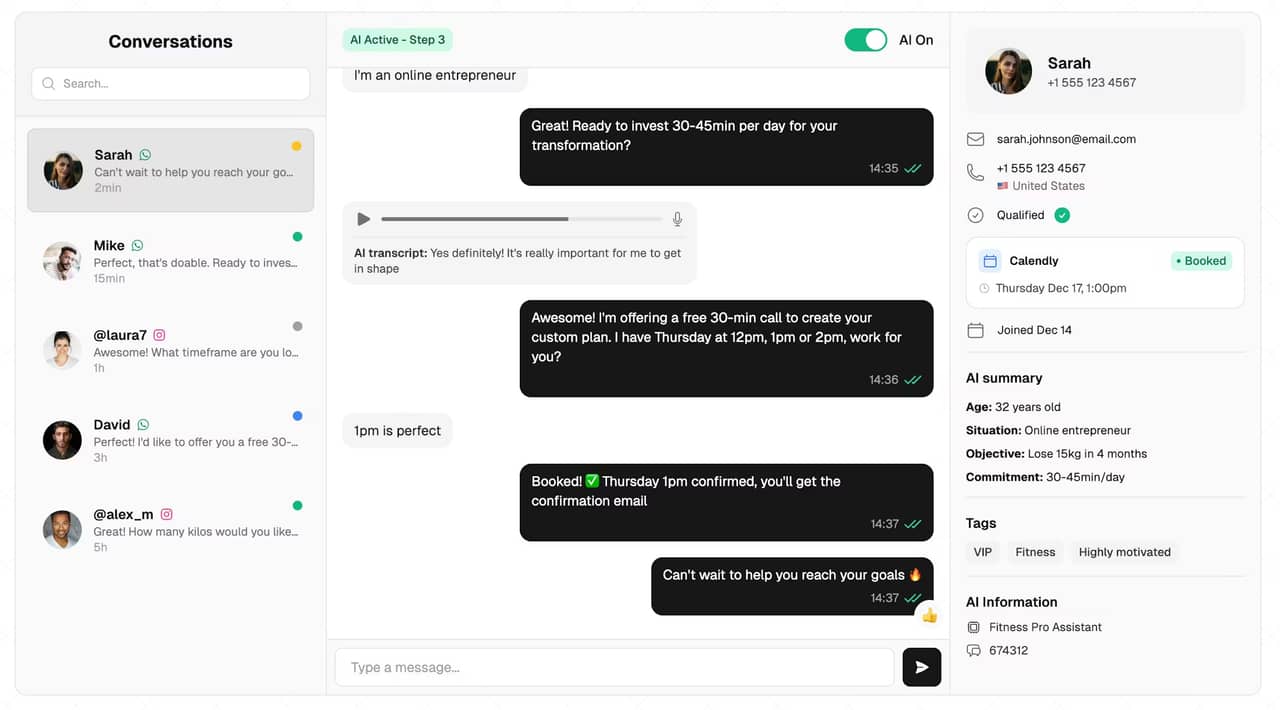
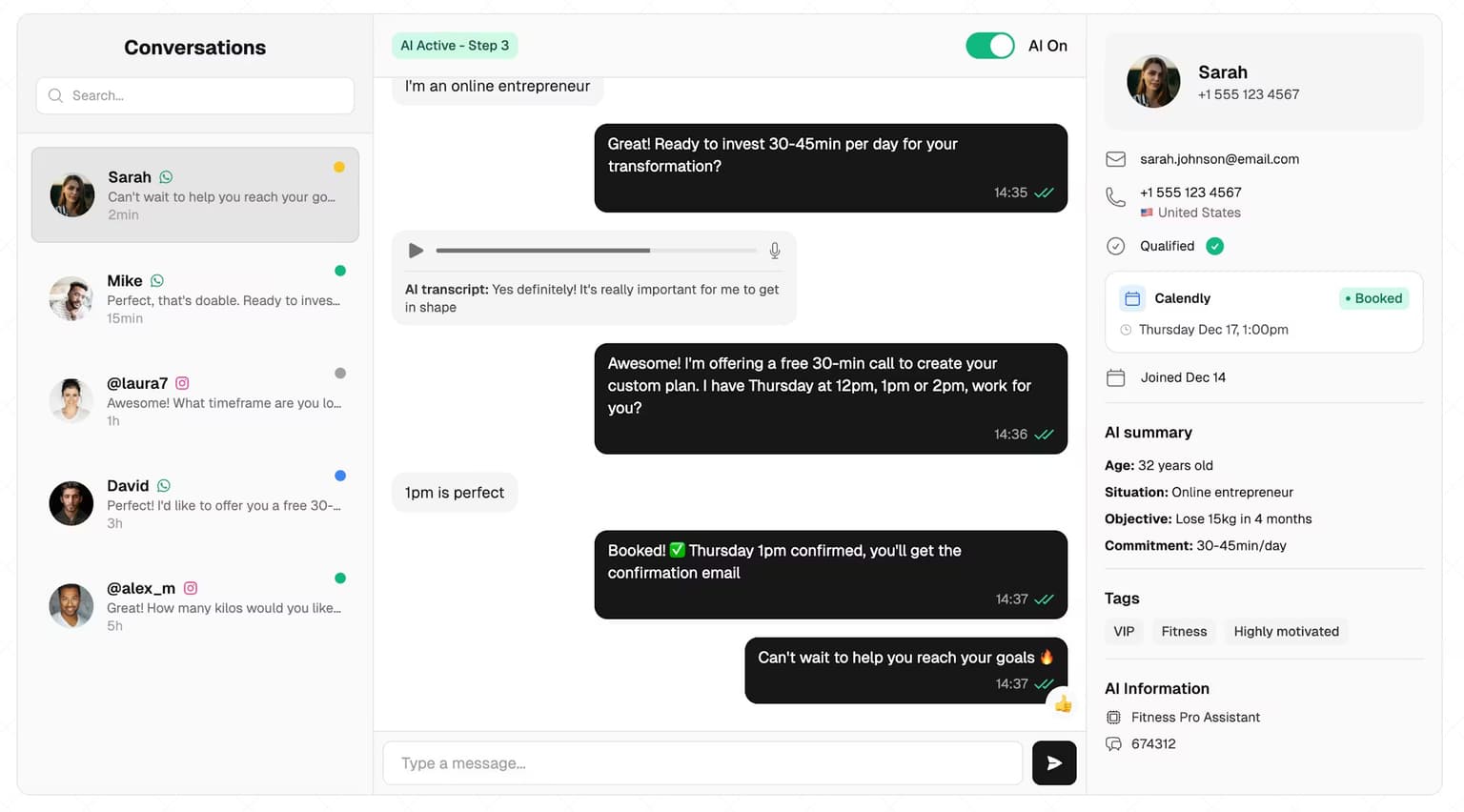
SetSmart is a DM-native AI setter that handles the five intake jobs end-to-end across IG DM, WhatsApp, Messenger, and SMS, with a website widget as an option. It replies in under 5 seconds, asks 4-6 automotive-intake-aware qualification questions, recognises high-intent keywords ("test drive", "trade-in", "today") to escalate to the right salesperson, and books a test-drive slot for the buyer — all from inside the same DM thread. The follow-up sequence runs for 30 days on the no-reply pile, which matters because most car shoppers compare 2-4 dealerships before signing anything.
The wedge versus legacy automotive chatbots: legacy tools live on the dealership website only and rely on a human BDC rep to relay the chat to WhatsApp. SetSmart treats DM and WhatsApp as primary, not as an afterthought. That matches how Gen-Z and millennial buyers, EV shoppers, and used-car browsers actually initiate contact — see also WhatsApp automation for businesses for the broader pattern and click-to-WhatsApp ads for the paid-acquisition path.
- Channels: IG DM, WhatsApp, Messenger, SMS, website widget
- AI quality: GPT-4-class, prompt-customisable per brand and store
- Automotive features: inventory-aware replies, test-drive booking, trade-in capture, salesperson routing by make
- CRM / DMS integration: VinSolutions, Elead, DealerSocket, HubSpot, Salesforce via native or Zapier
- Pricing: Free 7-day trial, then $97/month flat (1,000 messages included)
- Where it loses points: not the cheapest if you only need a website widget; a web-only product like Rybo or Tidio will cost less if DMs aren't part of your funnel.
2. Podium (Jerry AI) — best all-in-one for single-rooftop dealers
Best for: dealerships that want a single platform covering website chat, SMS, Google reviews, and payments — without buying four tools.
Podium has long been the Swiss Army knife of dealership communications: a chat widget on the site, a customer-messaging inbox that consolidates SMS and Google Business Messages, review requests, and payment links. The 2026 release of Jerry AI added a GPT-driven chatbot that handles the first conversation on the site and replies to Google Business Messages automatically, then hands off to the BDC for high-intent leads. The strength is the bundle: chat + SMS + reviews + payments in one workflow.
The trade-off vs SetSmart and Gubagoo: Podium is great if you want one stop, but it's website + SMS first and has limited native coverage of Instagram DM and WhatsApp. Mid-size dealer groups often pair Podium for SMS and reviews with a DM-native tool for Instagram and WhatsApp.
- Channels: website widget, SMS, Google Business Messages, Facebook Messenger (via add-on)
- AI quality: Jerry AI (GPT-driven) on the chat layer
- Automotive features: dealer review automation, payment links for deposits, BDC inbox
- CRM / DMS integration: VinSolutions, Elead, DealerSocket, CDK Drive
- Pricing: typically starting around $399/month for the chat + SMS bundle, scaling with seats and message volume
- Where it loses points: limited native IG DM / WhatsApp, pricier than software-only single-purpose tools.
3. Gubagoo ChatSmart — best for 24/7 human-backed dealer chat
Best for: franchise dealerships that want a managed chat service with US-based agents trained on automotive intake — not just AI alone.
Gubagoo (now part of Reynolds & Reynolds) has been one of the dominant website-chat vendors in the dealership world for over a decade. ChatSmart is the 2026 version: AI-driven first response, with live agents escalating any conversation that goes off-script or needs OEM-specific knowledge. The bot fires first, the agent takes over on complex matters, and the chat is delivered as an email / SMS / CRM lead to the dealership. Coverage is 24/7/365. For franchise dealers uncomfortable with a fully autonomous AI on a major-brand site, the human-in-the-loop model is reassuring — and well-tuned to OEM-compliance requirements that vary by manufacturer.
The cost: pricing is typically volume-based (per chat or per qualified lead), which can add up at high-traffic stores. And speed of first response is slower than a true AI bot — a few seconds at minimum for the live agent to type.
- Channels: website widget; SMS / email lead delivery; Facebook Messenger via add-on
- AI quality: scripted + GPT layer + live operators
- Automotive features: VDP-aware bot, OEM-compliant scripts, trade-in capture
- CRM / DMS integration: VinSolutions, Elead, DealerSocket, CDK Drive, Reynolds Contact Management
- Pricing: custom, generally several hundred to a few thousand dollars per month per store
- Where it loses points: web-only orientation, no native IG DM or WhatsApp, pricing scales with volume.
4. Spyne AI — best for inventory-driven used-car dealers
Best for: used-car groups and multi-rooftop dealers that want the chatbot wired tightly into VDPs and a photography / merchandising stack.
Spyne started as an automotive imaging platform and added an AI chatbot in 2024-2025 that pulls inventory data directly from the site's VIN list. When a buyer asks "Is this 2023 F-150 still available with the tow package?", Spyne can answer in context — pull live availability, surface comparable units, and offer to book a test drive. The strength is the merchandising integration: photos, 360s, descriptions, and chat are all powered by the same product.
The trade-off: Spyne is built around the website and the VDP. If your sales pipeline lives more in Instagram DMs or WhatsApp, you'll outgrow the channel coverage quickly.
- Channels: website widget, VDP-embedded chat
- AI quality: GPT-4-class, inventory-aware
- Automotive features: live inventory pull, image-aware responses, comparable-vehicle suggestions
- CRM / DMS integration: VinSolutions, DealerSocket via Zapier
- Pricing: custom; mid-market positioning
- Where it loses points: web-only, no native DM / WhatsApp, opaque pricing for small dealers.
5. Rybo — best lightweight AI dealer chatbot
Best for: single-rooftop dealers, indie used-car lots, and EV brands looking for a website AI chatbot without an enterprise contract.
Rybo is one of the newer entrants in the automotive AI chatbot space. The product is a website widget that uses GPT to answer dealer-site questions, capture leads, and route to the right salesperson. The bot is trained on the dealership's inventory feed and FAQs; setup is mostly self-serve. The strength is the lower price point and the faster time-to-launch compared to Gubagoo.
The downside: Rybo is website-only and lighter on automotive-specific features (no native trade-in valuation, no financing pre-qualification). Good entry point, less of a "single stack" play.
- Channels: website widget
- AI quality: GPT-driven, inventory-aware
- Automotive features: lead capture, basic VDP context, salesperson routing
- CRM / DMS integration: VinSolutions, Elead via webhook or Zapier
- Pricing: custom, generally lower than Gubagoo or Podium
- Where it loses points: website-only, lighter automotive feature set than Spyne or Gubagoo.
6. AutoFi — best financing & trade-in chatbot layer
Best for: dealers leaning into online financing, soft credit pre-qualification, and trade-in valuation as part of the digital-retail funnel.
AutoFi sits at the intersection of automotive chatbot and digital-retail platform. The chat layer captures the buyer's vehicle of interest, walks them through a soft credit application, generates a financing pre-qualification, and surfaces a trade-in estimate via Kelley Blue Book / Black Book integrations. The output: a deal jacket that's mostly built by the time the buyer walks in or hops on a call.
AutoFi makes more sense as part of a digital-retail strategy (alongside Roadster, Modal, or CarNow) than as a pure chatbot. If your goal is just "answer questions, book test drives", it's overkill.
- Channels: website widget, embedded in VDP and finance-application flow
- AI quality: scripted + GPT layer on financing prompts
- Automotive features: soft credit pull, KBB / Black Book trade-in, deal-jacket builder
- CRM / DMS integration: VinSolutions, Elead, CDK, Reynolds
- Pricing: custom; usually volume-based or part of a digital-retail bundle
- Where it loses points: heavy product overkill if you don't already run digital retail; web-only.
7. Tidio — best free / cheap chatbot for indie used-car lots
Best for: very small used-car lots, indie sellers, and brand-new dealerships testing the category without committing budget.
Tidio is a generic SMB chatbot that runs on website widgets and can be configured for automotive intake with a custom flow. The free plan covers 50 conversations per month; the paid plans start around $29/month and scale with seats and triggers. The bot can collect contact details, ask basic qualification questions, and book a test drive via a Calendly link.
Tidio is not built for automotive specifically — no VIN parsing, no inventory pull, no trade-in valuation, no DMS integration out of the box. For an indie dealer running a Shopify-like inventory site or a small WordPress dealer page, it's a solid starter. For a franchise with 100+ units in inventory, you'll outgrow it within a quarter.
- Channels: website widget; some Instagram and Messenger via paid plans
- AI quality: GPT add-on, scripted flows
- Automotive features: none native; configurable
- CRM / DMS integration: Zapier-based
- Pricing: free up to 50 conversations / month, paid from $29/month
- Where it loses points: not automotive-specific, no DMS integration, limited at scale.
Automotive chatbot coverage by channel
The single biggest differentiator across the 7 isn't features — it's which channels each chatbot actually runs on. This table is the fastest way to see the gap.
| Chatbot | Website / VDP | IG DM | Messenger | SMS | |
|---|---|---|---|---|---|
| SetSmart | Yes | Yes | Yes | Yes | Yes |
| Podium (Jerry AI) | Yes | No | Partial (add-on) | No | Yes |
| Gubagoo ChatSmart | Yes | No | Partial | No | Yes |
| Spyne AI | Yes | No | No | No | Partial |
| Rybo | Yes | No | No | No | No |
| AutoFi | Yes | No | No | No | Yes |
| Tidio | Yes | Paid add-on | Paid add-on | No | No |
The pattern: 6 of the 7 are website-centric. Only SetSmart covers the DM + WhatsApp side natively. If your dealership runs Meta or click-to-message ads, the gap matters.
Which automotive chatbot first? — decision framework
Here's how to match the chatbot to the dealership's current lead source mix. Pick the row that describes where most of your monthly leads actually come from.
| Your main lead source | Start with | Add later |
|---|---|---|
| Cars.com / AutoTrader / dealer site (organic) | Gubagoo or Podium | SetSmart on IG DM |
| Click-to-Messenger or click-to-WhatsApp ads | SetSmart | Rybo on the dealer site |
| Instagram Reels & DMs (used car, EV brands) | SetSmart | Podium for SMS & reviews |
| Digital retail / online financing focus | AutoFi or Spyne | SetSmart for DM channels |
| Single-rooftop dealer, any brand | SetSmart or Rybo (cheapest entry) | Podium when revenue allows |
| Franchise dealership group (5+ stores) | Gubagoo + Podium | SetSmart on the DM channels |
The simplest rule: if your monthly lead mix is more than 25% DM / WhatsApp / Messenger, lead with a DM-native tool. Otherwise lead with a website + SMS tool and add DM second.
3 paste-ready automotive chatbot scripts
The actual chatbot copy matters more than the vendor. The three scripts below — one per channel and use case — are the ones that consistently outperform generic "How can I help you?" openers on automotive intake. Paste them into your chosen tool and adjust the placeholders.
Website widget — new-car shopper
"Hi — looking at a new vehicle? I'm the virtual assistant. Three quick things so I can get you the right answer:
- Which make / model are you considering? (or 'browsing' is fine)
- Are you trading anything in? (year + make + model, no VIN needed)
- Looking to buy in the next 30 days, 60 days, or just researching?
If a test drive makes sense, I'll book one with the right salesperson on your preferred make today or tomorrow. If you'd rather talk to a person, just say 'human' and I'll page our BDC."
This opens with the practical question (make / model) rather than asking for the phone number, qualifies on the three things every sales manager wants to know (interest, trade-in, timeline), and leaves a "say 'human'" safety valve that dramatically lifts completion rates.
Instagram DM — used-car / EV brand
"Hey — thanks for the DM about the . Three quick questions so I can give you a straight answer:
- Are you paying cash or looking to finance / lease?
- Roughly what's your monthly budget?
- Are you trading anything in? (year + make + model)
If we're a fit on price & timing, I'll book a test drive at today or tomorrow — or send you a quick walk-around video if you can't come in this week."
Three questions, one fallback offer (walk-around video), and an immediate test-drive booking option. Instagram inquiries on used cars tend to be price-sensitive; the chatbot's job is to triage and route, not to negotiate. The video offer recovers buyers who can't drop by but are otherwise serious.
WhatsApp — service / test drive
"Hi , this is the WhatsApp service line for . To get you booked, four quick questions:
- Service or test drive?
- Year, make, and model of the vehicle?
- Approximate mileage? (for service) — or trim & color preference (for test drive)
- Best day this week to come by?
Once I have these, I'll confirm the slot and send you the bay number / salesperson on the day."
The "service or test drive" branch is essential — WhatsApp in dealership context handles both intake and after-sales service, and conflating them clogs the funnel. The mileage / trim branch routes by use case and keeps the chatbot conversation tight. See our WhatsApp automation guide for the broader WhatsApp playbook used across verticals.
AI vs scripted automotive chatbot — what's actually different in 2026
The single most common buying confusion in 2026 is between a scripted chatbot and an AI one. Both call themselves "chatbots". They behave very differently when a buyer goes off-script — which on automotive intake is most of the time ("Does it have the tow package? What's the residual on a 36/12k lease? Will my Apple CarPlay work with this trim?").
| Capability | Scripted bot | AI chatbot (2026) |
|---|---|---|
| Handles off-script buyer questions | No (falls through) | Yes |
| Mirrors buyer tone & urgency | No | Yes |
| Adapts qualification by vehicle type | Only if flow is built | Yes, dynamically |
| First response time | Instant | Under 5 seconds |
| Risk of misquoting price / financing | Low (constrained) | Medium (needs guardrails) |
| Setup time | Days (flow building) | Hours (prompt tuning) |
The 2026 picture: AI chatbots win on every dimension except the "misquoting price" risk — and that's manageable with the right system prompt (never quote a final price, always defer to the salesperson) and a clear disclaimer. Every chatbot in our top 5 is now AI-driven; pure scripted bots have effectively been retired in the automotive vertical.
How to deploy an automotive chatbot in 7 days
A realistic timeline for a single-rooftop or small dealer group rolling out their first chatbot:
- Day 1 — Pick the channel. Decide whether you're starting on website, DM, or both. If you're not sure, look at where last month's 30 leads actually arrived. Lead with that channel.
- Day 2 — Sign up and connect. Trial the tool, connect your Meta Business / dealer website / inventory feed. SetSmart and ManyChat take under an hour to connect; Podium and Gubagoo take a kickoff call.
- Day 3 — Write the intake script. Use one of the three scripts above as your base. Adapt to your brand mix, your store's hours, and the one or two things you wish you knew before every test drive.
- Day 4 — Define escalation keywords. "Today", "right now", "cash buyer", "fleet", "commercial", "trade-in over $20K", "Toyota tomorrow". Any of these should bypass the bot and page the BDC / sales manager.
- Day 5 — Configure handoffs and the calendar. Hook the chatbot to your CRM (VinSolutions / Elead / DealerSocket) and your Calendly / dealer scheduler. Test booking with three fake personas (new-car shopper, trade-in heavy, used-car browser).
- Day 6 — Soft launch. Turn it on during business hours only for the first 48 hours. Watch the first 10 transcripts. Fix obvious wording problems and OEM-compliance hiccups.
- Day 7 — Full launch and 30-day follow-up sequence. Go 24/7. Turn on the no-reply follow-up sequence (2 follow-ups in the first 24 hours, then +7 / +14 / +30 days). See our AI lead follow-up guide for the cadence specifics.
By the end of week 2, you'll have enough transcripts to identify the 3-5 things buyers ask that your script doesn't yet handle (residual values, manufacturer rebates, EV charging questions, OEM-financing programs). Iterate from there.
Single-rooftop vs franchise group — different chatbot, different stack
The right automotive chatbot depends as much on dealership size as on brand mix.
- Single-rooftop independent or used-car lot. Pick one tool that covers your dominant channel. SetSmart at $97/month if you're DM/WhatsApp-heavy. Rybo or Tidio if you're website-heavy and want a self-serve setup. Don't try to deploy three chatbots at once.
- Single-rooftop franchise (e.g. one Toyota store, one Honda store). Pair Podium for website + SMS + reviews with SetSmart for DM / WhatsApp. Two tools, one for each side of the funnel, both under $500/month combined.
- Multi-rooftop group (5+ stores). Add Gubagoo or ChatSmart for OEM-compliant website chat across the whole group, keep Podium for SMS and reviews, and run SetSmart on Instagram / WhatsApp at the brand-level account. The three layers cover 95% of inbound. Pair this with lead qualification questions tuned to each brand's intake standards.
- EV-only or DTC brand. Lead with SetSmart on Instagram and WhatsApp (where most EV buyers shop). Add a simple website widget like Rybo for the model-spec questions. Skip Gubagoo unless you have a physical showroom.
The mistake at every dealership size is buying the most expensive tool first. Start lean, prove the ROI on week-1 transcripts, then layer.
5 automotive chatbot mistakes that quietly kill conversion
The recurring patterns we see when dealers audit a chatbot that "isn't working":
- The chatbot asks for the phone number first. Don't. Ask about the vehicle first. Buyers will share trim and budget to a bot but resist giving phone before they feel the conversation is going somewhere. Ask for contact info only after the vehicle of interest is qualified.
- No escalation keyword. A buyer typing "ready to buy today" or "cash" should not still be answering "What's your last name?". Build a hard escalation rule for high-intent keywords — paging a salesperson within 60 seconds is the difference between closing and losing the deal.
- No follow-up on the no-reply pile. Automotive inquiries that go quiet at message 2 are still convertible — most car shoppers contact 3-4 dealerships simultaneously. A single follow-up the next day recovers a meaningful share of them. Our breakdown of generative AI for sales covers the broader pattern of automating the no-reply pile.
- The bot pretends to be human. Don't. Identify as "the virtual assistant" or "the chatbot". Trying to pass as human breaks trust the moment a buyer notices, and may run afoul of California, Colorado, and some EU rules on disclosure of AI.
- No price or financing guardrail. The chatbot must not quote a final out-the-door price, a residual value, or a financing rate without a human reviewing. Set a system prompt that defers any price discussion to "your dedicated salesperson will confirm the exact figure". Without this guardrail, dealers get into compliance issues fast.
A linked failure pattern that affects intake across verticals: slow response time. See lead response time statistics for the data on how response speed correlates with intake conversion.
Free automotive chatbots — what's actually available
Free options for dealers wanting to test the category without committing budget:
- ManyChat free plan — works on IG DM and Messenger, can be configured for automotive intake with a custom flow. Limited contacts (~1,000) and no native automotive features. See ManyChat pricing and ManyChat alternative for the trade-offs vs paid AI tools.
- Tidio free plan — website widget, 50 conversations / month. Decent for an extremely low-volume used-car lot.
- Chatfuel free tier — IG DM and Messenger, limited to 50 conversations. See Chatfuel pricing.
- Custom GPT (ChatGPT Plus) — for an indie dealer, a "Test Drive Concierge GPT" on the public ChatGPT directory can capture lightweight inquiries. No integration with your DMS, no follow-up, no DM/WhatsApp.
None of these are a substitute for a real intake tool above a tiny inquiry volume. They're useful for proving you'd use one before buying.
Automotive chatbot vs DMS vs CRM — the disambiguation
A common buyer-confusion point: dealers search "automotive chatbot" when they really need a DMS or a dealership CRM. Here's how to tell them apart.
- Automotive chatbot — handles the first conversation with a prospective buyer. Captures contact details, qualifies on vehicle / budget / timeline, books a test drive. Examples: SetSmart, Podium Jerry AI, Gubagoo ChatSmart. Lives on the website + DM + WhatsApp.
- Dealership CRM — organises and routes leads after the first conversation. Tracks the test drive, the deal jacket, the F&I status, the delivery. Examples: VinSolutions, Elead, DealerSocket, HubSpot Auto. Lives in the back office.
- DMS (dealer management system) — runs the store itself. Tracks inventory, parts, service, F&I, accounting. Examples: CDK Drive, Reynolds & Reynolds, Auto/Mate, Dealertrack DMS. Lives in the store.
The three layers are complementary, not substitutes. A good 2026 stack at a single-rooftop dealer is: chatbot + dealership CRM + DMS — three tools, each doing one thing well. For the broader playbook on stacking sales AI across a workflow, see CRM sales automation.
Real dealerships running this stack
Three composite examples (store names anonymised, workflow real) of how working dealerships combine the tools above:
- Single-rooftop Toyota dealer, Texas. Podium Jerry AI on the website (organic + Google Ads traffic) + SetSmart on Instagram and click-to-WhatsApp ads + VinSolutions for CRM. Result: chats answered in under 5 seconds, the BDC works only the qualified pile, after-hours leads converted at the same rate as weekday walk-ins for the first time.
- Indie used-car lot, 80 units, Florida. SetSmart on Instagram and Facebook DMs (organic + a small ad budget) + Rybo on the dealer website + Calendly for booking. Result: ~80 inbound DMs per month converted to ~22 test drives, no after-hours staff, monthly tools cost under $200 all-in.
- EV-only DTC brand, California. SetSmart for WhatsApp and IG DM (90% of their inquiries) + a custom website widget for spec questions + DealerSocket for the back-office CRM. Result: 24/7 intake in EN and ES, average time-from-DM-to-test-drive dropped from 36 hours to under 90 minutes.
The common pattern: one chatbot per channel, one CRM, one DMS. No dealership above runs more than two chatbots at the same time.
When NOT to deploy an automotive chatbot
Not every dealership should. Skip the chatbot if any of these are true:
- You don't yet have a consistent lead volume. Below ~10 inquiries per month, a chatbot is over-tooled. Answer the phone yourself for another quarter, see what people actually ask, then deploy.
- Your inventory turns over too fast for the bot to keep up. A used-car lot that flips 200 units a month needs a tight inventory-feed integration. Don't deploy a chatbot that can't pull live availability — it'll quote on units already sold and create customer-service problems.
- Your OEM contractually restricts third-party chat. Some manufacturers (luxury brands especially) require OEM-approved chat vendors only. Check your dealer agreement before deploying.
- You can't handle the leads you already have. A chatbot multiplies your inbound. If your BDC is already backlogged, fix the staffing first, then add the chatbot. Otherwise you'll just generate more frustrated buyers.
If none of the above apply, you're a candidate.
Automotive chatbot vs consumer auto AI — different jobs
A clarification that surfaces in every "best automotive AI" thread: a dealership intake chatbot and a consumer-facing auto AI (CarGurus' Charlie, Edmunds' AI assistant, generic GPT custom bots) are not substitutes. They sit on different sides of the marketplace.
- Automotive (dealership intake) chatbot. Talks to prospective buyers at the front of the store. Examples: the 7 above.
- Consumer auto AI. Talks to shoppers before they ever pick a dealership. Helps them research, compare trims, decode an OBD code, or simulate a financing scenario. Examples: CarGurus Charlie, Edmunds AI, MotorTrend AI, generic GPT custom bots.
You'll likely see both in your buyer's path. Consumers use Charlie or a custom GPT to narrow their shortlist, then DM your dealership for "Is this exact unit available?" — which is where your intake chatbot picks up. They don't compete for the same budget line, and confusing them is the source of most "ranked best automotive AI" lists that don't help anyone.
FAQ
What is an automotive chatbot?
An automotive chatbot is an AI-driven assistant that handles the first conversation with a prospective buyer on a dealership's website, Instagram DM, Facebook Messenger, WhatsApp, or SMS. It captures contact details, qualifies on vehicle / budget / timeline, and either books a test drive or hands the conversation off to a salesperson or BDC rep. Modern automotive chatbots in 2026 are GPT-driven, respond in under five seconds, and run 24/7.
What is the best automotive chatbot in 2026?
There's no single "best" — it depends on the dealership's lead mix. For dealers running click-to-Messenger or click-to-WhatsApp ads, SetSmart is the DM-native pick. For website + SMS + reviews on a single-rooftop store, Podium Jerry AI is the all-in-one. For franchise groups wanting OEM-compliant, human-backed chat, Gubagoo ChatSmart is the legacy choice. For inventory-driven used-car lots, Spyne AI ties the bot to the VDP feed.
Is there a free automotive chatbot for car dealerships?
Yes — ManyChat's free tier (IG DM + Messenger), Tidio's free website widget (50 conversations/month), and Chatfuel's free tier all work for very low lead volumes. None of them have automotive-specific features (VIN parsing, inventory pull, trade-in valuation, DMS integration). They're useful for proving you'd benefit from a paid tool, not as long-term solutions above ~10 inquiries per month.
How much does an automotive chatbot cost in 2026?
Pricing ranges widely. DM-native AI tools like SetSmart start at a flat $97/month for 1,000 messages. Website + SMS bundles like Podium typically start around $399/month and scale with seats. Enterprise dealership chat (Gubagoo, AutoFi, Spyne) is quoted custom — typically several hundred to several thousand dollars per month depending on volume and whether human-backed escalation is included. Free tiers exist (ManyChat, Tidio, Chatfuel) for low-volume testing.
How do I build a chatbot for the automotive industry?
Three paths. (1) Buy off-the-shelf: SetSmart for DM / WhatsApp, Podium or Gubagoo for the website. Configure your script and inventory feed; live in days, not weeks. (2) Use a builder: ManyChat, Chatfuel, or Tidio to build a custom flow on Instagram DM or website. Free or low-cost, but no native automotive features. (3) Build custom: hire an agency or developer to fine-tune a GPT-4-class model on your inventory and FAQs, then deploy via the OpenAI API. Most expensive, longest setup, only justified if you have unique workflow needs not covered by off-the-shelf vendors. Agencies serving several dealerships can compare rebrandable platforms in our white label AI chatbot platforms roundup.
Can an automotive chatbot quote prices or financing rates?
It can, but in 2026 most dealers configure their bot to defer on final pricing. The bot can share MSRP, dealer-stated starting prices, and rough financing estimates ("typical APR for your credit tier is around X%"), but should always end with "your dedicated salesperson will confirm the exact out-the-door figure". Quoting hard numbers without human review creates compliance and customer-service problems — and erodes trust when the in-store number differs from the bot's quote.
Does an automotive chatbot work for service appointments, not just sales?
Yes — and it's one of the higher-ROI use cases. A service chatbot books oil changes, brake jobs, tire rotations, and recall work via WhatsApp or SMS, syncs with the service department's calendar, and sends reminder messages 24 hours before the appointment. Many of the tools above (Podium, Gubagoo, SetSmart) support both sales and service workflows in the same product, with branch-based routing on the first message ("Service or test drive?").
Ready to automate your DMs?
Start your free 7-day trial and let AI handle your lead qualification 24/7.
Try SetSmart free