How to Sell Online Courses: Instagram DM Method (2026)

To sell an online course, you need a specific outcome for a specific person, proof that people will pay for it before you build it, and a sales path that matches the price. A $49 mini-course sells from a checkout link. A $497 course usually needs a short conversation first. A $2,500 program with coaching sells on a booked sales call. On Instagram, all three start the same way: a post that makes someone comment a keyword or send you a DM, and a fast, human reply.
That last part is where most courses stall. The content works, people comment, and then nobody answers the DMs for a day. In the 828K AI DM conversations we analyzed, 53% of conversations died before message 3, and a single follow-up doubled booked calls. A course launch is a burst of conversations, and the money is in how many of them you actually finish.
This guide is written for coaches and creators who sell knowledge through Instagram (and often WhatsApp): fitness and nutrition coaches, business coaches, educators, anyone with an audience and a skill. You will get the eight steps in order, the 2026 fees of the main course platforms, a launch calendar, DM scripts for buyers, the numbers to watch and the US rules that apply to course marketing.
How to sell online courses: the 8 steps
- Pick one outcome for one person. "Lose your first 5 kg without counting calories, for busy mothers" sells. "Nutrition masterclass" does not.
- Validate before you record. Presell a beta cohort or open a waitlist. Money or sign-ups are the only proof that counts.
- Let the price decide the sales path. Link, DM conversation or sales call, depending on what you charge.
- Choose a platform you can afford. Monthly fee plus transaction fee, compared at your real volume.
- Build demand on Instagram. Teach one piece of the course in public and end each post with a reason to message you.
- Turn comments and story replies into DMs. Answer fast, ask one or two questions, then send the link or book the call.
- Launch with a deadline. A short open-cart window beats a course that is "always available" and never urgent.
- Follow up and measure. Nudge the quiet ones in time, then fix the stage of the funnel that leaks the most.
The rest of this guide takes each step in turn. If you already sell on Instagram and want the general method rather than the course-specific one, our guide on how to sell on Instagram covers profiles, content and selling services.
Can you really make money selling online courses?
Yes, but the money comes from the sales system, not from the course file. A finished course that nobody hears about earns nothing. The revenue of a course business is a simple product: how many of the right people see your offer, how many of them start a conversation or click, how many of those buy, and at what price.
That math is why two creators with the same audience size can earn very different amounts. Here is an illustration with round numbers, not a benchmark:
| Scenario | People who start a conversation | Buyers | Price | Revenue |
|---|---|---|---|---|
| Low-ticket, link only | 300 | 30 | $49 | $1,470 |
| Mid-ticket, DM first | 300 | 12 | $497 | $5,964 |
| High-ticket, booked call | 300 | 4 | $2,500 | $10,000 |
The point is not the exact numbers. It is that each sales path needs a different amount of work per buyer, and that every leak (unanswered DMs, a slow reply, no follow-up) cuts the result at every price. Plan for a small number of buyers from your first launch, and treat it as a test of the system rather than a verdict on your idea.
Step 1: Pick an outcome people already pay for
The courses that sell describe a result, a person and a timeframe. "Learn Instagram" is a topic. "Book your first 10 coaching calls from Instagram in 30 days, without ads" is an outcome.
Three places tell you which outcome your audience will pay for:
- Your DMs and comments. The questions people ask you for free are the course. Copy their exact words into a note for a week.
- What you already sell 1:1. If clients pay you for coaching, the course is usually the repeatable part of that coaching, packaged so you do not have to say it every time.
- What people already buy elsewhere. Competing courses, books and programs prove there is demand. Your angle is the person or the method they ignore.
A clear outcome also makes every later step easier: the content writes itself (teach one piece of the result), the DM qualification is obvious (does this person want this result?), and the sales page has one promise to keep. If you sell coaching too, our guide to building a high-ticket offer explains how to package a program that people buy after a real conversation, not on impulse.
Step 2: Validate the course before you record it
Do not spend two months filming modules nobody asked for. Sell first, build second. Three ways to validate, from fastest to strongest:
- A waitlist with a keyword. Post about the outcome, ask people to comment a word to join the waitlist, and count. Comments are cheap, so treat this as a signal, not proof.
- A paid pilot. Offer a live beta cohort at a founding price, delivered over a few weeks on calls or in a group. If ten people pay, you have proof, testimonials and the real questions to build the course around.
- A presale with a refund promise. Sell the course before it exists, with a clear delivery date and a refund if you do not deliver.
A good lead magnet speeds this up. A checklist or a short training that solves the first part of the problem tells you who is interested enough to give you their attention. Our list of lead magnet ideas has fifteen that work in Instagram DMs.
Step 3: Let the price decide how you sell
This is the decision most guides skip. The price of your course decides how much conversation a buyer needs before they pay, and that decides your whole funnel.
| Price band | How people buy | What the DM has to do | Main sales asset |
|---|---|---|---|
| Under about $200 (mini-course, workshop, template pack) | From a checkout link, alone | Send the link, answer one or two questions | Short sales page or a link-in-bio store |
| About $200 to $1,000 (signature course) | After a short conversation | Check the fit, handle the main objection, then send the link | Sales page plus DM, often a webinar |
| Above about $1,000 (course plus coaching, cohort, mentorship) | On a booked sales call | Qualify the lead and book the call | Application or booking link, a video or training before the call |
Use these bands as a starting point, not a law: your audience's buying power matters more than the number. The trap is mixing paths. A $2,500 program sold with a "buy now" link gets few buyers and a lot of refund requests. A $29 course that requires a call wastes your calendar.
For the high-ticket path, the DM is the appointment-setting step: it qualifies and books, and the close happens on the call with you or your closer. Our Instagram sales funnel guide walks through each stage from the first follower to the closed call. For the mid-ticket path, a free training often does the heavy lifting: the automated webinar funnel playbook shows how to run one on repeat and follow up in the DM.
Step 4: Choose where the course lives (2026 fees)
The platform hosts the videos, takes the payment and gives access. Pick it once you know your price and your sales path, and compare the total cost at your expected volume: monthly fee plus transaction fee plus card processing.
Prices below were checked on each vendor's pricing page on November 27, 2026 (in US dollars, before tax):
| Platform | Entry plan | Fee on sales | Good fit when |
|---|---|---|---|
| Teachable | Starter: 39 dollars a month, or 29 billed yearly (7-day trial, no free plan) | 7.5% on Starter, 0% from Builder (89 dollars a month) with Teachable Payments, plus card processing | You sell one or a few courses and want simple hosting |
| Kajabi | Basic: 179 dollars a month, or 143 billed yearly (14-day trial) | No revenue share, card processing applies | You want courses, email, pages and checkout in one tool |
| Skool | Hobby: 9 dollars a month | 10% on Hobby, 2.9% on Pro (99 dollars a month) | Your course is a community with calls |
| Stan | Creator: 29 dollars a month, or 300 a year (14-day trial, no free plan) | No cut of sales, card processing applies | You sell low-ticket products from your Instagram bio |
Two details that older comparison articles miss. Teachable no longer has a free plan: its pricing FAQ says it is a paid service with a 7-day trial and a 30-day money-back guarantee, and its Starter plan keeps a 7.5% transaction fee. Kajabi now lists "Comment to DM" automation on its Growth and Pro plans (249 and 499 dollars a month, billed monthly), so a Kajabi user can send a link when someone comments a keyword. That covers delivery, not the conversation that follows.
For a ranked comparison of hosting tools, see our list of the best online coaching platforms. The short version: at a low price and low volume, a percentage fee costs less than a big monthly plan; once you sell every month, the flat monthly plan usually wins.
Step 5: Build demand on Instagram
Instagram sells courses when your content does two jobs at once: it proves you can get the result, and it gives people a reason to message you. Reach alone does not sell a course. Conversations do.
The content mix that feeds a course launch:
- Teaching posts with a keyword. A carousel or reel that solves one small piece of the outcome, ending with "comment PLAN and I'll send you the full checklist". Every comment is a hand raised.
- Proof posts. A client result, a before and after, a screenshot of a message from a student (with their permission). Proof answers the question every buyer has: does this work for someone like me?
- Behind-the-scenes stories. Story polls and question stickers asking what people struggle with. Each reply opens a DM conversation you can continue.
- Objection posts. "I don't have time", "I tried before", "I'm not ready": one post per objection, written in the words your followers use.
- A quiz or a free training. A short quiz that sorts people by situation lets you send each person the right next step. Our quiz funnel guide covers the tools and the DM follow-up.
Keep the call to action inside Instagram. Asking someone to comment or reply is easier than asking them to leave the app, find your link in bio and fill a form. You send the link in the DM, once they have answered.
Step 6: Turn comments and story replies into DMs
This is where the sale happens or dies. Someone comments your keyword at 10 p.m. If the reply arrives the next afternoon, the moment is gone.
Two Meta rules shape how you do this with automation. When someone comments on your post, an Instagram tool can send them one private reply in the DM, within 7 days of the comment. After that, a normal message can only be sent inside the standard messaging window, which lasts 24 hours from the person's last message for most actions (up to 7 days after a first message from a Click-to-Direct ad). Our guide to Instagram comment-to-DM automation explains the setup step by step.
What to send, depending on your price path:
Low-ticket: deliver, then ask one question.
"Here's the checklist you asked for: link. Quick question so I can point you to the right next step: are you starting from zero or already doing this?"
Mid-ticket: qualify before the link.
"Hey Sam, thanks for commenting! Before I send the details, what's your situation right now: are you already coaching clients, or still planning your first offer?"
Then, when they answer: "Got it. The course is built exactly for that stage. It's $497, lifetime access, and the first module is about their problem. Want the link?"
High-ticket: qualify and book the call.
"Thanks for reaching out! Two quick questions so I don't waste your time: what result do you want in the next 90 days, and have you invested in coaching before?"
If the answers fit, offer two time slots or your booking link. If they do not, recommend the cheaper course instead. A good no is still a sale.
Answer questions about price directly. Hiding the price until a call makes people leave. If someone says "let me think about it", ask what they are weighing, not when they will decide. A practical detail: on a new or recently restricted account, wait until the person has replied before you send a link, rather than opening with one.
If you already use a flow builder and hit its limits at launch time, our comparison of ManyChat alternatives for course creators covers what to look for when the volume spikes.
Step 7: Launch with a deadline (or go evergreen)
A course that is always available is never urgent. A launch gives people a reason to decide now: an open-cart window, a founding price, a bonus that ends.
A simple two-week launch calendar:
| When | What you post | What happens in the DMs |
|---|---|---|
| Days 1 to 7: warm-up | Teaching posts, proof, a waitlist keyword | Reply to every keyword, ask about their situation, collect emails |
| Days 8 to 10: free training | A live session or a webinar on the core problem | Send the replay to people who asked, answer questions |
| Day 11: open cart | Announcement, the offer, the deadline, a keyword | Send the link or book calls, depending on the price |
| Days 12 to 13: objections | Student results, a Q&A live, one post per objection | Handle "price", "time", "is it for me" one person at a time |
| Day 14: close | Last-day reminder, then "doors closed" | Final nudge to people who are still talking to you |
Two cautions. First, you cannot mass-message your Instagram followers through an automation tool: messages outside the 24-hour window are blocked for apps. That is why the warm-up collects emails (or invites people to a broadcast channel) for launch-day announcements. Second, keep the deadline real. A cart that "closes" and reopens the next day teaches your audience to wait.
Evergreen is the alternative once a launch has proved the offer: a free training or lead magnet that runs every day, a keyword in your posts, and the same DM conversation happening continuously instead of in bursts. It needs a steady flow of content and fast replies every day, which is exactly where automation helps.
Step 8: Follow up, then measure
Most buyers do not say yes in the first exchange. They ask a question, get distracted, and come back only if you nudge them. On Instagram and WhatsApp, the timing matters: a follow-up a few hours after the last message, and a second one before 24 hours have passed, while you can still message them. Our guide to follow-up texts after no response has twenty scripts for exactly these moments.
Then measure each stage separately, because the fix depends on where the leak is:
| Stage | What to count | If it is low, fix |
|---|---|---|
| Attention | Accounts reached by launch content | Hooks, posting frequency, collaborations |
| Conversations | Keyword comments and new DMs per post | A clearer call to action, a better lead magnet |
| Replies | Share of conversations that pass the first message | Speed of reply, a question that is easy to answer |
| Qualified | Conversations where the fit is confirmed | Who your content attracts, your qualification questions |
| Sales or calls | Checkouts, or calls booked and attended | Objection handling, follow-ups, the sales page or the call |
| Refunds | Refund requests per sale | Promises that do not match the content, the wrong buyers |
Rules to respect when you sell a course in the US
Course marketing leans on proof and promises, and both are regulated. Two Federal Trade Commission rules matter most.
Testimonials and reviews. The FTC's Trade Regulation Rule on the Use of Consumer Reviews and Testimonials (16 CFR Part 465) took effect on October 21, 2024. It bans fake or invented testimonials, buying reviews, undisclosed reviews from insiders and fake indicators of social media influence such as bought followers. The FTC can seek civil penalties from businesses that knowingly break it; its December 2025 warning letters put the maximum at $53,088 per violation. Use real student messages, with permission, and disclose when a reviewer got something in return.
Income claims. If your course teaches people to make money (a business, a side hustle, coaching), earnings claims are the risk. In October 2021 the FTC sent a Notice of Penalty Offenses Concerning Money-Making Opportunities to more than 1,100 businesses, business coaching included. It lists practices the FTC has already found deceptive, such as false or unsupported claims about what participants can earn. In 2023 it sued the online business coaching company Lurn, which had received that notice; the proposed settlement required $2.5 million in refunds. Describe typical results honestly and never present your best student as the norm.
This is general information, not legal advice. If you sell a money-making program, have a lawyer review your sales page and your DM scripts.
Mistakes that stall course sales
- Building for months before selling once. Validate with a pilot or a presale first.
- One sales path for every price. A link for a $2,500 program, a call for a $29 course: both waste sales.
- Slow replies during the launch. A keyword comment answered the next day is a lost buyer.
- Hiding the price. People who have to ask three times leave.
- No follow-up. The quiet lead is not a no. One nudge in time recovers many of them.
- Paying for features you do not use. Start on the cheapest platform that does the job and upgrade when sales justify it.
- Promising income you cannot prove. It hurts trust, it brings refunds, and in the US it can bring the FTC.
Where an AI setter fits in a course business
A course launch creates the same problem every time: dozens or hundreds of conversations in a few days, each needing a fast, personal answer. You can hire a setter, answer everything yourself, or let an AI setter handle the first part of every conversation.
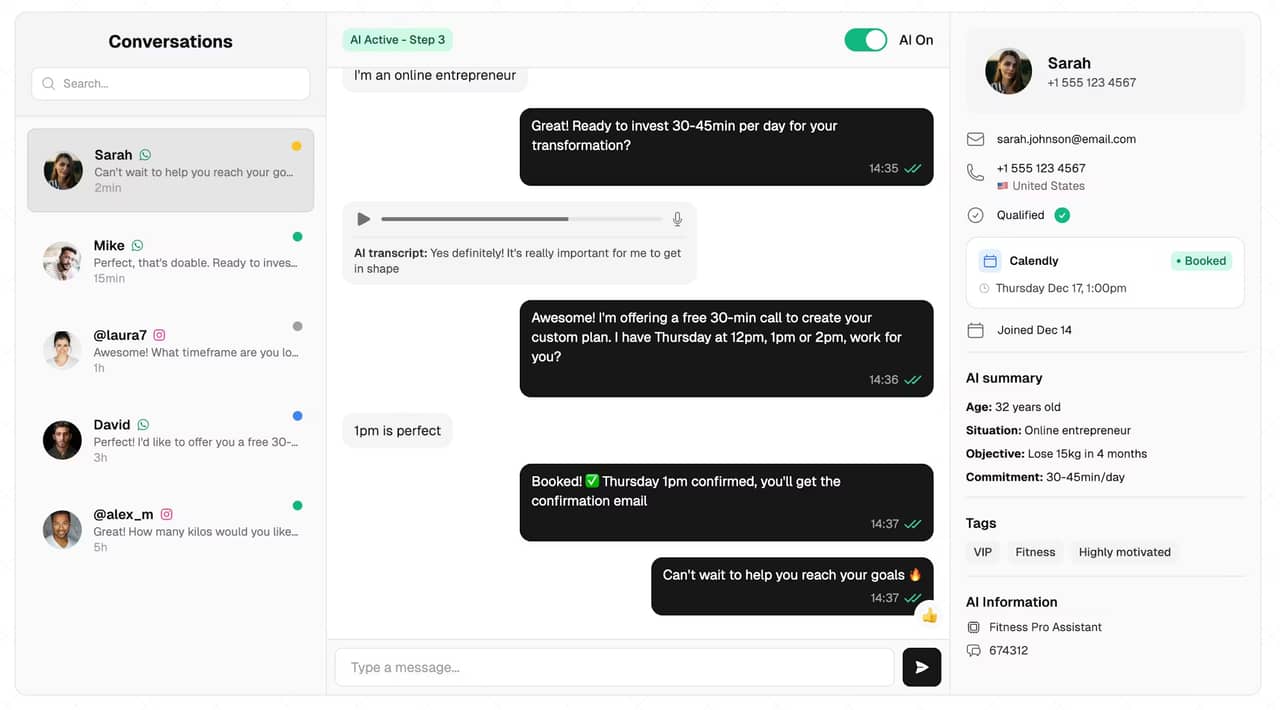
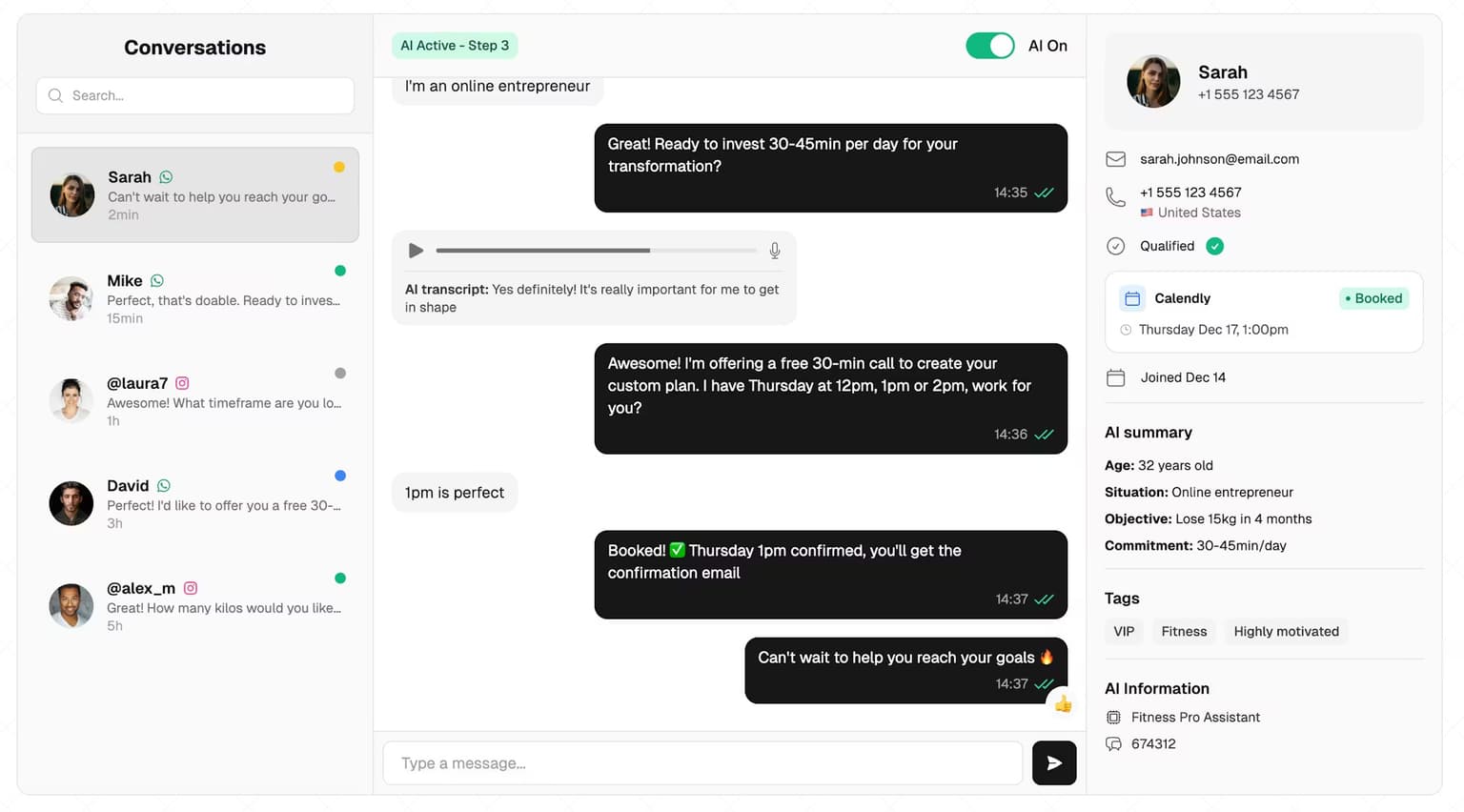
SetSmart is an AI setter for Instagram, WhatsApp and Messenger DMs. It replies to keyword comments, story replies and new DMs, delivers your freebie, asks your qualification questions in your tone, sends the course link to people who are ready to buy, and books qualified leads into your calendar (Calendly, Cal.com, iClosed or GoHighLevel) for high-ticket programs. It follows up with people who go quiet and can reply with voice notes in your own voice. It does not close the sale: the checkout page or your sales call does that, and you can pause the AI on any conversation to take over.
The Pro plan, the one we recommend for coaches, comes with a free 7-day trial, then $97/month with 1,000 messages included. Mathis Ladoué, an online fitness coach with 22.4K followers, puts it this way: "I book 15 to 25 calls per week... without managing a single setter."
FAQ
How do I sell my online course?
Define one outcome for one type of person, validate it with a presale or a paid pilot, then choose the sales path that matches the price: a checkout link for a low-priced course, a short DM conversation for a mid-priced one, and a booked sales call for a high-ticket program. Drive people into those conversations with Instagram content that ends with a keyword or a reason to send a DM.
How much money can you make selling online courses?
It depends on how many of the right people see your offer, how many start a conversation, how many buy and at what price. Some courses earn a few hundred dollars, others far more. Run your first launch as a test of the system, measure each stage, and fix the biggest leak before the next launch.
What is the best platform to sell online courses?
The one whose total cost fits your price and volume. In November 2026, Teachable starts at 39 dollars a month with a 7.5% transaction fee on its Starter plan, Kajabi at 179 dollars a month with no revenue share, Skool at 9 dollars a month with a 10% fee, and Stan at 29 dollars a month for selling from your Instagram bio. None of them answers your DMs for you.
Can I sell a course on Instagram without a website?
Yes. A link-in-bio store or a course platform's checkout page is enough for the payment, and the selling happens in the DMs: someone comments a keyword, you reply, ask a question, and send the checkout link when they are ready. A website helps with search traffic later, but it is not required to start.
How do I launch an online course with a small audience?
Sell a paid pilot to a small group first, using direct conversations with the people who already engage with you. A small audience that you actually talk to often converts better than a large one you only broadcast to. Use the pilot's results and testimonials to fuel the first public launch.
How much does Teachable cost?
On November 27, 2026, Teachable's pricing page lists Starter at 39 dollars a month (29 billed yearly) with a 7.5% transaction fee, Builder at 89 dollars a month and Growth at 189 dollars a month, both with 0% transaction fees when you use Teachable Payments. There is no free plan, but there is a 7-day trial and a 30-day money-back guarantee.
Ready to automate your DMs?
Start your free 7-day trial and let AI handle your lead qualification 24/7.
Try SetSmart free