Follow Up Text After No Response: 20 DM Scripts (2026)

A good follow up text after no response is short, refers to the last thing the lead said, asks one easy question and gives them a polite way out. Send the first one a few hours after the conversation stopped, a second one before 24 hours have passed (that is when Instagram and WhatsApp close the door to automated messages), and if both get nothing, one clean closing message. Then stop. Two good nudges and a clean exit do more for you than five "just checking in" messages.
That is the short answer. The longer one matters because silence is the normal state of a sales conversation, not the exception. In the 828K AI DM conversations we analyzed, 53% of conversations died before message 3, and a single follow-up doubled booked calls. Most of the leads who go quiet on you are not saying no. They got distracted, and nobody reminded them.
This guide is written for coaches, creators and small teams who sell a call, a program or a service through Instagram DMs, WhatsApp and text messages. You will get the timing for each channel, the 2026 rules that decide what you can still send after 24 hours, a formula for writing a follow-up that gets answered, and 20 scripts organised by the exact moment the lead went quiet.
Should you send a follow-up text after no response?
Yes, almost always. When a lead stops replying in the middle of a conversation they started, the most likely reasons are boring ones: they were at work, the kids woke up, they opened your message in a queue, a notification from someone else pushed yours down, or they wanted to think about the price and forgot to come back. None of those is a rejection, and all of them are fixed by one polite reminder.
The fear of "being annoying" comes from bad follow-ups, not from following up. A message that guilt-trips ("I guess you're not serious"), repeats the pitch, or arrives every day for a week is annoying. A message that picks up exactly where the lead left off and asks a question they can answer in five seconds is helpful. People reply to the second kind all the time, often with "sorry, crazy week, yes I'm still interested".
There are three cases where you should not follow up:
- The lead said no, in any form ("not for me", "I found someone", "please stop"). Thank them and stop. On text messages, a STOP has a legal meaning too (see the SMS rules below).
- The lead never started the conversation and never gave you permission to message them. A follow-up to someone who never replied to a cold message is just a second cold message, and on Instagram the platform will usually refuse it anyway.
- You already sent your two nudges and your closing message. At that point the next move belongs to the lead. Keep showing up in their feed with useful content; do not keep showing up in their inbox.
How long to wait before you follow up
For DMs, wait a few hours. For text messages, wait until the next day. The right gap depends on the channel, because each one has its own rhythm and, on Instagram and WhatsApp, a hard deadline.
| Channel | First follow-up | Second follow-up | After that |
|---|---|---|---|
| Instagram DM | A few hours after their last message | Before 24 hours have passed | Only by hand in the app, or when the lead engages again |
| WhatsApp (API or automation tool) | A few hours later | Before 24 hours have passed | Approved template only, billed by Meta |
| WhatsApp Business app (your phone) | A few hours later | The next day | One closing message a few days later |
| SMS | The next day | Two or three days later | One closing text about a week in, between 8 a.m. and 9 p.m. their time |
| Messenger | A few hours later | Before 24 hours have passed | Same limits as Instagram |
Why so fast on DMs? Because a DM conversation is live. The lead was on their phone, in the app, talking to you a few hours ago. A follow-up that same evening lands while the question they asked is still fresh. Wait three days and you are a stranger again.
Why not one hour? Because a nudge that arrives an hour after silence reads as pressure, and it often lands while the person is still busy with whatever pulled them away. A gap of a few hours gives them time to come back on their own, and when they do not, your message is the reminder.
Speed still matters at the start of the conversation, more than at any other point. If you are slow to answer the first message, no follow-up will save the lead. The data on that is in our lead response time statistics.
The 24-hour rules that decide what you can send
On Instagram and WhatsApp, a business tool can only send normal messages for 24 hours after the lead's last message. After that, the rules change, and they explain why the second follow-up has to go out on day one.
Instagram DMs
Meta's messaging policy gives businesses a "standard messaging window" to answer a person: for most actions it lasts 24 hours, and when the person sends their first message after clicking a Click-to-Direct ad, it can last up to 7 days. Inside that window you can send anything, including promotional content. Each new message from the lead reopens it, and Meta also lists a reaction to one of your messages among the actions that open it.
Outside the window, the only extra path is the Human Agent tag: a separate 7-day window for replies written by a person, which the app has to be approved for by Meta. It exists for "we were closed for the weekend", not for automated nudges.
Two practical consequences:
- If a lead only commented on your post and never answered your first DM, there is nothing to follow up through an automation tool. A comment lets the business send a single private reply, and until the person answers it, no conversation is open, and Instagram usually refuses a follow-up sent by a tool. Reply to the comment publicly instead, or wait for that person to reply to a story.
- These limits apply to apps that send through Meta's API. When you type a message yourself in the Instagram app, you are not bound by the window, but you are writing by hand, one lead at a time.
If your first DMs to new people land in their requests folder and never get seen, the fix is different; see how Instagram message requests work.
WhatsApp works the same way on the Business Platform (the API that every automation tool uses). When a person messages you, a 24-hour customer service window opens and resets with each of their messages. Inside it you can send normal messages. Once it closes, you can only send a pre-approved template.
That matters for follow-ups because of how Meta classifies templates. Utility templates must be non-promotional and tied to something the person asked for or bought. A "still interested in the program?" nudge has persuasive intent, so it is a marketing template. And Meta's documentation is explicit: WhatsApp does not currently deliver marketing templates to users with US phone numbers. For an American lead, a WhatsApp nudge on day three is not an option at all.
Costs follow the same split. Since October 1, 2026, Meta charges for service messages again after the first 1,000 per business number each month (in North America, $0.0034 per message beyond that), while a marketing template outside the window costs $0.025 for a North American number, $0.0859 for a French one and $0.1365 for a German one. Leads who come from a click-to-WhatsApp ad open a free entry point window of up to 7 days in which Meta does not charge for your template or service messages, which is one more reason to run click-to-WhatsApp ads to your DMs instead of a form. How templates get approved is covered in our guide to WhatsApp message templates.
On the WhatsApp Business app on your phone, there is no window and no template: you can write whenever you want. The rules of good manners still apply, so keep the same rhythm of two nudges and a clean exit.
SMS in the US
Text messages have no 24-hour window, but they have the Telephone Consumer Protection Act. Under the FCC rules (47 CFR 64.1200), a marketing text sent with an autodialer needs the person's prior express written consent, telephone solicitations are banned before 8 a.m. and after 9 p.m. at the recipient's location, and an opt-out ("stop", "quit", "end", "revoke", "opt out", "cancel" or "unsubscribe") must be honored within a reasonable time not exceeding ten business days. The FCC's latest amendments to these rules were published in the Federal Register on October 26, 2026.
In practice: replying by text to someone who filled in your form and asked to be contacted is not the same as a cold marketing blast, but your form should say they agree to receive texts, and a STOP ends the follow-up for good. This is not legal advice; if you send texts at volume, have your consent wording checked.
How to write a follow-up text that gets a reply
A follow-up that gets answered has three parts: their words, one question, and an easy way out. Everything else is optional.
- Their words. Start from the last thing the lead said, not from your offer. "You mentioned you've been stuck at the same weight since summer" proves you were listening and reminds them why they wrote. A generic "just checking in" proves the opposite.
- One question they can answer in five seconds. "Is the price the issue, or the timing?" is easy. "What are your thoughts on everything I sent?" is homework. If the answer takes effort, the reply waits until later, and later never comes.
- An easy way out. "If now isn't the right time, just tell me and I'll stop messaging" lowers the pressure, and that is exactly what makes people answer. Many leads go quiet because saying no feels awkward. Make no easy, and you will get more yeses as well.
Keep it short: two or three lines in a DM, one or two in an SMS. Use their first name, your own voice, no corporate signature. On WhatsApp and Instagram, a voice note works well as a follow-up because it proves a real person is on the other side; keep it under 30 seconds and say the same three things.
What not to send:
- "Just checking in" or "Bumping this up" with nothing else. It asks the lead to scroll back and do the work.
- "?" on its own. It can work with someone you know well. With a new lead, it reads as impatience.
- Guilt or scarcity you cannot back up ("I guess you're not serious", "price goes up tomorrow" when it doesn't).
- A second copy of your pitch. If the pitch did not get a reply the first time, the same pitch will not get one either.
- A link on its own, with no question. A link is something to do; a question is something to answer.
For the openers that come before any follow-up (story replies, comment triggers, pricing questions), see our Instagram DM scripts.
20 follow-up text templates after no response
These scripts are written for DMs and WhatsApp first, and they work as texts too. Replace the brackets with your details, keep the first name, and cut anything that does not sound like you. Each one is built on the same formula: their words, one question, an easy way out.
When they asked for the price and went quiet
The price is the most common place a conversation stops. Usually the lead is not shocked by the number; they just do not know yet whether the result is worth it to them.
1. The reason check
Hi Sarah, quick one about the price I sent. Most people ask about it before they know what the program would change for them. What made you reach out in the first place?
2. Price or timing
Hey Sarah, was it the price that didn't fit, or the timing? Either answer is fine, it just tells me what to send you next.
3. The smaller step (only if you really have one)
Sarah, if the full program is more than you want to commit to right now, I also have a smaller way to start. Want me to send you the details?
When they said "let me think about it"
"Let me think about it" means there is a question they have not asked. Your follow-up should help them ask it.
4. The one thing
Hey Sarah, no rush on the decision. To help you think it over: what's the one thing you'd want to be sure of before starting?
5. The answer before the question
Hi Sarah, you said you wanted to think about it, so here's what people usually want to know at this point: it takes about 3 hours a week and you can pause anytime. Does that answer it, or is it something else?
When you sent the booking link and they did not book
A booking link is a task, and tasks get postponed. The fix is to make the choice smaller.
6. Did the link work
Hey Sarah, did the calendar link work for you? If none of the times fit, tell me a day and I'll find a slot.
7. Two slots
Sarah, I can keep Thursday at 6pm or Friday at noon for you. Which one works better?
8. Call or chat first
Hi Sarah, quick check: is a call the right next step for you, or would you rather I answer your questions here first?
When a story reply or comment stopped at message one or two
Leads who come from a story reply or a comment keyword are curious, not committed. The follow-up has to turn curiosity into a first real answer.
9. The story callback
Ha, glad that story landed. Are you working on your goal yourself right now, or just curious?
10. Did the guide arrive
Hey Sarah, I sent you the guide you asked for under my post. Did it come through? Which part are you most interested in?
11. The sorting question
Sarah, one question so I can point you to the right thing: are you starting from zero, or trying to get past a plateau?
When a form or application got no reply
Here you sent the first message, on WhatsApp or by text, and heard nothing. Remind them who you are before you ask anything.
12. Who I am
Hi Sarah, it's Alex from business. You filled in the application for program yesterday. Is this a good number to reach you?
13. Two questions to see if it fits
Hi Sarah, Alex again. Two quick questions and I'll know if the program is a fit: what's your main goal right now, and when would you like to start?
When you called and they did not pick up
A missed call followed by a text is one of the most effective follow-ups there is, because the text explains the call. (If they booked a call and did not show up, that is a different situation, covered in our appointment reminder text templates.)
14. Text is easier
Hi Sarah, Alex here, I just tried to call about your program request. Is text easier? I can answer your questions here.
15. Pick a time
Sorry I missed you, Sarah. Would tomorrow at noon or 6pm be a better time for a quick call?
When the lead went quiet weeks ago
A lead from last month needs a reason to come back, so bring something new: a date, an opening, an answer to the question they once asked. On WhatsApp, after 24 hours this has to be an approved template (and it cannot reach a US number), so these two work best by hand in the app or by text with consent.
16. Something new
Hi Sarah, you asked about program in September. I'm opening three spots for January. Is it still something you want to work on?
17. I thought of you
Hey Sarah, I just answered a question on my stories that you asked me back in October, about topic. How are things going with your goal?
When it is time to close the loop
The closing message is not a third nudge. It is a decision you announce, and it gets surprisingly many replies, because it removes all the pressure.
18. I'll stop here
Hi Sarah, I haven't heard back, so I'll assume now isn't the right time and stop messaging. If that changes, just reply here anytime.
19. Close the file or keep a spot
Sarah, should I close your file for now, or keep a spot open for you in January?
20. The voice note version (under 30 seconds)
"Hey Sarah, it's Alex. I know you're busy, so this is my last message. You told me you wanted their goal, and I still think we can get you there. If you want to talk, reply with a time. If not, no worries at all, and good luck with it."
A follow-up plan you can copy
Two nudges in the first day, then one closing message, then silence. Here is the plan for a lead who started a conversation in your DMs and stopped replying:
| When | What you send | Goal |
|---|---|---|
| A few hours after their last message | Nudge 1: their words + one question | Restart the conversation |
| The same day or next morning, before 24 hours | Nudge 2: a different angle (price or timing, two slots, a voice note) | Make the next step smaller |
| Day 3 to 7, where the channel allows it | Closing message, by hand or through a channel they opted into | Get a clear yes or no |
| After that | Nothing in the inbox; useful content in their feed | Be the first name they think of when they are ready |
Every time the lead replies, the plan starts again from the top: they answered, so the conversation is live and the clock resets. The limit is on unanswered messages in a row, not on the length of the conversation. Long conversations are good news: they are where leads qualify and book.
For a lead who came through a form or an ad and never replied to your first message, swap the DM timing for the SMS rhythm: next day, two or three days later, then a closing text around day seven.
If you want the longer view, with nurture sequences for leads who stay quiet for months, see our lead nurturing examples. Real estate agents have a version of this plan with portal and open-house leads in real estate lead follow up.
Follow-up mistakes that kill the conversation
Most follow-ups fail because of what they ask the lead to do, not because they were sent. The usual suspects:
- Waiting too long. Three days after a DM conversation, the lead has forgotten the context, and on Instagram and WhatsApp your automation tool can no longer send a normal message.
- Following up too often. Two unanswered nudges in a row is the ceiling inside one conversation. Beyond that, people mute or block you, which is the opposite of what you want.
- Changing the subject. If the lead asked about online coaching and your follow-up pushes your group program, you started a new conversation without finishing the first.
- Asking open questions. "Thoughts?" is the hardest question there is. Give them a choice between two answers.
- Sending the same text to everyone. Leads talk to each other in comments and group chats, and copy-pasted messages show.
- Ignoring the answer you got. "Not right now" is an answer. Ask when would be better, write it down, and come back then with something new.
- Following up from the wrong channel. If the lead talks to you on Instagram, a sudden SMS from an unknown number feels like a data leak. Switch channels only when they gave you that channel.
When to stop following up
Stop when the lead says no, when two nudges and a closing message got nothing, or when the channel stops you. Signs that it is time:
- They said "no", "not interested", "stop" or anything close to it. A text STOP is also a legal opt-out in the US.
- They read your messages (you can see it) and still did not answer three times in a row.
- The 24-hour window closed on Instagram or WhatsApp and you have no reason to write that would pass as a utility message.
- They told you a date ("after the holidays"). Then the right move is to stop now and come back on that date.
Stopping is not losing the lead. The people who went quiet keep watching your stories, and many of them come back months later with "I'm ready now". Make it easy: the last message they got from you should be friendly and leave the door open.
Can you automate follow-up texts after no response?
Yes, and for DMs you mostly have to, because the 24-hour window does not wait for you to finish your day. If a lead goes quiet at 9 p.m. and you only check your inbox the next evening, the window has closed and your follow-up has to become a paid template, or a message typed by hand.
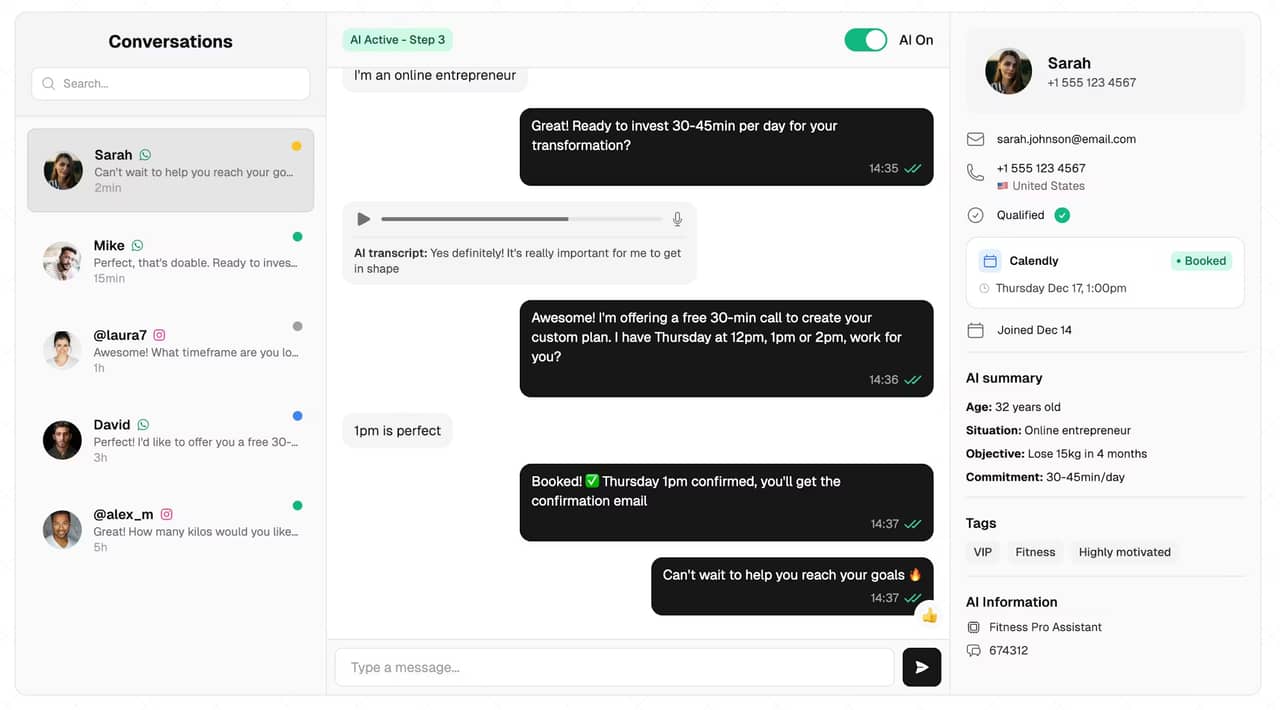
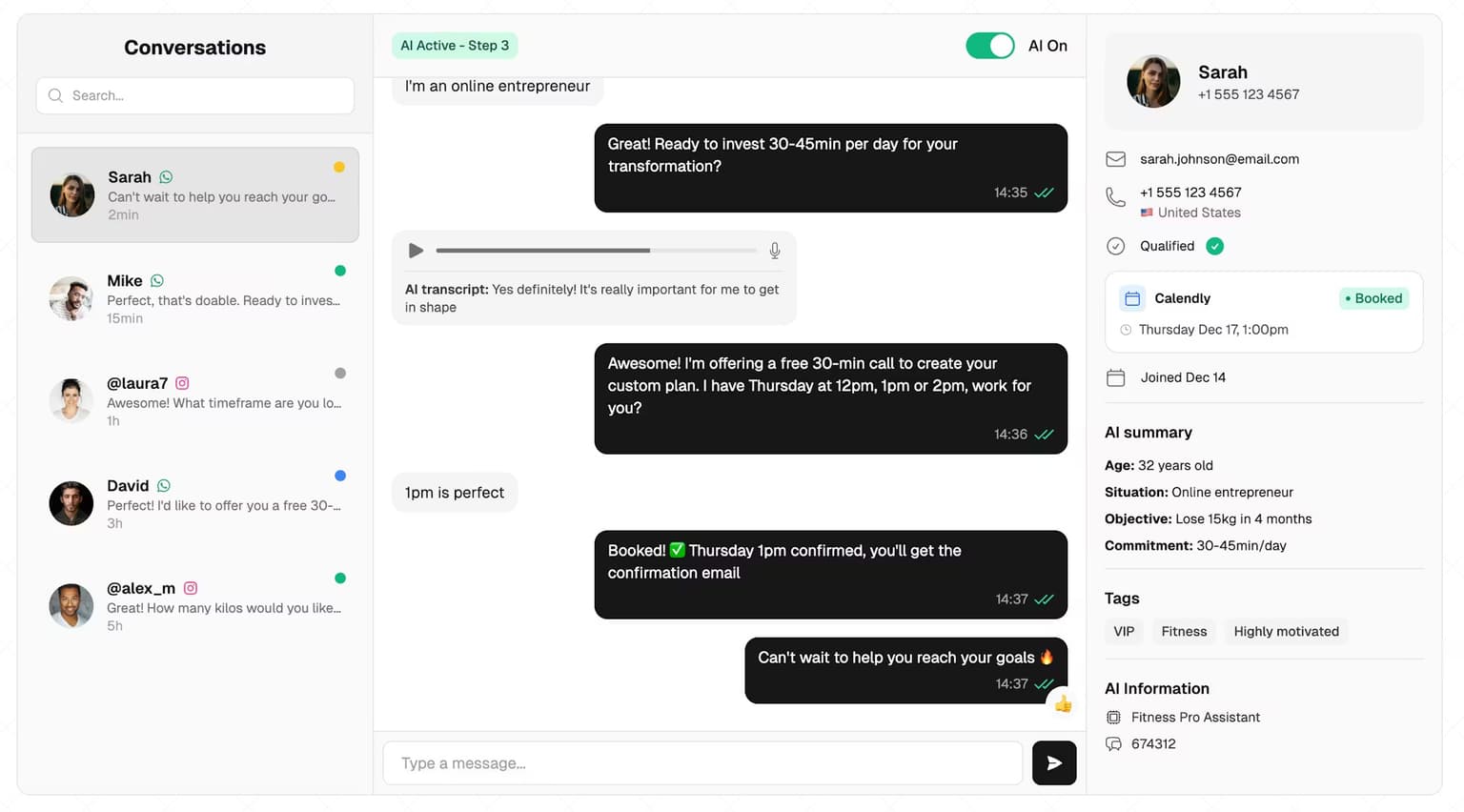
An AI setter handles this part. SetSmart answers your Instagram and WhatsApp DMs, qualifies the lead with your questions, and offers a time on your calendar; when a lead goes quiet, it sends two automatic follow-ups in the first day, written by the AI from what the lead said (or a fixed message, or a voice note that goes out once per conversation). When the lead replies, the follow-ups re-arm, and you can cap how many times that happens. When the conversation ends, they stop. The sales call itself stays yours: the AI's job is to get qualified people onto your calendar, not to close them in the chat. The Pro plan comes with a free 7-day trial, then $97/month with 1,000 messages included.
One online fitness coach put it this way: "I book 15 to 25 calls per week... without managing a single setter." (Mathis Ladoue, 22.4K followers.)
If you want to understand the timing logic before you switch anything on, our guide to AI lead follow up explains why two follow-ups beat five. For the bigger picture of what an AI setter does in your DMs, start with what an AI setter is. And when the call is booked, the next skill is the call itself: see high-ticket closing.
FAQ
Is it okay to send a follow-up text after no response?
Yes. Most people who stop replying got distracted, and a short reminder that picks up where they left off is welcome. Stop only if they said no, never started the conversation, or ignored two nudges and a closing message.
How long should you wait to text again after no response?
In Instagram DMs and WhatsApp, a few hours, and send the second nudge before 24 hours have passed, because automation tools can only send normal messages inside that window. For SMS, wait until the next day, then two or three more days.
How many follow-up texts is too many?
More than two unanswered nudges in a row inside one conversation, plus a closing message, is too many. Each time the lead replies, the count starts again, so a long conversation with many messages is fine.
How do you politely follow up after no response?
Use their own words, ask one question they can answer in a few seconds, and give them an easy way out, such as "if now isn't the right time, just tell me". Skip "just checking in", guilt and repeated pitches.
Is no response always a rejection?
No. In DMs especially, silence usually means the lead was busy or wanted to think about the price and forgot. Treat silence as "not yet" until they tell you otherwise, and treat "no" as no.
Can I follow up on Instagram or WhatsApp after 24 hours?
Through an automation tool, not with a normal message. On Instagram, only a person can answer within a separate 7-day Human Agent window, and the app needs Meta's approval. On WhatsApp, you need an approved template, and marketing templates are not delivered to US numbers. Typing by hand in the apps is not limited by the window.
Ready to automate your DMs?
Start your free 7-day trial and let AI handle your lead qualification 24/7.
Try SetSmart free