Wati vs AiSensy: WhatsApp Costs for Coaches (2026)

Wati vs AiSensy comes down to what you do most on WhatsApp. AiSensy is the cheaper broadcast engine: a real free plan, paid plans from ₹1,500 a month in India ($45 on its USD page), and strong campaign tooling. Wati is the more complete team inbox: no free plan, a higher platform fee, but a lower per-message markup, chatbot flows included in every plan, and Instagram, Messenger and TikTok in the same inbox. Both are official WhatsApp Business Solution Providers. Neither was built to qualify an inbound lead and book a sales call on its own.
Most comparisons stop at the plan table, and the plan table is the least important part of your bill. On both tools, Meta's per-message charges, the platform's markup on those charges, extra seats, and the chatbot or AI add-ons usually cost more than the subscription itself. And since October 1, 2026, even customer service replies are no longer free past a monthly allowance, which changes the math for anyone running a busy inbox.
This comparison is written for coaches, course creators and agencies who sell through WhatsApp conversations, many of them in India where both tools are household names. We checked AiSensy's live INR and USD pricing pages and Wati's live plan page on October 19, 2026. If you want the single-tool deep dives first, read our Wati pricing breakdown and our hands-on AiSensy review.
What Wati and AiSensy actually are
Direct answer: both are no-code layers on top of the official WhatsApp Business API, but AiSensy grew up as a marketing and broadcast tool, while Wati grew up as a shared support and sales inbox.
AiSensy is an Indian WhatsApp marketing platform and official Meta Business Partner. Its pricing page says it is trusted by more than 2.3 lakh (230,000) businesses across 68 countries. The core product is broadcasting and retargeting: you upload contacts, send approved template campaigns, track clicks, and retarget the people who engaged. Around that core sit a Click-to-WhatsApp Ads Manager, WhatsApp forms, payments, catalogs, and a drag-and-drop chatbot builder plus an AI Agent Builder, both sold as add-ons. AiSensy is WhatsApp only.
Wati started as a WhatsApp team inbox and is now an omnichannel messaging platform. Its 2026 plan page lists an inbox that pulls in WhatsApp messages, WhatsApp Business Calling, Facebook, Instagram, TikTok, a website widget and wa.me links, plus broadcast campaigns, Instagram DM and comment automations, Click-to-WhatsApp ad capture, and ecommerce tools like the WhatsApp catalog and Shopify abandoned-cart templates. Its AI layer is called Wati AI (a copilot for agents, AI agents, and a "bring your own agent" option), with the Astra AI agents sold separately.
The mental model: AiSensy is a campaign tool that added an inbox, and Wati is an inbox that added campaigns. If you remember only one line from this article, make it that one.
Wati vs AiSensy: quick comparison
| Feature | Wati | AiSensy |
|---|---|---|
| Built around | Team inbox for sales and support | Broadcasts and retargeting |
| Free option | 7-day free trial | Free Forever plan (no broadcasting) |
| Entry plan (India, monthly) | Growth ₹2,999 | Basic ₹1,500 |
| Marketing message markup over Meta (India) | About 15% | About 26% |
| Chatbot flows | Included (1,000 to 5,000 triggers a month) | Paid add-on (5 flows) |
| AI agent | Astra add-on, priced separately | AI Agent Builder add-on, 1,000 AI messages |
| Seats included | 3 (Growth, fixed) or 5 (Pro, Business) | 1 owner + 5 agents (Basic, Pro), 9 on Premium |
| Instagram, Messenger, TikTok | Yes, in the same inbox | No, WhatsApp only |
| Books sales calls in the chat | Not out of the box | Not out of the box |
The short answer: AiSensy wins on entry price, the free plan, included seats and broadcast-first simplicity. Wati wins on per-message cost at volume, included automation, the team inbox and multi-channel coverage. For a coach whose goal is booked calls rather than campaigns, the last row matters most, and we come back to it below.
Wati vs AiSensy pricing in 2026
Both tools charge a platform subscription and bill WhatsApp messages separately from a prepaid balance. That is where the similarity ends: they price seats, automation and AI very differently, and both show different numbers depending on your currency.
Pricing in India (INR)
AiSensy's figures below come from its live INR pricing page on October 19, 2026. Wati loads its prices by region with JavaScript, so its INR figures come from two independent October 2026 price checks (by CampaignHQ and Jeedesigns) that list the same numbers.
| Tier | Wati (monthly / annual, per month) | AiSensy (monthly) |
|---|---|---|
| Free | None, 7-day trial | Free Forever: API, inbox, no broadcasts |
| Entry | Growth ₹2,999 / ₹2,199 | Basic ₹1,500 |
| Mid | Pro ₹6,499 / ₹4,899 | Pro ₹3,200 |
| Upper | Business ₹18,499 / ₹14,799 | Premium ₹9,100, Unlimited ₹45,000 |
| Extra seats | None on Growth, ₹1,299 (Pro), ₹2,199 (Business) | ₹750 per agent |
| Chatbot / AI add-ons | Astra AI priced separately | Flows ₹2,500, AI agent ₹1,350 |
AiSensy gives 5% off on quarterly billing and 10% off yearly, so Basic drops to ₹1,350 a month on a yearly plan. Wati's annual discount is steeper (Growth goes from ₹2,999 to ₹2,199), which narrows the gap if you are ready to commit for a year. Even then, AiSensy Basic is the cheapest way in.
Pricing in USD
Outside India, AiSensy publishes a separate USD page, and it is not a straight currency conversion of the INR page. On October 19, 2026 it listed Basic at $45/mo, Pro at $99/mo, Premium at $299/mo and Unlimited at $899/mo, with yearly plans working out to $40.50, $89.10, $269.10 and $809.10 a month. Its add-ons on the USD page are $80/mo for the drag-and-drop chatbot builder (5 flows), $50/mo for the AI Agent Builder (1,000 AI messages), and $20 per extra seat per month.
Wati's USD plans are commonly listed at about $49/mo (Growth), $99/mo (Pro) and $299/mo (Business) on annual billing, with extra users at $24 per user per month on Pro and $69 on Business, as shown on its live plan page. Wati also lists a $4.99 Shopify add-on. Because Wati's prices render by region, confirm the exact figure on wati.io/pricing before you buy.
The takeaway for international buyers: in USD the two ladders look almost identical at the top of the funnel, so the deciding factors become what is included (seats, flows, channels) and what each charges per message.
Message rates: the markup nobody headlines
Your WhatsApp messages are billed per delivered message, at a rate set by Meta per country and category, and the provider resells that rate with its own margin on top. This is the line item that decides most real bills, and the two tools differ more here than on the plan page.
For messages to Indian numbers, a price check published by Jeedesigns on October 14, 2026 put the rates side by side. AiSensy's own pricing page confirms its half of the table.
| Message type (to India) | Meta direct | Wati | AiSensy |
|---|---|---|---|
| Marketing template | ₹0.8631 | ₹0.9926 | ₹1.09 |
| Utility template | ₹0.115 | ₹0.1495 | ₹0.145 |
| Service reply (after 1,000 free) | ₹0.115 | ₹0.138 | ₹0.145 |
On marketing templates, where most of the money goes, AiSensy charges roughly 26% above Meta's rate and Wati roughly 15%. On utility messages the two are within half a paisa of each other. AiSensy publishes its rates openly on its pricing page; Wati shows them on a rate card behind a "View Rate Card" link, so ask for the card that applies to your plan before signing.
The October 2026 change both tools passed on
Since October 1, 2026, every WhatsApp Business number gets 1,000 free service messages a month, and service replies past that are charged. Utility templates sent inside the 24-hour customer service window are now charged too. Incoming customer messages stay free, and so do replies inside the 72-hour free entry point window opened by click-to-WhatsApp ads. AiSensy spells this out on its pricing page, and it applies to Wati the same way because the rule comes from Meta, not the provider.
One detail matters for anyone using AI: on AiSensy, chatbot and AI agent replies count as service messages, so an AI reply can use up an AI credit from the add-on and, once the free 1,000 are gone, a paid service message as well. Our WhatsApp Business API pricing guide explains the categories and windows in more depth, though Meta's rate card changes often enough that you should always check the live numbers.
A real monthly bill for a coach
Picture an online fitness coach in India with one WhatsApp number. Each month she sends a weekly broadcast to 2,000 opted-in contacts (8,000 marketing templates) and sends about 2,000 service replies to inbound leads, half of which fall inside the free allowance.
- AiSensy Basic: ₹1,500 plan + ₹8,720 marketing + ₹145 service = about ₹10,365. Add the AI Agent Builder and it becomes about ₹11,715. Add the chatbot flow builder too and it is about ₹14,215.
- Wati Growth: ₹2,999 plan + ₹7,941 marketing + ₹138 service = about ₹11,078, with chatbot flows already included.
So for a pure broadcaster, AiSensy is about ₹700 a month cheaper. But the gap closes as volume grows: at roughly 15,000 marketing messages a month, Wati's lower markup cancels out its higher plan fee. That happens to be exactly where Wati Growth tops out (15,000 broadcasts a month), so past that point you are comparing Wati Pro against AiSensy Pro, and the math starts over. Run your own numbers with your real volumes; the plan fee is rarely the deciding line.
Chatbots and AI: what is included and what is an add-on
Direct answer: Wati includes rule-based chatbot automation in every plan and sells its AI agents separately. AiSensy sells both its chatbot builder and its AI agent as add-ons on top of any plan.
Wati gives every plan a monthly allowance of automation triggers (1,000 on Growth, 2,000 on Pro, 5,000 on Business), and you can buy more from the "Your Plan" page, even on an annual plan. Each time a keyword, button or rule starts a chatbot session, that is one trigger. When you run out, Wati's FAQ is blunt: you respond to customers manually. Plans also include AI copilot credits for your agents (250, 500 and 1,500 a month). The Astra AI agents, which Wati says can run on the web, WhatsApp and voice, are a separately priced add-on.
AiSensy offers a drag-and-drop chatbot builder (₹2,500 a month in India for 5 chatbots, $80 on the USD page) and a WhatsApp AI Agent Builder (₹1,350 a month including 1,000 AI messages, $50 in USD). The AI agent is genuinely capable on paper: knowledge-base Q&A, long-term user memory, tool calling, API integrations, and 500 free AI messages to test it. AiSensy notes that one agent covers all your conversations, so you do not pay per agent.
What neither gives you is a finished sales conversation. Both AI options are building blocks: you write the knowledge base, design the handoffs, and decide what the agent should do when a lead asks about price or goes quiet. AiSensy's tool calling means a developer could connect the agent to a calendar, and Wati positions Pro around helping AI "qualify leads", but neither ships a ready-made qualify-and-book flow for a coaching offer.
Instagram and other channels
This is the most lopsided part of the comparison. AiSensy is WhatsApp only. It has no Instagram DM, Instagram comment or Messenger automation, so if your audience finds you on Instagram, AiSensy cannot touch those conversations and you will need a separate Instagram DM automation tool next to it.
Wati covers far more ground. Its plan page lists Instagram, Facebook, TikTok, a website widget and wa.me links in one inbox, with DM and comment automations for Instagram and DM automations for TikTok and Messenger. Two caveats: Growth lets you connect only one channel, and Instagram automation is listed among the Pro additions, so running WhatsApp and Instagram together realistically means Pro. Wati's Instagram side is also newer than its WhatsApp side; our Wati vs ManyChat comparison covers how it stacks up against an Instagram-first tool.
For coaches this matters a lot. Most of the coaches we work with get their leads from Instagram content and then move the serious ones to WhatsApp or a call. A WhatsApp-only tool handles half of that journey.
Team inbox, seats and support
If several people answer your chats, the seat model can matter as much as the plan price.
- AiSensy is generous on seats. Basic and Pro include one owner plus five agents, Premium includes nine, and Unlimited goes up to 200. Extra agents cost ₹750 (or $20) a month each. Pro adds smart agent routing and custom agent rules; Premium adds number masking so agents see only the last four digits of a customer's number.
- Wati is stricter but deeper. Growth includes three users and does not allow more, which pushes any team of four into Pro. Pro and Business include five users, then charge per extra user. In exchange, Wati's inbox is the more mature support tool: teams, auto-routing, operator reports, and on Business, multiple WhatsApp numbers with round-robin assignment and a dedicated success manager.
- Support hours differ by plan on Wati. Growth lists 24x5 email support in English and Portuguese, Pro lists 24x7 email and chat, and Business adds priority support. AiSensy's support is frequently praised in public reviews, which we covered in our AiSensy review.
For a solo coach, none of this changes the decision. For an agency running WhatsApp for several clients, or a coaching business with a team of setters, AiSensy's included seats are a real saving and Wati's routing and reports are a real productivity gain. Decide which one your team will actually use.
Where each one genuinely wins
Both tools are good at what they were designed for. Here is the honest split.
Where AiSensy wins
- Cheapest way to start. The Free Forever plan gets you the official API, a Blue Tick application and 1,000 free Meta ad credits at zero cost, although you need a paid plan to broadcast.
- Broadcast-first workflow. Uploading a list, sending a campaign, tracking clicks and retargeting the people who engaged is the center of the product. If WhatsApp broadcasts are your growth engine, AiSensy feels built for you because it was.
- Seats included. Six logins on the entry plan is generous for small teams.
- Transparent message rates. Every rate is printed on the pricing page, which makes budgeting easy.
Where Wati wins
- Lower markup at volume. On marketing templates, Wati's rate sits closer to Meta's, which compounds when you send tens of thousands of messages.
- Automation included. Chatbot triggers come with every plan instead of being a separate subscription.
- Multi-channel inbox. WhatsApp, Instagram, Messenger and TikTok in one place, with Instagram comment automations.
- Team operations. Routing, operator reports, multiple numbers and round-robin assignment for teams that work in shifts.
The gap both share for coaches: qualifying and booking sales calls
Here is the part that matters most if you sell coaching, a course or a service through conversations. Wati and AiSensy are excellent at sending messages and organizing an inbox. Neither, out of the box, does the job a coach actually needs from WhatsApp: read each inbound message, figure out whether the lead fits the offer, handle the "how much is it?" question, and get the right people onto a booked sales call.
That job is not a broadcast and it is not a ticket. It is a conversation that adapts to each lead, follows up when they go quiet, and ends with a time on your calendar. On both tools you can approximate it with flows, forms and an AI add-on, but you are the one designing the logic, and every time your offer changes you rebuild it.
It is also the job where WhatsApp shines. In our analysis of 828K Instagram and WhatsApp DM conversations, WhatsApp leads who replied qualified at 34%, roughly 1.9x the Instagram rate. A WhatsApp lead who answers is one of the warmest leads you will get, so the cost of a slow, scripted or missing reply is high.
And to be clear about what automation should and should not do: no WhatsApp tool should be closing a high-ticket coaching offer in the chat. The close happens live, on the call, with you or your closer, which is a separate skill covered in our high-ticket closing guide. The job of the messaging layer is to qualify and book. The calendar is the finish line.
When an AI setter makes more sense
If your goal is a calendar full of qualified calls rather than a bigger broadcast list, the alternative to both tools is a DM-native AI setter. Here is how the three approaches compare for a coach running inbound WhatsApp and Instagram conversations.
| Factor | SetSmart | Wati | AiSensy |
|---|---|---|---|
| Core job | Qualify leads and book calls | Team inbox + campaigns | Broadcasts + retargeting |
| How it qualifies | AI conversation, no flows to build | Flows, forms, AI add-on | Flow add-on, AI add-on |
| Books the call | In the chat | Link or custom build | Link or custom build |
| Follow-ups | Automatic, context-aware | Rules and templates | Campaigns and templates |
| Channels | Instagram, WhatsApp, Messenger | WhatsApp, Instagram, Messenger, TikTok | WhatsApp only |
| Ecommerce tools | Not the focus | Catalog, cart, Shopify | Catalog, cart, payments, Shopify |
| Best for | Coaches booking sales calls | Support and sales teams | High-volume broadcasters |
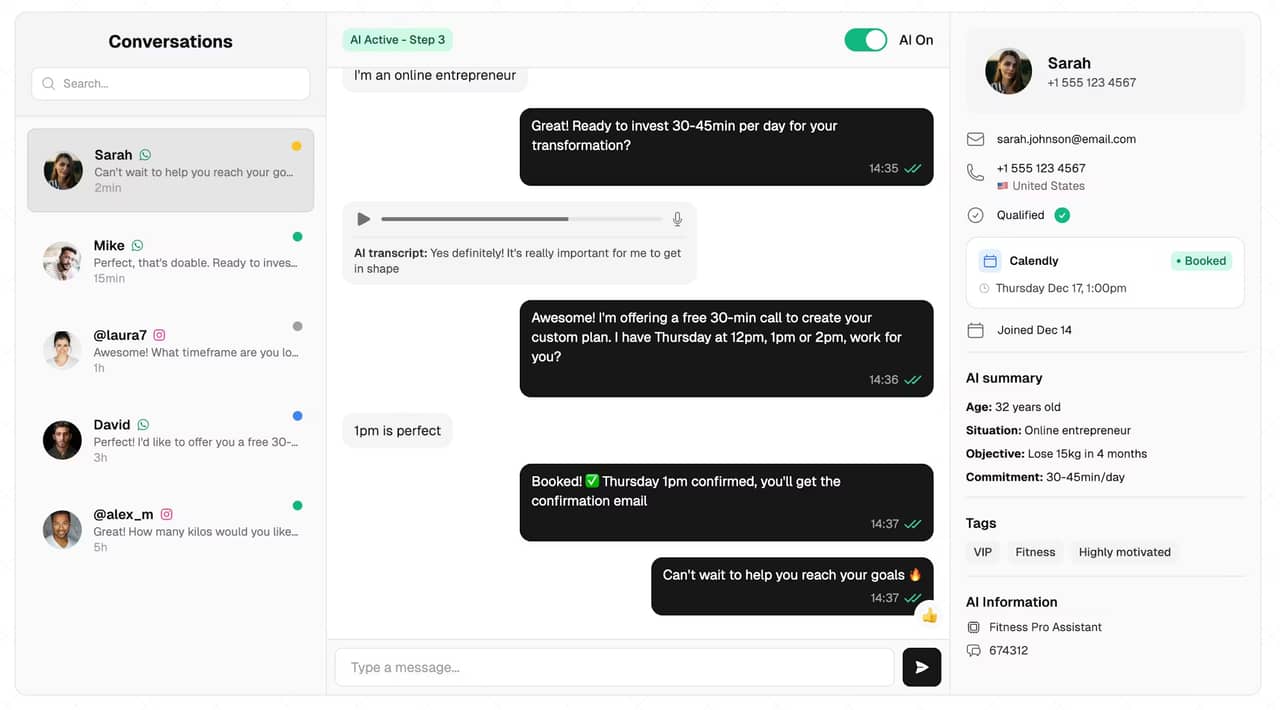
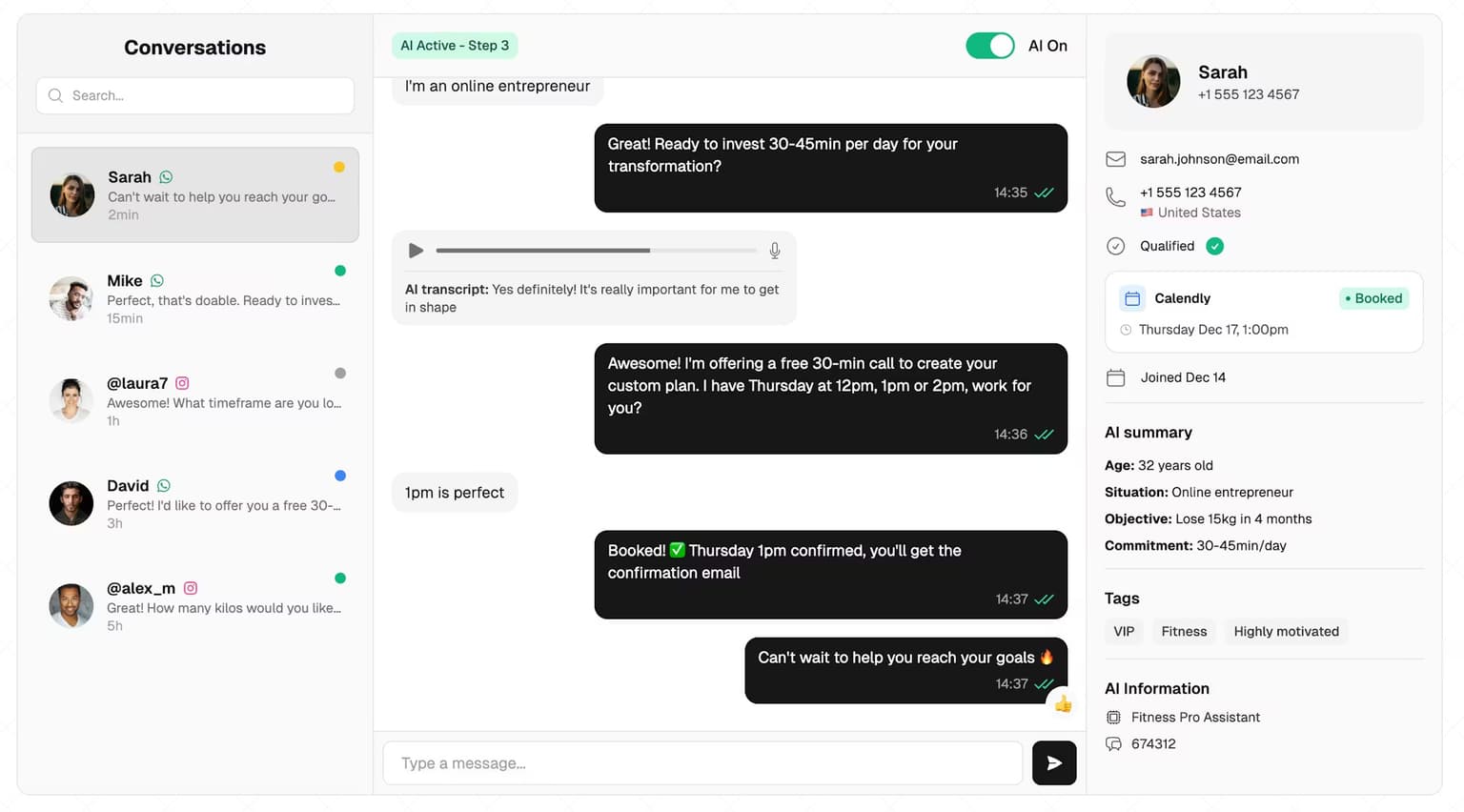
SetSmart is built for that first column. It is an Official Meta Business Partner that connects to WhatsApp through the official API, either on a dedicated number or in coexistence with the WhatsApp Business app you already use (it can import up to six months of chat history, and it can pause the AI on a conversation as soon as you reply from the app). The AI reads each message, answers questions from your offer details, asks your qualifying questions, follows up on its own when a lead stalls, and proposes times so the lead books straight into your calendar. It runs the same way on Instagram and Messenger, so a lead who comments on a Reel and later messages you on WhatsApp is handled by one system.
It is not a broadcast suite. SetSmart can send approved WhatsApp templates (for example an outreach campaign to contacts you import, or a message when someone books, cancels or no-shows), but it has no catalog, cart or Shopify flows. If campaigns and order updates are your engine, Wati or AiSensy is the right tool for that part of the job. Pricing is a free 7-day trial, then $97/month with 1,000 messages included, and WhatsApp template messages count as half a message. Our SetSmart vs AiSensy comparison goes deeper on that matchup.
"I book 15 to 25 calls per week... without managing a single setter."
Mathis Ladoué, Online Fitness Coach, 22.4K followers
A common setup is to keep both layers: AiSensy or Wati for broadcasts and order or reminder messages, and an AI setter on the inbound conversations that should turn into booked calls.
Which should you choose?
Choose AiSensy if WhatsApp is your only channel, broadcasts and retargeting drive your revenue, you want to start on a free plan, and you have a small team that will use the included seats. Budget for the chatbot or AI add-on if you need automation, and remember its marketing markup is higher if your volumes grow.
Choose Wati if you run WhatsApp as a team, you want chatbot automation included, you send enough marketing templates that a lower markup pays for the higher plan, or you need Instagram, Messenger and TikTok in the same inbox. Plan on Pro if you need more than three users or more than one channel.
Choose neither as your setter if your real goal is qualified sales calls from inbound DMs. Both are messaging platforms you have to program. A purpose-built setter qualifies and books through conversation, and the close stays where it belongs, on the call. Whatever you choose, the basics of WhatsApp conversion (reply fast, ask the right questions, follow up) matter more than the logo on the dashboard.
FAQ
Is Wati better than AiSensy?
Wati is better if you need a team inbox, included chatbot automation, a lower per-message markup at volume, or Instagram and Messenger alongside WhatsApp. AiSensy is better if you want the cheapest entry, a free plan, generous included seats and a broadcast-first workflow. For booking sales calls from inbound leads, neither does the job out of the box.
Is AiSensy cheaper than Wati?
On the plan fee, yes. In India AiSensy Basic is ₹1,500 a month against ₹2,999 for Wati Growth on monthly billing. But AiSensy charges more per marketing message (₹1.09 against about ₹0.99 to Indian numbers) and sells chatbot flows and AI as add-ons, so for heavy broadcasters, or anyone who needs automation, the total bill can end up close or even favor Wati.
Does AiSensy work with Instagram?
No. AiSensy is WhatsApp only and does not automate Instagram DMs, Instagram comments or Messenger. Wati does list Instagram DM and comment automations plus Messenger and TikTok in its inbox, although Growth connects only one channel. If Instagram is your main lead source, you will need a tool that covers it.
Do Wati and AiSensy charge for service messages in 2026?
Yes, beyond an allowance. Since October 1, 2026, every WhatsApp Business number gets 1,000 free service messages a month, and replies after that are charged on both platforms, along with utility templates sent inside the 24-hour window. Incoming messages and replies inside the 72-hour free window from click-to-WhatsApp ads stay free.
Is Interakt cheaper than Wati and AiSensy?
It can be. An October 14, 2026 price check listed Interakt Growth at ₹2,799 a month (₹2,200 on yearly billing) with unlimited agents, and a yearly-only Starter plan around ₹1,000 a month. That sits between AiSensy Basic and Wati Growth on plan price, with its own per-message markup. Compare the full bill, not the sticker price.
What is the best Wati or AiSensy alternative for coaches?
It depends on the job. For broadcasts, the two are each other's main alternative, and our Wati alternative roundup covers the rest of the field. For coaches who want inbound WhatsApp and Instagram leads qualified and booked onto sales calls automatically, an AI setter like SetSmart is the closer fit, with a free 7-day trial before you pay.
Ready to automate your DMs?
Start your free 7-day trial and let AI handle your lead qualification 24/7.
Try SetSmart free