How to Start a Personal Training Business (2026)

Most guides on how to start a personal training business are a paperwork checklist: get certified, form an LLC, buy insurance, print business cards. All of that matters, and this guide covers each step. But the paperwork takes a few weekends. The part that actually decides whether your business survives year one is the part most checklists skip: where your next ten clients come from.
Personal trainers who go independent rarely fail because their LLC was filed wrong. They fail because their calendar has gaps, their income depends on how many hours they can physically stand on a gym floor, and every lead that messages them on Instagram waits hours for a reply. So this guide gives you the full setup, step by step, and then spends real time on the client pipeline: how online and hybrid coaches turn Instagram comments and DMs into booked consultation calls without living in their inbox.
TL;DR: how to start a personal training business
Direct answer: to start a personal training business, get an NCCA-accredited certification plus CPR and AED, pick a niche and a business model, write a one-page business plan, register your business, buy liability insurance, price packages instead of single sessions, set up a lean tech stack, and build a client pipeline before you quit your gym job.
- Get certified with an accredited exam, and keep CPR and AED current.
- Pick a niche and a model: in-gym, studio, in-home, online, or hybrid.
- Write a one-page business plan with a client target and a lead source.
- Handle the legal side: structure, name, EIN, bank account, taxes.
- Get insured and prepare a waiver, a health screening, and a client agreement.
- Price packages and programs, not hours.
- Set up your tools for booking, payments, programming, and client records.
- Build an Instagram DM pipeline that books consultation calls.
- Launch, retain, and grow through results, referrals, and price increases.
Is a personal training business worth starting in 2026?
Direct answer: yes, if you treat it as a business and not as a job you happen to run yourself. Demand is growing, but employed trainer pay is modest, so the upside comes from owning your client base and your pricing.
The US Bureau of Labor Statistics occupational outlook for fitness trainers and instructors shows both sides of that:
- Fitness trainers and instructors held about 388,400 jobs in 2025, and employment is projected to grow 7 percent from 2025 to 2035, much faster than the 3 percent average for all occupations.
- About 68,000 openings are projected each year over the decade.
- The median annual wage was $47,160 in May 2025. The lowest 10 percent earned less than $28,800 and the highest 10 percent earned more than $83,100.
- About 15 percent of fitness trainers and instructors are self-employed.
One detail matters for anyone going independent: BLS wage data does not include self-employed workers. The median above describes trainers on a payroll. Your income as a business owner depends on three numbers you control: your price, your client count, and how many of your hours you have to trade for that income.
That is why the business model you choose in step 2 matters more than most new trainers think.
Step 1: Get an accredited certification (and CPR/AED)
Direct answer: there is no state license for personal trainers in most of the US, but gyms, insurers, and clients expect a certification from an NCCA-accredited program, plus a current CPR and AED certificate.
According to the BLS, personal trainers "usually must be certified before they begin working with clients," and most trainers also need certification in CPR, first aid, and AED use. Certification exams test human physiology, exercise technique, client assessment, and program design.
The accreditation to look for is the NCCA (National Commission for Certifying Agencies), the accrediting body of the Institute for Credentialing Excellence. NASM, ACE, ACSM, and NSCA all have NCCA-accredited personal trainer credentials. One trap: some providers sell two exams. As ISSA's own comparison page explains, its open-book course exam is not NCCA-accredited, and the accredited option is the separate, proctored NCCPT-CPT exam. Book the accredited, proctored exam if you plan to work with gyms or need it for insurance.
Cost-wise, PT Pioneer's list of NCCA-accredited certifications puts entry prices for accredited packages between roughly $400 and $1,000, depending on the provider and the bundle. Prices change with promotions, so check the provider directly.
Two practical tips:
- Do not over-stack credentials before you have clients. One accredited CPT is enough to start. Add a specialization (nutrition, corrective exercise, pre and postnatal) once you know what your clients actually need.
- If you plan to coach nutrition, learn your local scope of practice. Rules on individualized nutrition advice vary by state and country, and medical nutrition therapy belongs to registered dietitians. Our guide on how to become a nutrition coach covers that line in detail.
Step 2: Pick your niche and business model
Direct answer: choose one type of client you can get results for, and one primary delivery model. The model sets your startup costs and your income ceiling.
A niche is not a limitation, it is a marketing shortcut. "Strength training for women over 40 who sit at a desk all day" is easier to market than "general fitness," because every post, reel, and DM speaks to one person's problem.
Then pick how you will deliver the training:
| Model | Main costs | Income ceiling | Best for |
|---|---|---|---|
| Independent in a gym | Rent or a revenue share paid to the gym | Capped by your hours on the floor | Trainers leaving an employed gym role |
| Private studio | Lease, equipment, utilities | Higher, once you add other trainers or small groups | Trainers with an existing local client base |
| In-home or mobile | Portable equipment, travel time | Capped by hours plus driving | Premium local clients who value convenience |
| Online coaching | Software and content time | Not capped by location or session hours | Trainers who can build an audience on Instagram |
| Hybrid | A mix of the above | Grows as online clients replace hourly slots | Most new independent trainers |
The hybrid model is where most independent trainers end up: a handful of in-person clients pay the bills while an online program grows. If you want to go fully remote from day one, our guide on how to start online fitness coaching walks through that path specifically.
Step 3: Write a one-page personal training business plan
Direct answer: a personal training business plan does not need to be a 30-page document. One page that answers seven questions is enough to start, and it forces you to do the math before you quit a paycheck.
| Section | The question it answers |
|---|---|
| Client | Who exactly do you train, and what problem do they want solved? |
| Offer | What do they buy: a session pack, a 12-week program, a monthly membership? |
| Price | What does each offer cost, and how does it compare locally or online? |
| Model | Where does training happen: gym, studio, home, online, or hybrid? |
| Costs | What are your fixed monthly costs (rent, insurance, software) and one-off costs? |
| Target | How many active clients do you need to cover costs, then to hit your income goal? |
| Lead source | Where will new clients come from every month, and how will you follow up? |
The last row is the one most plans leave blank or fill with "word of mouth." Word of mouth is great, but it is not a system. If you cannot name the channel that will send you leads every week, that is the first gap to fix, and steps 8 and 9 below are about exactly that.
Step 4: Set up the legal and money side
Direct answer: pick a business structure, check your name, get an EIN, open a separate bank account, and set money aside for self-employment tax. None of this is complicated, but skipping it creates headaches later.
Sole proprietorship or LLC?
The US Small Business Administration's guide to choosing a business structure explains that you are automatically a sole proprietorship if you do business without registering as anything else. It is the simplest option, but your business and personal assets are not separate, so you can be held personally liable for business debts. The SBA notes sole proprietorships can be a good choice for low-risk businesses and for owners testing an idea.
An LLC protects your personal assets "in most instances," per the SBA, and the agency is clear that this protection has limits. Formation fees and annual fees vary by state.
So does a personal trainer need an LLC? Not legally. Many trainers start as sole proprietors and form an LLC once revenue is steady. What an LLC does not do is replace insurance: if a client gets injured, your liability policy is what responds to the claim. Talk to a local accountant before deciding, especially about how each structure is taxed in your state.
Name, EIN, and bank account
- Name: check your state's business registry, the domain, and the Instagram handle at the same time. A name you cannot get on Instagram is a name you will regret.
- EIN: an Employer Identification Number from the IRS is free and lets you open a business bank account without handing out your Social Security number.
- Bank account: keep business money separate from day one. It makes taxes, bookkeeping, and any future LLC protection much cleaner.
Taxes when you are self-employed
The IRS page on self-employment tax sets the rate at 15.3% (12.4% for Social Security and 2.9% for Medicare), owed once your net self-employment earnings reach $400. That is on top of income tax, and nobody withholds it for you, so you may need to pay estimated taxes quarterly. A simple habit: move a fixed share of every client payment into a separate tax account the day it lands.
Step 5: Get personal training business insurance and client paperwork
Direct answer: buy professional and general liability insurance before your first independent session, and have every client sign a waiver, complete a health screening, and agree to your terms.
Insurance. Professional liability covers claims that your training or advice caused harm. General liability covers accidents like a client tripping over your equipment. Insurance Canopy's personal trainer insurance cost breakdown says most personal trainer liability policies cost between $160 and $400 per year. For a concrete example, Insure Fitness Group lists a policy at $189 per year with $1 million per occurrence and $3 million per year in professional and general liability. Certification bodies often have partner programs too: NASM's insurance partner advertises plans from about 11 dollars a month. Check that the policy covers every place you train, including clients' homes, parks, and online sessions.
Client paperwork. Three documents cover most of your risk:
- A liability waiver and informed consent, ideally reviewed by a local lawyer once.
- A health screening. Many trainers use the PAR-Q+, a free pre-participation questionnaire that flags when a client should get medical clearance before training harder.
- A client agreement covering price, payment terms, cancellation and late policy, session expiry, and refunds.
Once a client signs, an intake form sets up your first session properly. Our coaching intake form template includes a fitness version with the screening and training-history questions.
Step 6: Price packages and programs, not single sessions
Direct answer: sell outcomes over a fixed period, such as a 10-session pack or a 12-week program, instead of single hourly sessions. Packages improve retention, smooth your cash flow, and stop clients from "taking a week off" every time life gets busy.
Start with local reality. Check what gyms and independent trainers near you charge, then position yourself on specialization and results, not on being cheapest. Then do the capacity math, because it explains why so many trainers burn out.
Here is a worked example with round numbers (adjust them to your market):
- Goal: $100,000 in yearly revenue.
- Working weeks: 48, which means about $2,083 per week.
- At $70 per session, that is roughly 30 paid sessions every week, every week, before expenses, insurance, and the 15.3% self-employment tax.
Thirty sessions a week is possible, but it is a full gym-floor schedule with early mornings and evenings, and it leaves no room for a sick week. That ceiling is the main reason trainers move toward:
- Session packs and memberships: same hours, better retention and cash flow.
- Small-group or semi-private training: three or four clients in one hour at a lower individual price. Our guide on group coaching covers formats and pricing.
- Online programs: an 8 to 12 week transformation program sold as one offer, where your hours scale far better than one-to-one sessions.
For structuring the offer itself, including premium programs priced on the outcome, see how to design coaching packages. A practical rule: let new clients in at a launch price in exchange for testimonials, then raise prices as your proof builds.
Step 7: Set up a lean tech stack (software for a personal training business)
Direct answer: you need one tool for each of five jobs, and most new trainers need far less software than they buy. Add tools only when a manual process starts costing you clients.
| Job | What it does | When you need it |
|---|---|---|
| Booking | Lets clients and leads pick a session or consultation slot | Day one |
| Payments | Takes card payments, packs, and recurring billing | Day one |
| Programming app | Delivers workouts, tracks progress, hosts check-ins | As soon as you train anyone online |
| Client records | Keeps leads, clients, notes, and renewal dates in one place | Around 10 active clients |
| DM automation | Replies to Instagram and WhatsApp leads, qualifies them, books calls | When leads arrive faster than you can reply |
We compared booking tools in our roundup of scheduling software for coaches, and client-record tools in our guide to the best CRM for coaches. The last row is the one that directly drives revenue, so it gets its own step.
Step 8: Build a client pipeline from Instagram DMs
Direct answer: post content that invites a comment or a story reply, open the DM automatically, ask a few qualifying questions, and book a consultation call. The close happens on that call, not in the chat.
For most independent trainers in 2026, Instagram is the shop window. A potential client watches a few reels, decides you might be the person to help, and sends a message or comments a keyword. What happens in the next few minutes decides whether that person ever books.
Here is the pipeline that works for in-person, online, and hybrid trainers alike:
- Content with one clear call to action. End reels and stories with something like "comment PLAN and I will send you my 4-week starter program." One keyword, one next step.
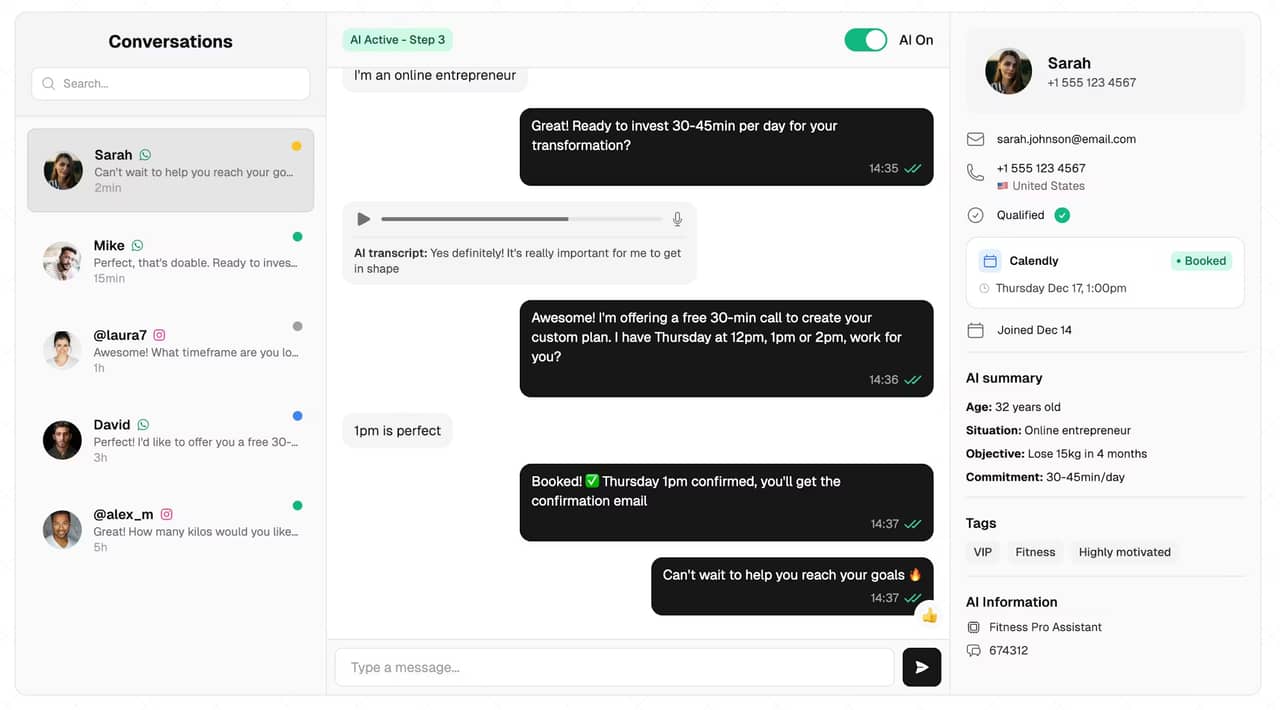
- The DM opens automatically. A comment-to-DM automation sends the promised resource in seconds and starts the conversation while the lead is still on your profile.
- Qualify in the chat. Ask about their goal, what they have tried, their timeline, and whether they want in-person or online coaching. Keep it to a few natural questions, one at a time.
- Book the consultation call. Qualified leads get your calendar link inside the chat. You run the call, explain your program, and sign the client.
- Follow up when they go quiet. Most people do not say no, they just stop replying.
That last step is where most trainers lose money without noticing. Across the 828K AI DM conversations we analyzed, 53% died before message 3, and a single follow-up doubled booked calls among engaged leads. A trainer who replies hours later and never follows up is leaving half the pipeline on the table.
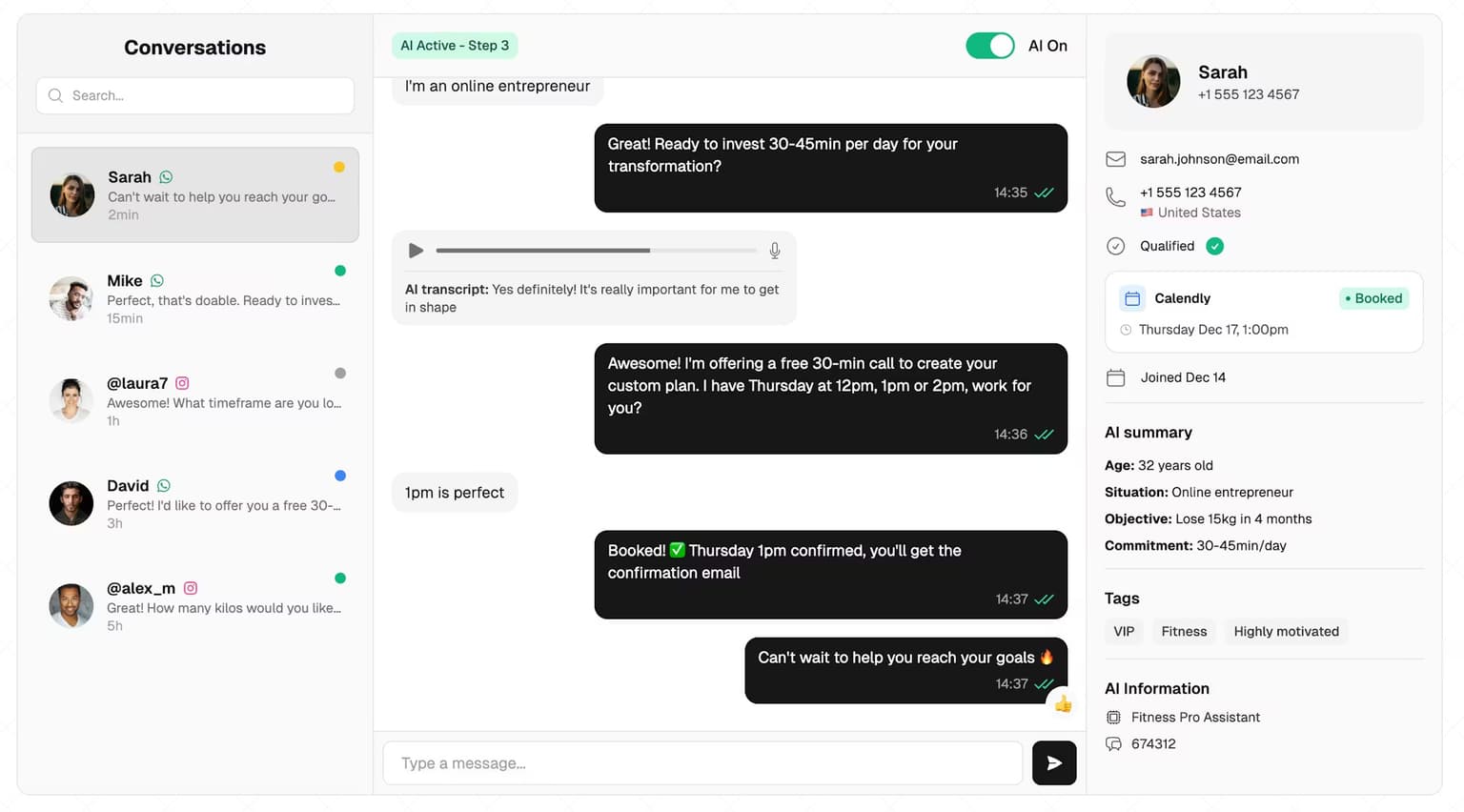
This is the job an AI setter does for coaches: it answers Instagram and WhatsApp DMs within seconds, day and night, asks your qualifying questions the way you would, follows up with leads who go quiet, and books qualified people straight onto your calendar. You keep doing the part only you can do: the consultation call and the training itself.
Mathis Ladoué, an online fitness coach with 22.4K followers, put it simply: "I book 15 to 25 calls per week... without managing a single setter."
For the full content side of this funnel, our playbooks on fitness marketing and on getting personal training clients through Instagram DMs go step by step.
Step 9: Launch, retain, and grow your personal training business
Direct answer: your first 90 days are about proof, not scale. Sign a small number of clients, get them results, collect testimonials, and use those results to fill the next round.
A simple 90-day launch plan:
- Days 1 to 30: finish the setup steps above, tell your existing network you are taking clients, post three times a week with one call to action, and offer a limited number of launch spots.
- Days 31 to 60: deliver great sessions, take progress photos and measurements with consent, and turn early wins into before-and-after posts and short client stories.
- Days 61 to 90: ask happy clients for referrals and reviews, raise the price for new clients, and review which content brought in DMs that actually booked.
Retention is your cheapest growth lever. A client who renews costs you nothing to acquire. Schedule a progress review before every package ends, so the renewal conversation is about the next goal, not about the price.
To grow a personal training business past one person, you have three main paths: add online clients whose delivery does not need your physical presence, add small-group sessions, or hire other trainers under your brand. Each of them needs a steady flow of leads, which is why the pipeline in step 8 is not optional.
How to start an online personal training business
Direct answer: an online personal training business uses the same foundations (certification, insurance, structure, pricing) but replaces the gym floor with a programming app, check-ins, and an Instagram-led sales process.
The main differences from an in-person business:
- Your offer is a program, not a session. Clients buy a result over 8 to 12 weeks, delivered through an app, weekly check-ins, and messaging support.
- Your audience is your location. You can coach anyone in your language and time zone range, so your niche has to be sharper to stand out.
- Sales happen on a call. Higher-priced online programs are rarely bought from a checkout page. Leads message you, you qualify them, and you close on a consultation call.
- Insurance still matters. Confirm your policy covers online coaching, and clients in other states or countries.
The online fitness coaching guide linked in step 2 covers the online-only path in more depth, including a 30-day launch plan.
Starting a personal training business from home
Direct answer: you can run a personal training business from home in two ways: training clients in a home studio, or coaching online from home. Both keep overhead low, but each has rules to check.
For a home studio, check local zoning and home-business rules, your homeowner's or renter's insurance (most personal policies exclude business activity), parking, and whether your liability policy covers the location. Keep the space professional: clear floor, enough equipment for your programs, and a clean place to talk through a session.
For online coaching from home, all you need is a reliable connection, a decent camera angle for form checks, and the tech stack from step 7. That is the lowest-cost way to start, and the reason many trainers launch online first and add in-person clients later.
How much does it cost to start a personal training business?
Direct answer: a lean independent or online personal training business can start for low four figures, mostly certification and insurance. A private studio costs far more because of the lease and equipment.
The main cost lines to plan for:
- Certification: accredited packages from roughly $400 to $1,000, per PT Pioneer's list.
- CPR and AED: a short course, renewed on the provider's schedule.
- Liability insurance: most policies between $160 and $400 per year, per Insurance Canopy.
- Business registration: state filing fees if you form an LLC, which vary by state.
- Software: booking, payments, and a programming app, many of which have free or low-cost starter tiers.
- Equipment: minimal for online or in-gym work, significant for a home or private studio.
- Rent: zero online, a monthly fee or revenue share in a gym, a lease for a studio.
Why most personal trainers quit (and how to avoid it)
Direct answer: most trainers who leave the field are not short on skill. They are short on predictable income, tired of split shifts, and stuck trading hours for money.
The BLS notes that many fitness trainers work variable or part-time schedules that may include nights, weekends, or holidays. Combine that with an hourly pay model, and burnout is predictable. The fixes are the ones in this guide:
- Packages and programs instead of single sessions, so income is steadier.
- A hybrid or online offer, so your income is not capped by the hours you can stand on a gym floor.
- A real lead source with fast replies and follow-up, so your calendar does not depend on luck.
- Retention reviews before every package ends, so you are not replacing clients faster than you sign them.
FAQ
Does a personal trainer need an LLC?
No. You are automatically a sole proprietor when you start doing business without registering a different structure, and many trainers start that way. An LLC can protect personal assets in most cases, but it does not replace liability insurance, and fees vary by state. Ask a local accountant which structure fits your income and state.
How much does it cost to start a personal training business?
A lean in-gym, home-based, or online personal training business can start for low four figures. The core costs are an accredited certification (roughly $400 to $1,000), CPR and AED, liability insurance (most policies cost $160 to $400 per year), registration fees if you form an LLC, and starter software. A private studio adds a lease and equipment.
Can you make 100K a year as a personal trainer?
Yes, but rarely with single sessions alone. At $70 a session over 48 weeks, $100,000 in revenue means about 30 paid sessions every week before expenses and taxes. Trainers who get there usually add packages, small-group training, or an online program so their income is not capped by hours.
Do personal trainers make good money?
Employed trainers earn modest pay: the BLS median for fitness trainers and instructors was $47,160 in May 2025, and the top 10 percent earned more than $83,100. Those figures exclude self-employed trainers, whose income depends on their pricing, client count, and lead flow.
How do I start an online personal training business?
Get certified and insured for online coaching, choose a narrow niche, package an 8 to 12 week program, set up a programming app and payments, and build an Instagram funnel where leads comment or message you, get qualified in the DMs, and book a consultation call.
What software do I need for a personal training business?
Start with a booking tool, a payment processor, and a programming app if you coach online. Add a CRM around 10 active clients, and DM automation once Instagram or WhatsApp leads arrive faster than you can answer them.
Your certification, insurance, and pricing get the business open. Clients keep it open. SetSmart answers your Instagram and WhatsApp DMs in seconds, qualifies every lead with your questions, follows up when they go quiet, and books consultation calls straight onto your calendar. Free 7-day trial, then from $97/month, or see the full pricing.
Ready to automate your DMs?
Start your free 7-day trial and let AI handle your lead qualification 24/7.
Try SetSmart free